
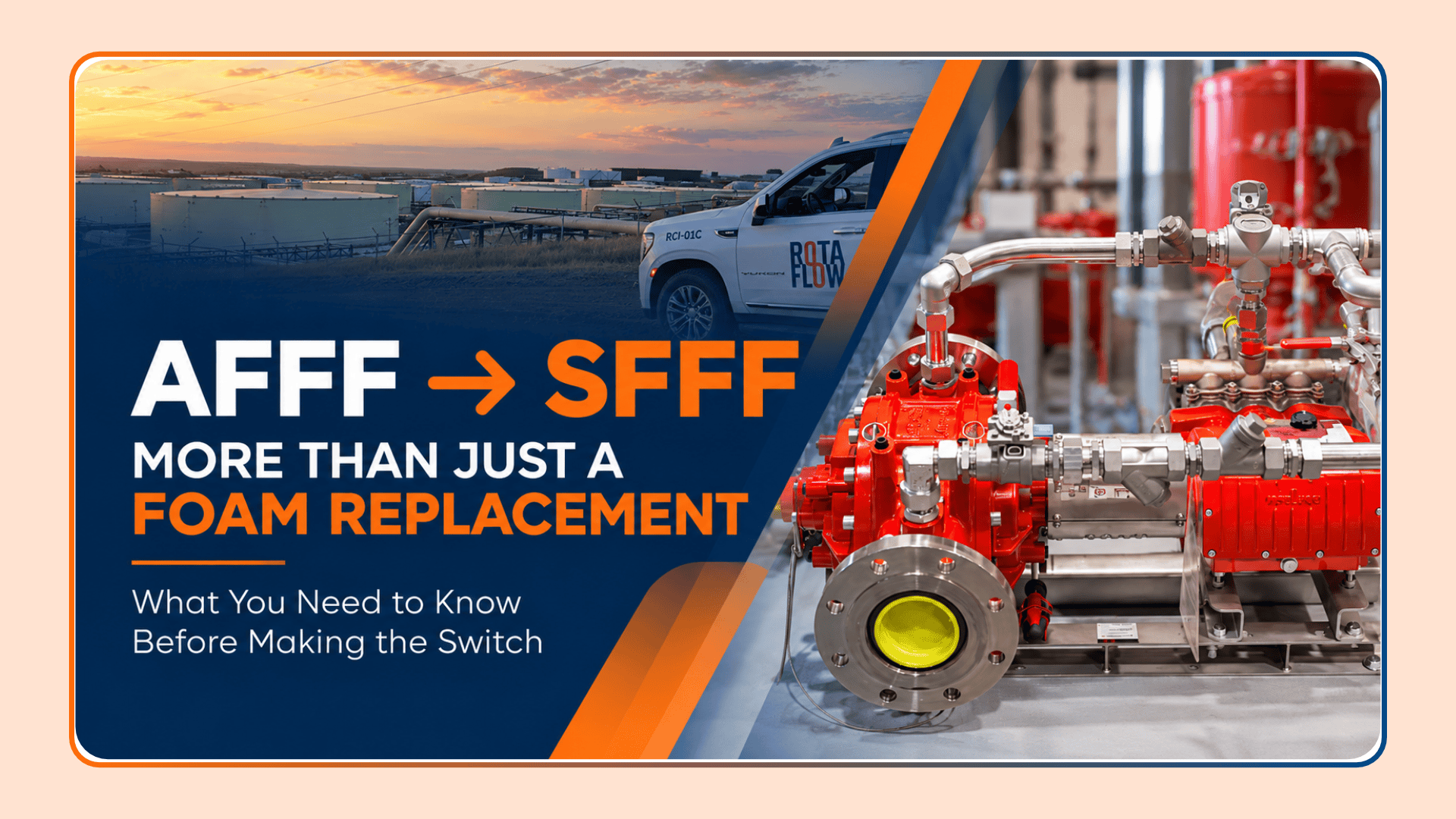
Event: Alberta Industrial Fire Emergency – FireDos Event
Topic: Transition to SFFF
Date: September 17, 2026
Venue: Fantasyland Hotel, West Edmonton Mall
Location: Edmonton, Alberta, Canada
Presented by: Rotalflow Team
The global fire prevention market is undergoing a major transformation, from fluorinated foam concentrates to synthetic fluorine-free foam (SFFF). This change is propelled by regulations, environmental concerns and the joint responsibility of manufacturers, authorities and operators to deliver safer and more sustainable fire prevention.
However, the transition requires painstaking preparation, despite the clear benefits of SFFF. Foam concentration is a major factor in the design and operation of extinguishing systems . It is not as easy as dumping one tank and dumping another one in to change the agent .
Why a Concept for the Transition is Needed
SFFF concentrates often have different viscosities, proportioning characteristics, and extinguishing performance than ordinary fluorinated foams. Hence, a transition concept is needed to ensure a proper operation of the system after the conversion. This includes:
- selecting an SFFF concentrate suitable for the specific fire risks (demonstrated by standard fire tests).
- eliminated system design factors and re-evaluated application rates.
- checking the conformity of the proportioning technique.# Changes to the System
When changing to SFFF, all components of the extinguishing system should be checked:
Hydraulics: Changes may be required in water supply, tank size, pump capacity, pipe sizes and valve sizes.
Foam discharge devices: The chosen SFFF has to be suitable with expansion ratios and working ranges.
Proportioning systems: Many proportioners have problems with higher viscosity SFFF concentrations. It should, really , be possible to tell whether the present unit can admix the new agent reliably .
How to Convert Successfully
A systematic approach decreases risk and ensures compliance:
System draining and cleaning Tanks, pipes, pumps and valves need to be fully cleaned or replaced and drained completely.
Disposal: Old fluorinated foam and cleaning residues are to be handled and disposed of by certified businesses.
Component adaptation: Tanks, suction lines and proportioners may need adaption.
System verification: verification of the hydraulic performance of the new SFFF and its extinguishing efficiency.# Summary of the Invention
Conclusion
Transitioning from fluorinated to SFFF foams is a multi-faceted process of preparation, assessment, and adaption. Thanks to the support of an expert partner and the right transition idea, owners may go forward with a smooth and future-proof conversion – assuring reliable fire protection in accordance with environmental and regulatory requirements.