
Balancing Cost, Environmental Impact, and Uptime
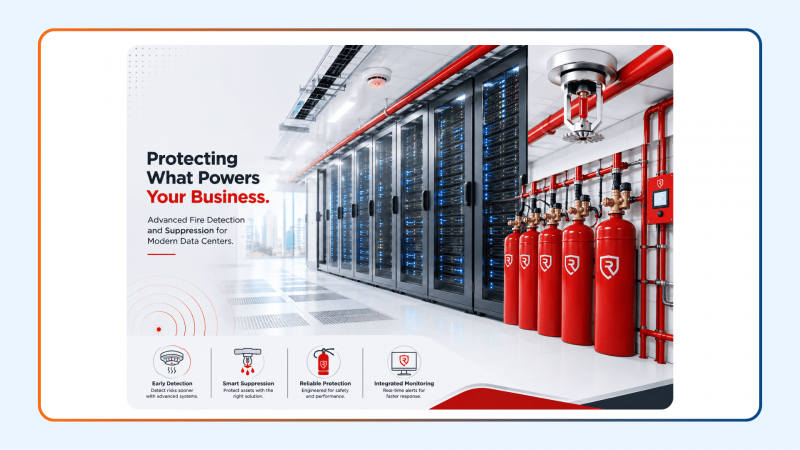
Alberta’s data center pipeline is growing quickly, and the equipment density inside these
facilities continues to increase. Modern data centers may include high-density server
environments, UPS systems, battery rooms, electrical equipment, hot and cold aisles, and
other spaces with very different fire risks.
Fire protection codes establish important minimum requirements for life safety and property
protection. However, meeting those requirements is only part of the decision for a data
center owner or operator. The larger question is how a protection strategy affects installation
cost, maintenance, business continuity, recovery time, environmental impact, and the long-
term cost of operating the facility.
A fire protection system should therefore be evaluated as a total cost of ownership decision
rather than simply an installation expense. A system with a lower initial price may create
higher costs later through maintenance requirements, water damage, agent replacement,
cleanup, equipment loss, or extended downtime.
The ideal procedure is to first examine the risk, and then evaluate the prevention methods
depending on their effect on the facility and business.
Start With Risk, Not With a Product List
Instead of directly weighing different fire prevention technologies, the business needs to
know the protection goal and how much disruption it can deal with.
Briefly defining risks should answer the questions:
● What spaces need coverage?
Data storage areas, UPS room, battery rooms, switchgear areas, underfloor plenums,
mechanical rooms or admin rooms are likely to involve different risk levels and different
protection requirements, which means different systems can be applied.
● How quickly does the system need to respond?
Early detection can provide valuable time to investigate and respond to developing
conditions. Detection technologies should be selected and designed around the facility’s
airflow, equipment layout, containment strategy, and hazard profile.
● Which assets are truly critical?
But not all areas have the same operational or financial impact. Knowing which infrastructure
is critical for business continuity can reveal where adding more layers of protection or faster
recovery capabilities can provide the most benefit.
● What could a discharge cost?
A discharge has a financial impact that goes beyond the suppression equipment. Costs may
include cleanup, equipment replacement, refilling of agents, restoration of the system,
investigation and business interruption, depending on the technology used and the area
impacted by the discharge.
●How much downtime can the business absorb?
It is necessary to consider recovery time when designing your suppression system in the
facilities where even a short downtime means huge financial losses. Availability of the spare
equipment, availability of services, requirements for restoring the system and availability of
skilled workers will define how quickly the facility will get back into business.
The aim is not to choose the cheapest system but to develop a protection policy that will
combine risk coverage with investment costs and operating costs.
Matching the System to the Space
Once the risk profile is established, protection options should be evaluated against several
practical and financial considerations.
Installation requirements
Consider the infrastructure required for each system, including piping, pumps, agent storage,
detection equipment, controls, ventilation, pressure relief, power requirements, and available
mechanical space.
A system that requires significant additional infrastructure may have a higher initial
installation cost, even if its operating costs are attractive.
Inspection, testing, and maintenance
Different systems have different service requirements. More sophisticated systems may
require more extensive inspection, testing, and maintenance, along with trained technicians
and specialized equipment.
These ongoing requirements should be included when calculating the long-term cost of
ownership.
Supporting infrastructure
Water provision, tube dimensions, electrical supply, air circulation, structure of the room,
release of pressure, and so on are part of the support services and can influence both the
installation cost and the design of the facility.
Recovery after discharge
The duration and necessary resources to put the system back to working conditions after an
incident affect the continuity of the business. You have to take into consideration cleanup,
equipment examination, agent replacement, system testing, and the availability of spare
parts while comparing technologies.
Regulatory and insurance alignment
Eligibility for a particular system for a particular case can be determined by the authority
having jurisdiction (AHJ), applicable rules and regulations, insurance companies and
requirements related to a project.
Environmental profile
Environmental concerns are becoming more and more important in fire-protection decisions.
The efficiency of fire protection must be considered along with the required levels of water
consumption, properties of the agents, lifetime of the equipment, energy consumption and
environmental laws.
Comparing Fire Protection Technologies by Total Cost
of Ownership
There is no single fire protection system that is appropriate for every area of a data center.
The most economical solution over the life of a facility depends on the hazard, application,
required performance, installation conditions, maintenance requirements, and consequences
of an incident.
| System | Economic and Operational Considerations | Potential Advantages | Key Trade-Offs |
| Pre-action sprinkler systems | Installation includes piping, valves, detection, and water supply requirements. Maintenance is generally familiar to fire protection service providers. | Provides automatic sprinkler protection while helping reduce the likelihood of accidental water discharge from sprinkler piping. | A water discharge can still result in cleanup, equipment assessment, and downtime. System configuration should be selected according to the hazard and design requirements. |
| Clean agent systems | Initial costs can include agent storage, distribution piping, detection, controls, room integrity, and pressure-relief requirements. | No water residue and potentially faster recovery in applications where the system is appropriately designed and accepted. | Requires appropriate room conditions, periodic inspection, and agent-related considerations. Agent selection should account for environmental regulations and the specific hazard. |
| Water mist systems | May reduce water demand and associated infrastructure in some applications, but installation and testing depend heavily on the listed system and application. | Can provide an alternative where minimizing water use or water damage is important. | Performance is application-specific. The listed system, hazard, AHJ requirements, and insurer acceptance must all be considered. |
| Oxygen-reduction systems | Need for constant operation, supervision, and regulation of conditions.Installation and operating costs may be affected by the type of construction. | Can reduce the likelihood of ignition and sustained combustion in appropriately designed, controlled environments. | Requires suitable enclosure conditions and continuous system operation. It may not be appropriate for high-airflow environments or every data center application. |
The table demonstrates that installation cost alone is insufficient. Systems with a higher initial investment may have operational benefits, resulting in less recovery costs, while systems with a lower installation cost may incur other costs over the life of the installation.
Detection Supports Early Response
Detection is an important component of a data center fire protection strategy, but it works as part of a broader system rather than as a replacement for automatic suppression.
As rack density and airflow increase, detection should be designed around the actual conditions inside the facility.
● Aspirating smoke detection (ASD) continuously samples air through a network of sampling pipes. When properly designed for the airflow conditions, ASD can provide earlier detection than conventional detection approaches in appropriate applications.
● Multi-criteria detection can combine different measurements to help identify developing fire conditions and reduce unwanted alarms.
● Detector placement should account for containment systems, airflow patterns, ceiling spaces, and underfloor plenums because these factors can influence how smoke travels.
● Battery-room-specific detection may include technologies designed to identify early indicators associated with battery failure. The appropriate detection approach depends on the battery chemistry, room design, applicable requirements, and overall fire protection strategy.
Early detection can provide valuable time for investigation, response, and system operation. At the same time, automatic suppression remains an important independent layer of protection where required or appropriate.
Lithium-Ion Batteries Change the Risk Profile
The increasing incorporation of lithium-ion batteries in UPS units and energy storage systems further complicates the issues of fire protection in data centers. Once thermal runaway commences inside a lithium-ion cell, suppression may not be sufficient enough to stop the chemical reaction inside the battery. However, this does not signify that suppression is not effective; it simply indicates that the use of battery protection should be viewed as a multi-layered method that involves detection, prevention, confinement, suppression, ventilation, and emergency response.
Depending on the application, considerations may include:
● Early-warning detection, including technologies designed to identify indicators of battery failure
● Physical separation and compartmentalization to help limit the spread of fire or thermal events
● Ventilation and gas management designed around the characteristics of the battery system and its failure modes
● Appropriate suppression, selected according to the battery technology, hazard, applicable standards, and system listing or approval
● Coordination with the AHJ and insurer regarding detection, suppression, emergency response, and facility-specific requirements
For lithium-ion applications, the most effective strategy is rarely based on a single technology. The goal is to combine multiple layers of protection that address the risks before, during, and after a thermal event.
Cost, Sustainability, and Total Cost of Ownership
The installation cost of a fire protection system is just a small portion of its total economic effect. .In the case of data center owners and operators, their total costs can comprise:
Cleanup and downtime
The effects of such discharge may surpass only the costs of fire protection restoration. For example, water-related incidents require clean-up and inspection of the equipment, while gas-operated systems alleviate post clean-up asperations made in fields suitable for their use.
In this way, the duration of possible downtime must be taken into account in conjunction with the installation cost.
Installation and infrastructure
The price of pumps, pipes, cylinders, detectors, control units, pressure releasers, room preparation, water supply, and other infrastructure differs in systems significantely.
So, a solution which seems cheap on the level of equipment may need a lot of changes in building works leading to higher cost of the project overall.
Maintenance and service
Lifecycle costs are impacted by inspection and testing, maintenance, replacement, agent servicing, and availability of technicians. Therefore, systems need to be evaluated based on the resources needed to operate them for the whole period of time the facility is used rather than on the costs of their purchase.
Environmental considerations
The significance of environmental impact is growing in deciding on a system solution. Characteristics of agents used, applicable legal regulations, water consumption, lifecycle of equipment, and general environmental impact of the technology must be taken into account when designing.
Recovery and resilience
The ability of a facility to recover from a failure has significant economic value. Components should be available, spare parts should be arranged, reserve agent capacity should probably be planned, and the restoration process should be clearly defined.
The most cost-effective solution is not necessarily the one that requires the lowest initial outlay. The best solution is reached by balancing costs of the investment, operation, minimizing the possible risks of failure, reducing recovery times, and ensuring continuity of work of the business.
A Practical Design Approach for Data Centers
Rather than applying one technology throughout an entire facility, data center owners can benefit from a layered approach based on the hazards and operational requirements of each space.
1. Detection and early warning
Use detection technologies appropriate for the facility’s airflow, equipment layout, containment strategy, and specific hazards.
2. Automatic sprinkler protection
Provide automatic sprinkler protection where required and appropriate under applicable codes, standards, and project requirements. Pre-action configurations can be considered where they are suitable for the specific application.
Single-interlock and double-interlock pre-action systems operate differently, so the configuration should be selected based on the hazard, design objectives, and applicable requirements rather than treating one configuration as a universal solution.
3. Protection for critical spaces
Where a gaseous suppression system is appropriate and accepted, it may be considered for selected high-value or mission-critical areas. The suitability of clean agent protection should be evaluated separately for each application, particularly in areas containing lithium-ion batteries.
4. Selective water mist applications
Water mist may be considered where its listed performance is appropriate for the hazard and application. Acceptance by the AHJ and insurer should be confirmed during design.
5. Battery-specific protection
Lithium-ion battery rooms and energy storage applications may require additional measures addressing early detection, thermal runaway, ventilation, separation, suppression, and emergency response.
6. Operational resilience
The final design should consider not only how a system responds during an incident but also how quickly it can be inspected, restored, and returned to service afterward.
There is no universal fire protection configuration for every data center. The most effective approach combines the requirements of the applicable codes and standards with an assessment of the facility’s hazards, operational priorities, financial exposure, and long-term ownership costs.
How Rotaflow Supports This Process
Rotaflow collaborates with data centre proprietors, planners, and operators in Western Canada to design, implement and uphold fire protection solutions suitable for their premises.
They offer services like fire alarm and detection systems, aspirating smoke detection, automatic sprinklers, clean agent suppression, water mist protection, engineering, creation of the fire protection systems, and monitoring.
Rotaflow devises a suitable fire protection plan while bringing in aspects such as the danger levels in the building, its working requirements, regulatory restrictions, and the overall expense of operating the fire protection systems.
Are you establishing a new facility or enhancing fire safety solutions in existing data centres?
Request a Consultation
Technical References and Standards
The design and application of data center fire protection systems should be evaluated against the standards and requirements applicable to the specific project. Relevant references may include:
● NFPA 13 – Standard for the Installation of Sprinkler Systems
● NFPA 75 – Standard for the Fire Protection of Information Technology Equipment
● NFPA 2001 – Standard on Clean Agent Fire Extinguishing Systems
● NFPA 750 – Standard on Water Mist Fire Protection Systems
● NFPA 855 – Standard for the Installation of Stationary Energy Storage Systems
● Applicable FM guidance, where relevant to the project and insurer requirements
● Requirements of the applicable authority having jurisdiction (AHJ) and project insurer
The applicable edition and requirements should always be confirmed during project design.
Articlewrittenby: RezaShami
Senior Project Manager / Estimator, Rotaflow.