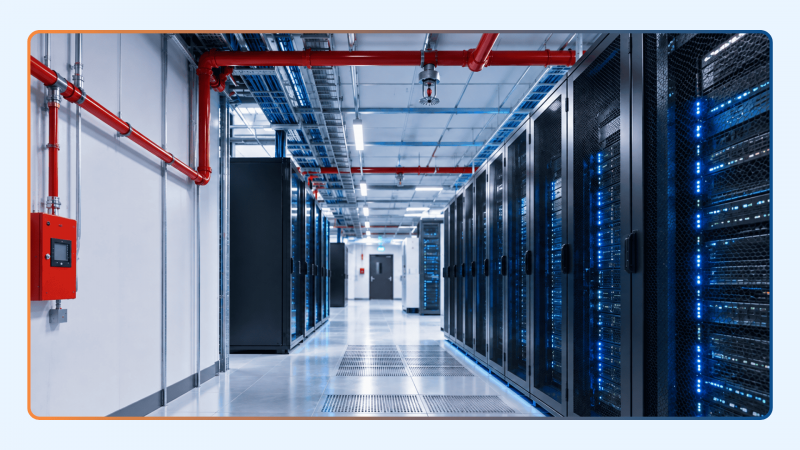

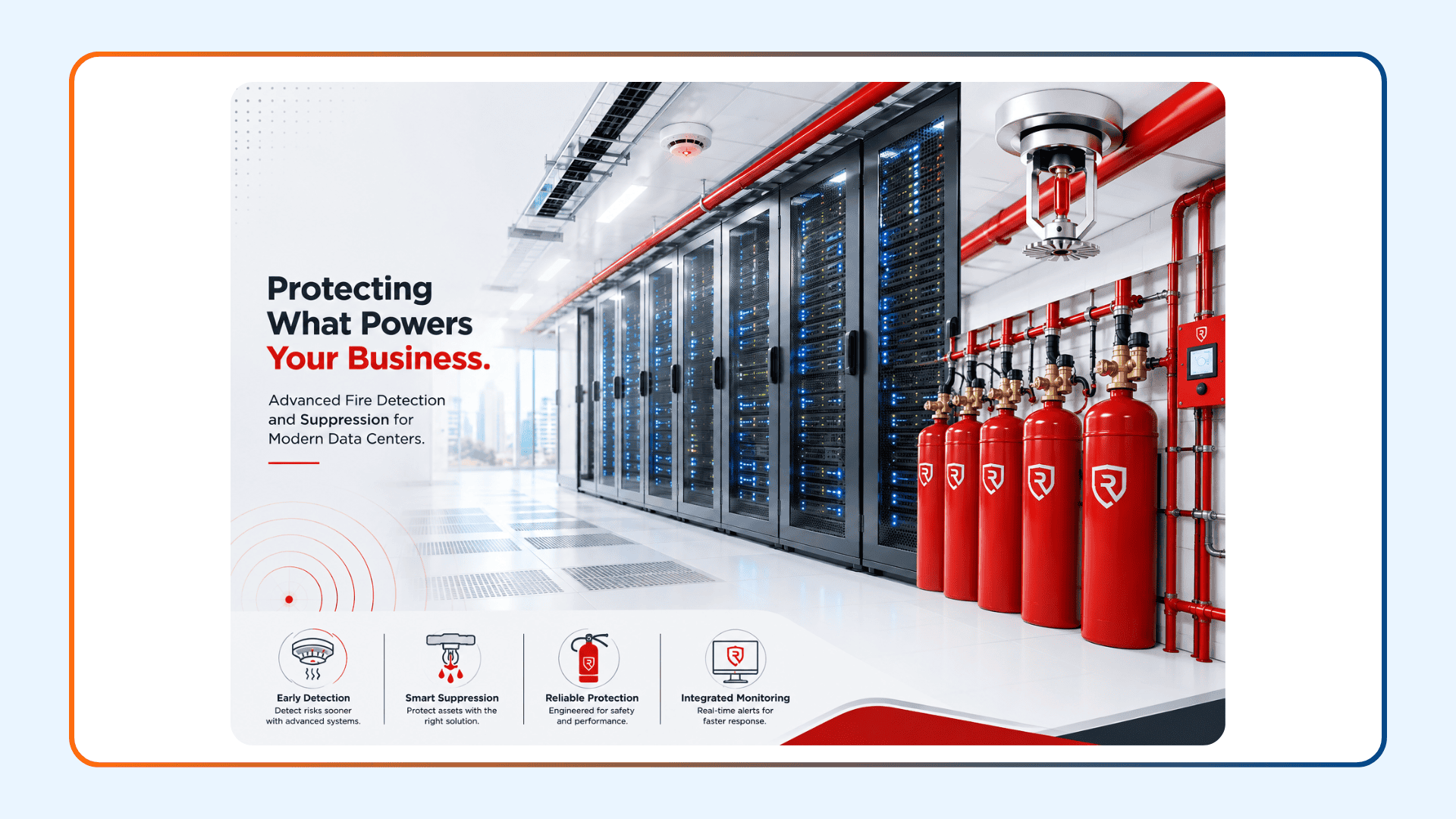
Modern data centers power everything from cloud computing and financial transactions to healthcare systems and industrial processes. Even a small fire incident can result in significant downtime, equipment damage, data loss, and business interruption. Because of these unique risks, fire protection for data centers requires systems that can detect hazards as early as possible and do so with minimal damage to critical equipment. Modern facilities often employ numerous levels of detection, suppression, monitoring and emergency response working together to safeguard people, infrastructure and business continuity rather than depending on a single suppression approach.
This is a look at the most prevalent fire suppression and detection methods in use in data centers today, how they function together, and the design factors that go into determining the best combination for a given facility.
The Four Layers of Data Center Fire Protection
An effective data center fire safety strategy typically combines several systems working together rather than relying on a single technology:
- Early detection — identifying smoke or heat before flames develop
- Automatic suppression — controlling or extinguishing a fire with minimal collateral damage
- Fire alarm and monitoring integration — coordinating a fast, organized emergency response
- Inspection, testing, and maintenance — ensuring every system continues to perform as designed over the life of the facility
Understanding the Risk Profile
Most data center fires originate from electrical failures — overloaded circuits, damaged cabling, failing power supplies, or overheating components. These fires often start small and can smoulder for some time before producing visible flame, which is a problem in a raised-floor environment where high-volume airflow through hot and cold aisles quickly dilutes and disperses smoke before it reaches a ceiling-mounted detector.
Adding battery-based backup power and on-site energy storage further changes the risk profile. Lithium-ion cells can enter thermal runaway, a self-sustaining chemical reaction that generates heat, flammable off-gas, and potentially fire with very little warning. This has pushed the industry toward prevention-first design in battery rooms rather than relying on suppression alone.
Any effective fire strategy for a data center starts with an honest risk assessment: what’s in the space, how the air moves, what’s most critical to protect, and what a false discharge would cost the business.
Detection
Different areas of a data center often call for different detection technologies, matched to that space’s airflow, equipment, and risk profile.
Aspirating smoke detection (ASD), often known in the industry by the genericized trade name VESDA, is now standard practice in high-airflow data center environments. These systems continuously draw air samples through a network of small-bore pipes back to a central detector, which can identify smoke particles at concentrations far below what a conventional spot detector would notice. Because sensitivity thresholds can be configured by zone, VESDA-type detection can give facility staff an early warning stage — long before conditions reach the point where automatic suppression would need to activate. This makes aspirating smoke detection especially well suited to raised-floor server rooms and data halls where high air exchange rates would otherwise dilute smoke before it reaches a ceiling.
Spot smoke detectors (photoelectric or ionization) remain a cost-effective, code-required layer in offices, corridors, storage areas, and other support spaces where airflow is closer to a standard commercial environment.
Heat detectors are often used in areas where smoke detectors are impractical or prone to false alarms, such as some mechanical and electrical rooms, and can trigger a response based on a fixed temperature or rate of temperature rise.
Flame detectors are commonly deployed in generator rooms, fuel storage areas, and battery or energy storage rooms, where a fast-developing flaming fire is a more relevant risk than smoldering smoke.
Across all of these, an intelligent, addressable fire alarm system ties every detector back to a central panel, pinpointing the exact device and location that activated so facility staff aren’t left guessing where a problem originated.
Suppression
There’s no single fire suppression system that fits every part of a data center. Most facilities use a layered approach, selecting the right system for each space based on what’s being protected and what a discharge would cost if it happened unnecessarily.
Pre-Action Sprinkler Systems
Pre-action sprinklers are the most common water-based approach for data center white space, and for good reason. Unlike a standard wet-pipe system, the piping stays dry until a detection event occurs.
- Single-interlock systems fill the pipe with water as soon as a connected detection device activates; a sprinkler head still has to activate before water actually discharges.
- Double-interlock systems go a step further, requiring both a detection signal and a sprinkler head to activate before water enters the pipe at all.
Benefits:
Because the pipe is normally dry, pre-action systems significantly reduce the risk of accidental discharge from a damaged pipe, fitting, or head — a meaningful consideration in a room full of servers. They’re also well understood, code-compliant, and comparatively straightforward to install, inspect, and maintain.
Limitations:
Pre-action systems still use water, so even a legitimate discharge carries some risk of equipment damage, and double-interlock configurations require careful coordination with the detection system to avoid a delayed response. They’re best thought of as a foundational protection layer — often paired with clean agent or water mist protection in the most sensitive spaces.
Clean Agent Fire Suppression
Clean agent systems extinguish fire using a gaseous agent that leaves no residue and causes no water damage, making them a common choice for data halls, UPS rooms, and other spaces housing high-value electronic equipment.
- FM-200 (HFC-227ea) has long been one of the most widely used halocarbon clean agents, valued for its fast discharge and compact cylinder footprint.
- Novec 1230 is another halocarbon agent that has seen wide adoption, in part due to its very low global warming potential compared to older agents; as with any agent choice, it’s worth confirming current environmental regulations and availability with a qualified design professional, as this space continues to evolve.
- Inert gas systems (using blends of nitrogen, argon, and/or CO2) suppress fire by lowering the oxygen concentration in a space rather than through chemical interruption, and are often selected where agent environmental profile or storage space is a key consideration.
Clean agent systems require a well-sealed room to hold the agent at an effective concentration long enough to extinguish the fire, along with a design that accounts for occupant safety and egress during and after a discharge.
Water Mist Systems
Water mist systems use very fine water droplets — rather than the larger droplets produced by a standard sprinkler — to suppress fire through a combination of cooling and localized oxygen displacement. Because the droplets are so fine, these systems typically use only a fraction of the water volume of a conventional sprinkler system for an equivalent level of protection.
Water mist is often considered for space-constrained retrofits, or for facilities looking to balance strong suppression performance against reduced water damage risk, without the ongoing agent-replacement costs associated with a clean agent system.
Fire Alarm and Building Integration
Modern fire protection systems don’t operate in isolation. Detection, suppression, HVAC shutdown, smoke control, emergency power, access control, and building management systems are increasingly integrated so they respond together, in a coordinated sequence, rather than as separate systems reacting independently.
Integrated monitoring allows facility personnel to:
- Identify the exact location and device associated with an incident
- Receive real-time status of every connected fire protection system
- Coordinate emergency procedures and building shutdown sequences automatically
- Minimize unnecessary downtime by distinguishing a genuine event from a fault condition
For a facility where every minute of downtime has a cost, this level of integration is often just as important as the suppression system itself.
Battery Rooms and Energy Storage
Because thermal runaway can progress faster than a conventional suppression system can respond, battery and energy storage rooms are generally treated as a prevention and containment problem first. That typically means off-gas and early-warning detection tuned to the chemical signatures of a failing cell, physical compartmentalization to limit fire spread between racks or cabinets, and ventilation strategies designed to manage flammable gas buildup — with suppression as one part of a broader design rather than the sole line of defense.
Inspection, Testing, and Maintenance
Even the most advanced fire protection system is only as reliable as its maintenance program. Regular inspection, testing, and maintenance (ITM) is what keeps detection and suppression systems functioning as designed — and compliant — over the full life of the facility. A typical program includes:
- Sprinkler and pre-action system inspections and trip tests
- Fire alarm testing and device verification
- Aspirating smoke detection (VESDA-type) maintenance and sensitivity testing
- Clean agent cylinder inspections and pressure checks
- Fire pump and valve testing
- Integrated system (interlock) testing to confirm detection, suppression, and building systems respond together as intended
- Code compliance verification and documentation
Relevant Codes and Standards
The design of fire protection in data centers is driven by a combination of national and industry-specific standards, such as:
- NFPA 13 – Installation of Sprinkler Systems
- NFPA 72 National Fire Alarm and Signalling Code
- NFPA 75 – Protection of Information Technology Equipment
- NFPA 76 – Fire Protection of Telecommunications Facilities
- NFPA 2001 — Clean Agent Fire Extinguishing Systems
- NFPA 855 — Installation of Stationary Energy Storage Systems
- Applicable CAN/ULC standards and provincial fire and construction codes in Canada
A skilled fire protection engineer may determine which requirements apply to a certain facility, occupancy classification, and jurisdiction.
Key Design Considerations
The choice of the appropriate system combination for a specific facility is influenced by a variety of site-specific factors, including:
- Facility size and overall rack density
- Air flow management, elevated floors, hot/cold aisle layout
- Presence of on-site generators or battery energy storage systems
- Objectives of Business Continuity and Redundancy
- Plans for further growth
- Insurance issues and local code requirements
- Budget and long-term operating and maintenance costs
Comparing Common Data Center Fire Protection Systems
| Solution | Primary Purpose | Common Applications |
| Aspirating Smoke Detection (VESDA) | Very early smoke detection | Server rooms, raised floors, data halls |
| Pre-Action Sprinklers | Water-based fire suppression | White space, general building areas |
| Clean Agent Systems | Fire suppression without water damage | Data halls, UPS and electrical rooms |
| Water Mist Systems | Suppression with reduced water use | Space-constrained or retrofit equipment rooms |
| Portable Extinguishers | Manual first response | Throughout the facility |
Conclusion
Protecting a modern data center requires more than selecting a fire suppression system. Effective data center fire safety comes from integrating early detection, reliable suppression, intelligent monitoring, and ongoing inspection and maintenance into a coordinated strategy tailored to the facility’s operations. Whether designing a new data center or upgrading an existing one, an engineering-led approach helps ensure code compliance, supports business continuity, and protects critical infrastructure for the long term.
Article written by Hamid Shami, Lead Engineering Rotaflow.