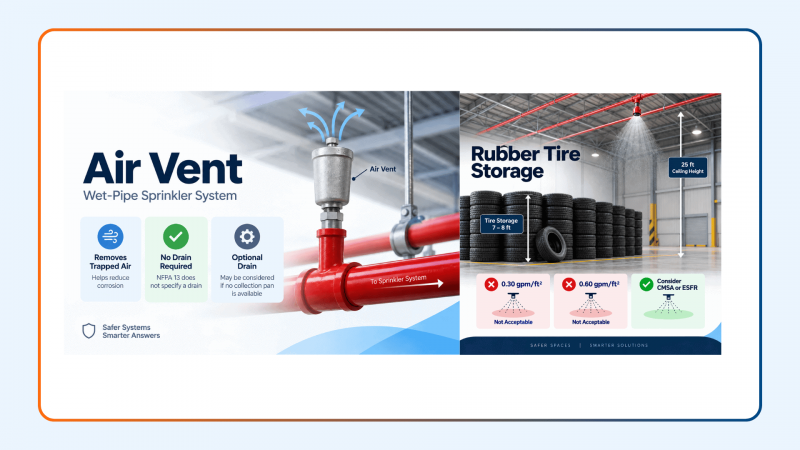

Introduction
Proper identification of the storage and commodity classification is one of the most critical aspects in the design of fire sprinkler protection. NFPA 13 has separate criteria for miscellaneous storage, low-piled storage and idle pallets, and knowing where each applies might directly affect the protection system. These classes can occasionally be mistaken with the occupation classifications established by the International Fire Code (IFC), which creates issues for designers, building owners, and Authorities Having Jurisdiction (AHJs). This article discusses the major NFPA 13 standards for miscellaneous and low-piled storage, miscellaneous tire and rolled paper storage, and idle wood and plastic pallets, and emphasises understanding when each set of criteria applies.
NFPA 13 Requirements for Miscellaneous, Low-Piled Storage, and Idle Pallets
The most crucial stage is to ascertain the commodity category correctly to determine the relevant fire protection regulations under the IFC, NFPA 1, and NFPA 13.
Responsibility for the design and approval process lies with all parties involved including the building owner or his agent, the licensed design professional, and the AHJ. The importance of each lies in the accurate definition of the commodity categorisation and the subsequent development, assessment and installation of the fire prevention system.
One area of possible confusion is the distinction between Miscellaneous and Low-Piled Storage. These storage options fill a unique niche between the criteria for standard storage (beginning in Chapter 20) and the requirements for occupancy hazards (Chapter 4).
At the other end of the range is the storing of idle pallets. Idle pallet storage may create fire problems that are greater than those associated with regular storage, and the fire threat can be significantly higher. Many building owners and / or renters are unaware of these problems.
It is important to understand the differences between these and to accurately identify the commodity and hazard categorisation so that the fire prevention system is properly designed for the hazard and offers the level of protection required by the applicable codes and standards.
IFC Requirements for Occupancy Classification
Section 203 of the International Fire Code (IFC) requires that every structure be assigned one of 26 separate occupancy classifications to determine its primary use before a Certificate of Occupancy can be issued.
It is vital to understand that IFC occupancy ratings are completely separate from National Fire Protection Association (NFPA) 13 classifications. While the IFC establishes the building’s use, NFPA 13 assesses the fire risk within that use using either “Classification of Hazards” for non-storage spaces or “Classification of Commodities” for storage facilities.
Discrepancies between these two frameworks sometimes cause misunderstanding for both designers and AHJs. System designers are often familiar with NFPA 13, but less so with the IFC. Conversely, AHJs frequently prioritise IFC compliance over NFPA requirements. Misalignment or misunderstanding of these separate regulatory regulations creates a considerable danger, typically resulting in ineffective fire sprinkler system design and protection.
The “occupancy classification” specified by the IFC has 26 classifications, as follows:
Occupancy Classifications (IFC 203.1) (IBC 302)
- Assembly: Groups A-1, A-2, A-3, A-4 and A-5
- Business: Group B
- Educational: Group E
- Factory and Industrial: Groups F-1 and F-2
- High Hazard: Groups H-1, H-2, H-3, H- and H-5
- Institutional: Groups I-1, I-2, I-3, and I-4
- Mercantile: Group M
- Residential: Groups R-1, R-2, R-3 and R-4
- Storage: Groups S-1 and S-2
- Utility and Miscellaneous: Group U
Miscellaneous & Low-Piles Storage (NFPA 13)
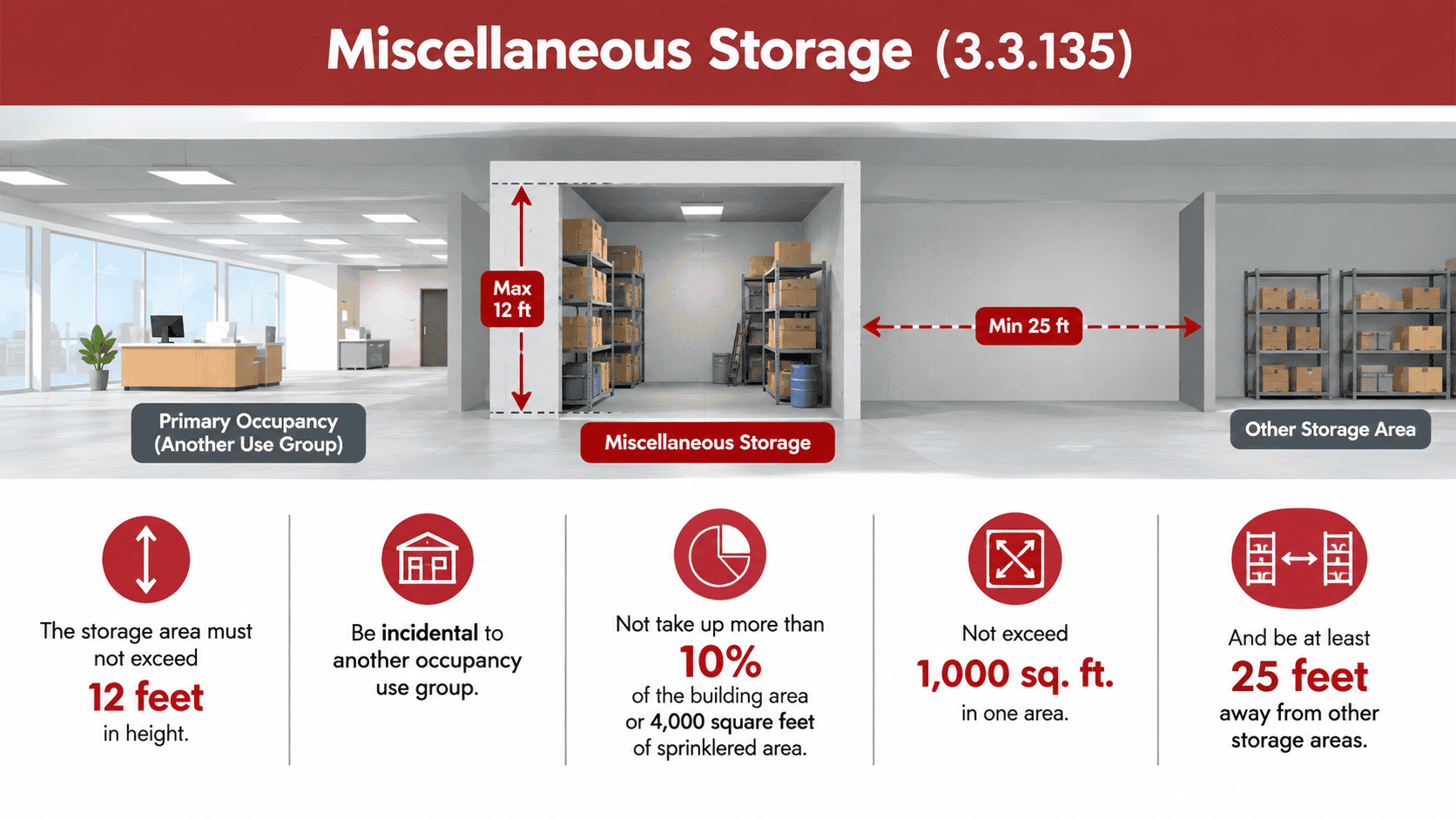
Miscellaneous Storage (3.3.135)
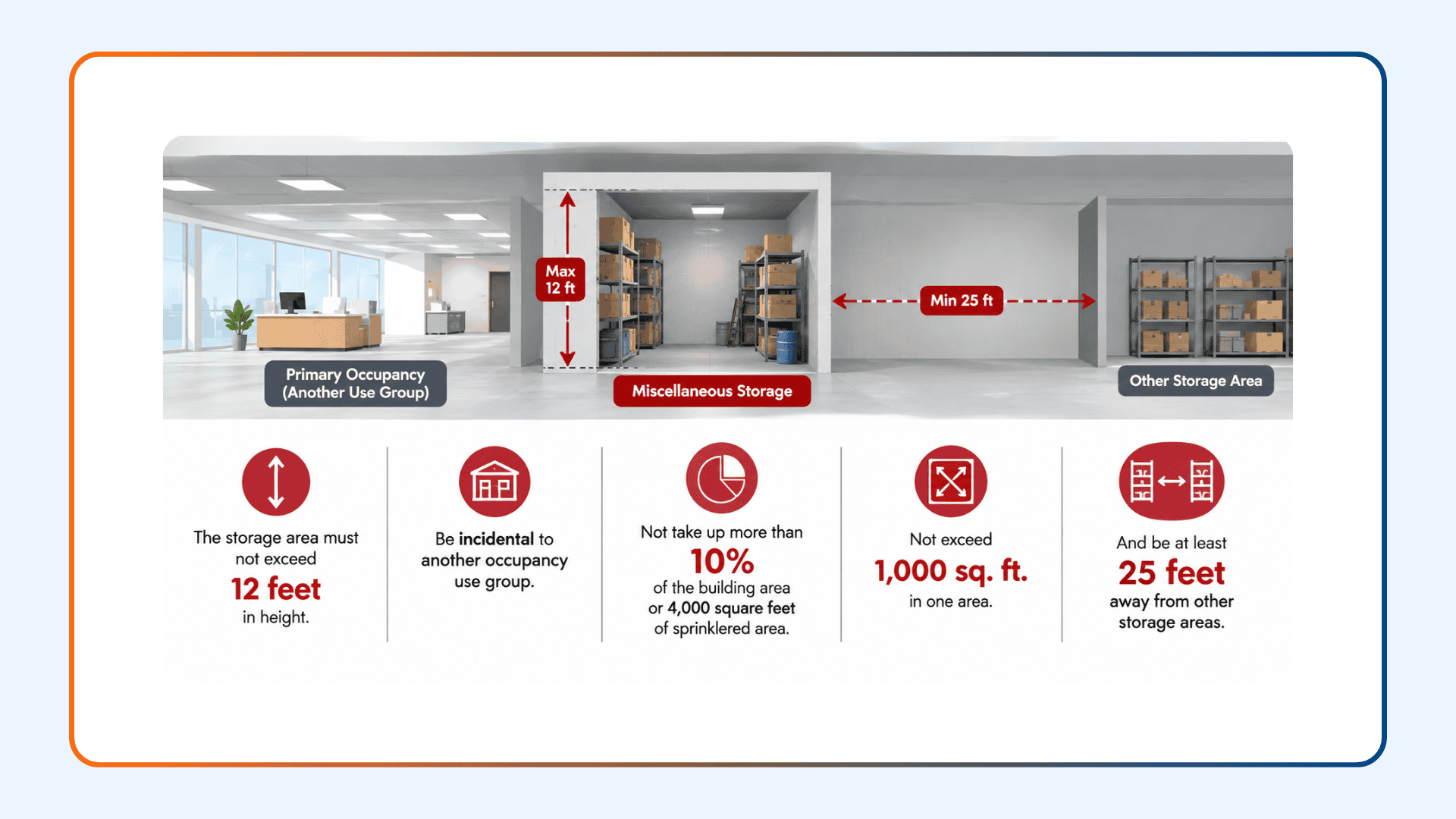
- The storage area must not exceed 12 feet in height
- be incidental to another occupancy use group
- not take up more than 10% of the building area or 4,000 square feet of sprinklered area
- not exceed 1,000 square feet in one area
- and be at least 25 feet away from other storage areas
Miscellaneous Storage Example
Consider a very generic example of a strip mall that has the following “occupancy classifications” according to the IFC.
Group A- 2 Restaurant
Group M-Mercantile
Group S-1 Storage Area
Group B- Office.
Because the strip mall contains a portion of the Mercantile that contains “storage” in the back portion of the store, an authority having jurisdiction (AHJ) may assume fire protection requirements would be contained beginning in Chapter 20 of NFPA 13, and have to be classified as one of the following commodity classifications:
- Class I
- Class II
- Class III
- Class IV
- Group A Plastics
Under very specific conditions, sprinkler protection would enable the user to meet the protection criteria in Chapter 4 under “miscellaneous storage,” which allows storage that is “incidental” to the primary function of the building to be classified as the same hazard as the mercantile occupancy, which in this case is an Ordinary Hazard 2. (Refer to A.4.3.3.2 (16) for OH2 occupancy uses and Table A.20.4.3 for Class III Commodity Textile Materials- Clothing).
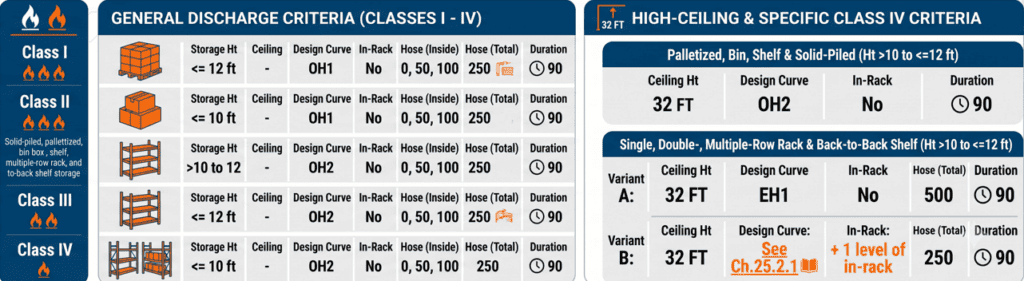
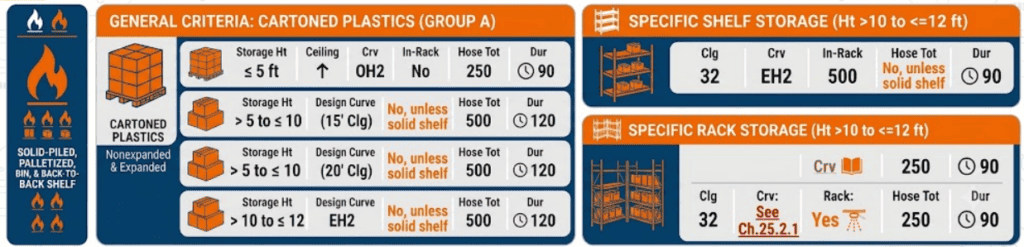
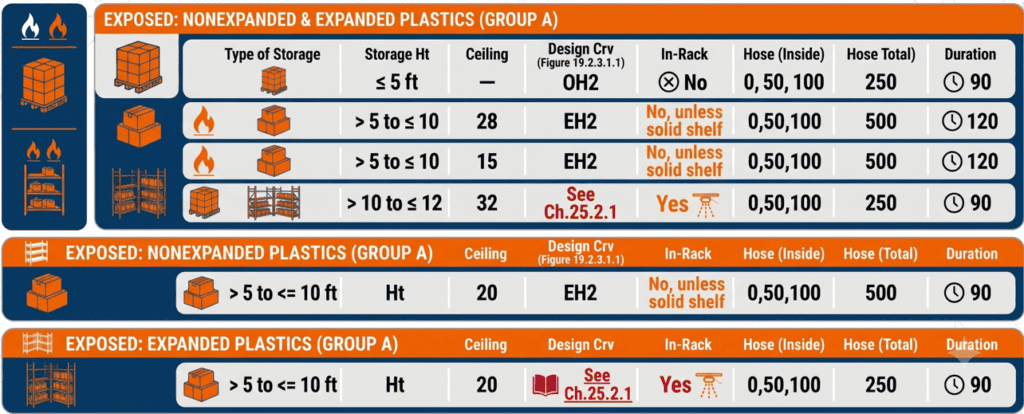
Ceiling Sprinkler Protection Criteria (Table 4.3.1.7.1)
Class I – IV Commodities
Group A Plastics (Cartoned)
Group A Plastics (Exposed)
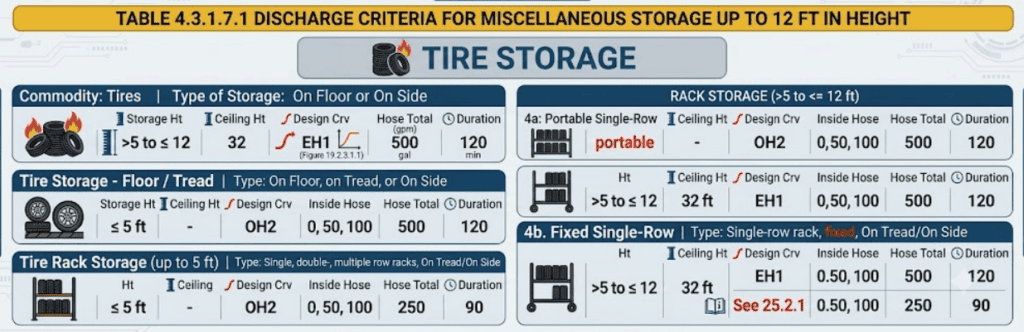
Miscellaneous Tire Storage (NFPA 13)
Rubber tires sold within a mercantile occupation are another potential source of commodity classification errors. NFPA 13 addresses particular sprinkler protection parameters for rubber tire storage based on sprinkler type in chapters 21–23.
Chapter 4 allows “Miscellaneous Tire Storage” to be protected under extremely precise situations, as detailed below.
Miscellaneous Tire Storage Definition (3.3.136)
Tire storage must be incidental to the building’s primary use. (Example: a little display of tires in a retail store).
The height of the Tire storage is regulated by the following storage arrangements:
- On-floor, on-side Tire storage is less than 12 feet.
- On-floor, on-tread Tire storage within 5 feet.
- Double-row or multirow (permanent or moveable) racks with on-side or on-tread Tire storage 5 feet
- Single-row (permanent or portable) racks with on-side or on-tread Tire storage 12 feet.
- Racks for storing laced tires under 5 feet.
Miscellaneous Tire Storage Rules (4.3.1.6).
- Tire storage should not exceed 2,000 square feet.
- Tire storage piles, regardless of storage method, may not exceed 25 feet in the direction of the wheel holes.
Ceiling Sprinkler Protection Criteria (Table 4.3.1.7.1)
Miscellaneous Storage (Tires)
Miscellaneous Rolled Paper Storage (NFPA 13)
NFPA 13 sprinkler protection guidelines for rolled paper are found in Chapters 21–23 of the storage chapters.
Chapter 4 allows “Miscellaneous Rolled Paper Storage” to be managed by the provisions in Chapter 4 under very precise conditions, as detailed below.
Miscellaneous Rolled Paper Storage is not officially described in Chapter 3, but Table 4.3.1.7.1 does provide the Protection Criteria.
Miscellaneous Storage (Rolled Paper)
Low-Piled Storage (NFPA 13)
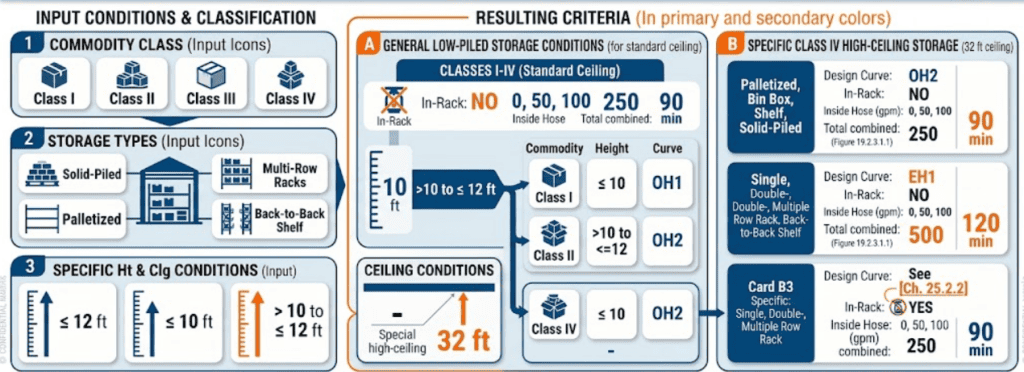
NFPA 13 allows low-piled storage (up to 12 feet for Class I-IV commodities and 5 feet for Group A plastics) to be managed by Chapter 4, rather than the dedicated storage chapters beginning with Chapter 20.
In the 2022 and previous editions of NFPA 13, the tables describing the protection standards for Miscellaneous Storage combined Class I-V Commodities, Group A Plastics (Cartoned and Exposed), Rolled Paper, and Low-Piled Storage.
The 2025 Edition added separate rules and a table for Low-Piled Storage with the purpose of providing additional explanation and differentiation between Miscellaneous and Low-Piled Storage and directing the end user to Chapter 4. Table 4.3.1.7.4 contains the updated ceiling sprinkler discharge criteria for low-piled storage.
Ceiling Sprinkler Protection Criteria For Low-Piled Storage (Table 4.3.1.7.4)
Class I To Class IV Commodities
Group A Plastic Commodities

Protection of Idle Pallets – NFPA 13 (20.17)
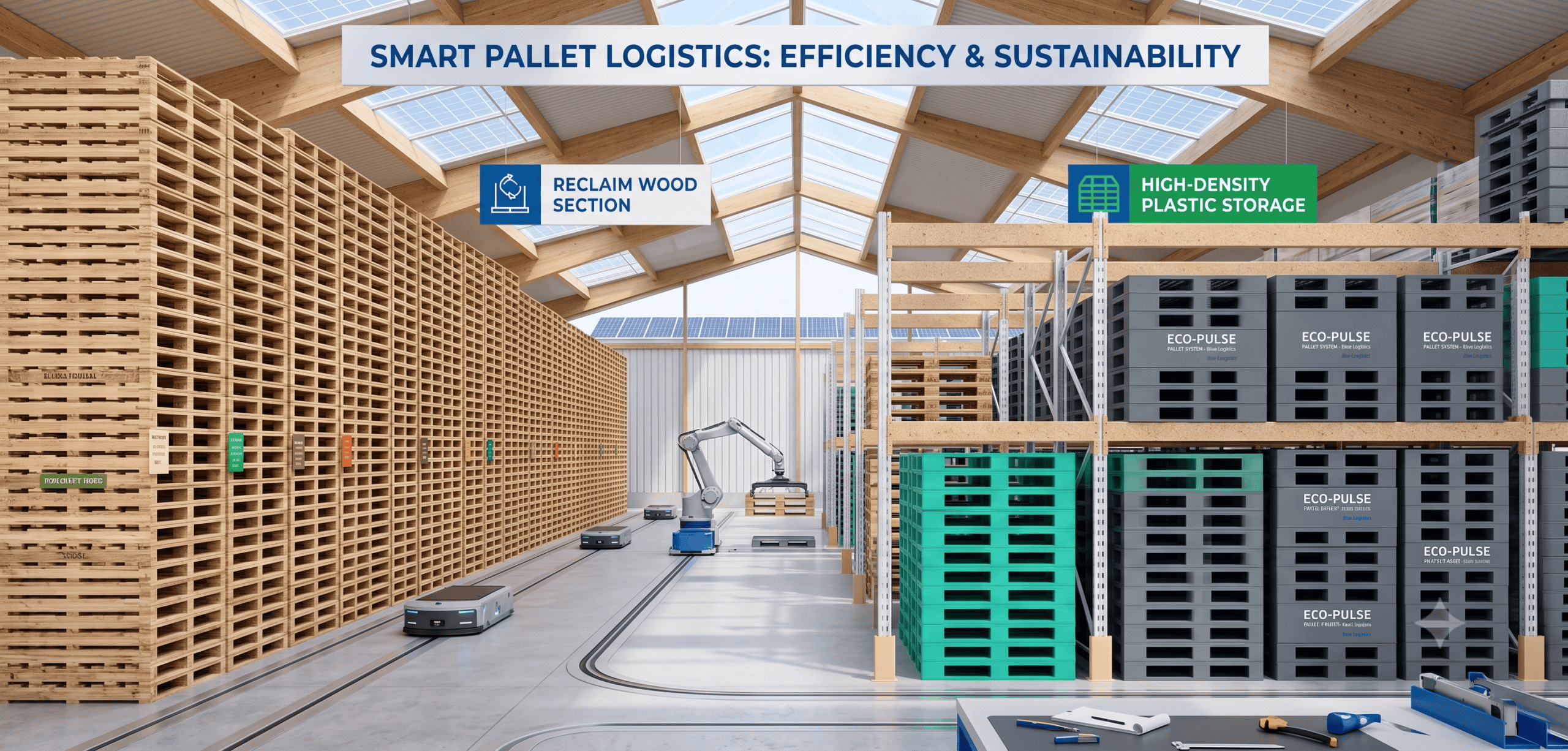
Idle pallet storage is a unique and major fire hazard. Pallets have the happy coincidence of combining fuel and ambient oxygen in a way that the structural design of pallets results in rapid fire propagation and extremely high heat output. Also, wood pallets dry out with time, which causes faster flame spread, but plastic pallets offer a much higher heat threat. These complex arrangements impose tougher demands on sprinkler protection.
A series of large-scale fire tests with idle pallet storage was performed by Underwriters Laboratories to establish the permitted storage configurations and fire protection parameters indicated in Section 20.17.
If you are a building owner or agent for a building, you have a responsibility under Chapter 20.17 to ensure that idle pallets are not stored higher than the maximum storage and ceiling heights. Storage must also meet the specific protection parameters of the sprinkler system (CMDA, CMSA or ESFR). Owners should work with their sprinkler contractor or the authority having jurisdiction (AHJ) as the assessment of these technical standards typically requires expert knowledge. While the owners are ultimately responsible for compliance with regulations, it’s important that all parties involved are proactive in an effort to minimise the considerable dangers of indoor storage of pallets and to ensure safety at the facility.”
Sprinkler protection criteria standards are based on the kind of the sprinkler (CMDA, CMSA or ESFR), the pallet type (wood or plastic) and the storage arrangements.
CMSA Sprinkler Protection with Cut-Off Rooms
A cutoff room must have at least one exterior wall and be segregated from the rest of the structure by 3-hour rated fire walls.
The following security and storage arrangements apply:
Storage is secured by sprinklers that produce 0.6 gpm/sf throughout the space, or by high-expansion foam sprinklers that deliver 0.3 gpm/sf throughout the room.
Storage stacked no higher than 12 feet.
Any steel columns must be protected by 1-hour fireproofing or a sidewall sprinkler directed to one side of the column at the top or 15 feet below, whichever is lower.
CMSA Sprinkler Protection Without Cutoff Rooms
The following security and storage arrangements apply:
- Maximum storage height is 10 feet.
- Maximum ceiling height: 30 feet.
- Sprinkler density: 0.6 gpm/sf for 2,000 square feet.
- The minimum sprinkler K-factor is 16.8.
Conclusion
Proper storage classification is an important step in creating an effective fire sprinkler protection system. As this TechNote demonstrates, miscellaneous storage, low-piled storage, and idle pallet storage are not interchangeable categories with specific restrictions and protection needs under NFPA 13. The difference between the IFC occupancy classification and the NFPA 13 hazard and commodity classification is also essential and should not be confused, or it may lead to incorrect protective tactics.
Idle pallets are of special concern, as their configuration and composition can present a considerable fire problem. Specific sprinkler protection is required depending on the type of pallet, storage arrangement, storage height and sprinkler technology. Building owners, design professionals, sprinkler contractors and AHJs should work collaboratively early in the design and approval process to determine the suitable classification and related requirements. With the proper identification of the storage configuration, and the application of the proper NFPA 13 requirements, stakeholders are able to help ensure that the sprinkler system is providing the level of protection that is required for the actual hazard.