Question #1. Does an FM Approval meet NFPA 13, Section 7.1.1.1 and include evidence that we can submit?
Answer: FM, formerly known as Factory Mutual or FM Global, is a large insurance firm that focuses on loss prevention for highly protected risk (HPR) properties. FM is a nationally recognised testing laboratory (NRTL), alongside Underwriters Laboratory (UL), Intertek, Southwest Research Institute, and a few others in the U.S. They have contributed significantly to the development of sprinkler protection criteria for storage and warehouse operations. Many of the fire sprinkler protection methods for high-piled combustible storage rely on FM’s earlier testing and research.
NFPA 13, 2019 edition, Section 7.1.1.1, permits the use of materials and devices as long as they are used in compliance with its special listing:
“7.1.1.1 Materials or devices not specifically designated by this standard shall be used in accordance with all conditions, requirements, and limitations of their special listing.”
Table A.7.1.1, an annexe to Section 7.1.1, contains examples of sprinkler product standards. FM approval standards are often used examples in Table A.7.1.1.
Section 1.5 of NFPA 13 concerns the use of equivalent procedures or devices (equivalency). Nothing in this standard prohibits the use of systems, methods, or equipment of equal or greater quality, strength, fire resistance, effectiveness, longevity, and safety than those specified in this standard.”
Furthermore, the International Fire Code (IFC) states in Section 102.8 that some topics are not covered by the code. Compliance with applicable National Fire Protection Association or other nationally recognised fire safety standards, as approved, shall be regarded as prima facie evidence of compliance with the intent of this code in cases where applicable standards or requirements are not specified in this code or are contained in other laws, codes, regulations, ordinances, or bylaws adopted by the jurisdiction. This provision does not restrict the fire code official’s authority to assess code or standard compliance for activities or installations that fall under their purview.
The authority having jurisdiction (AHJ) may recognise compliance with FM approval standards or product listing criteria in accordance with these provisions.
After that, it is decided whether more changes can be made to the design area when high-temperature or large-orifice sprinklers are added under Sections 19.2.3.2.6 and 19.2.3.2.7.
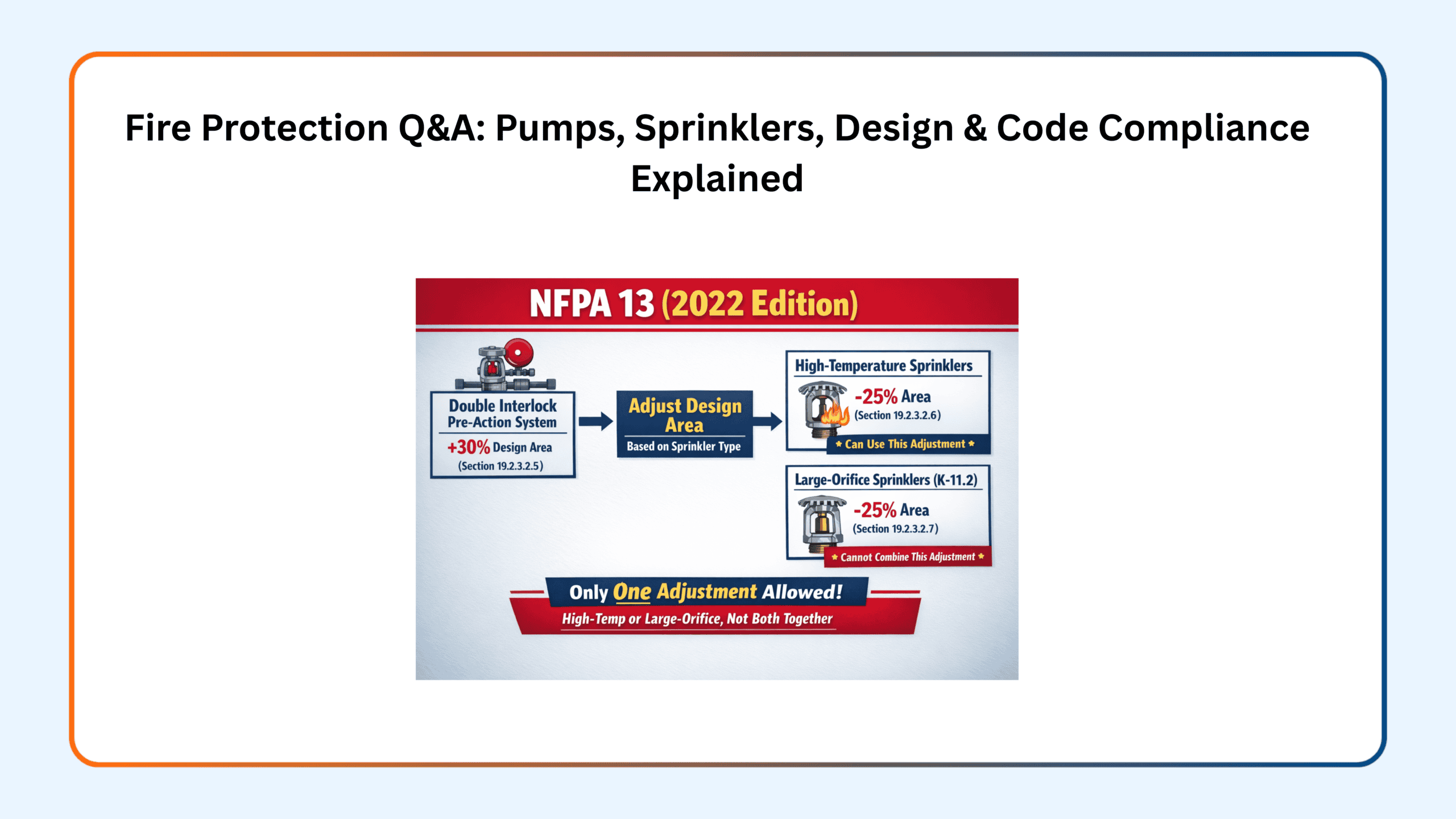
Question #2. According to the 2022 edition of NFPA 13, after applying the 30% design area increase required for a double-interlock preaction system in accordance with Section 19.2.3.2.5, can the design area be reduced by using high-temperature sprinklers (Section 19.2.3.2.6) and large-orifice sprinklers (Section 19.2.3.2.7)?
Answer: Yes, you can use the 30% design area increase needed for a double-interlock preaction system in Section 19.2.3.2.5. After that, you can lower the design area based on the type of sprinkler you have. But you can’t combine the cuts for high-temperature sprinklers (Section 19.2.3.2.6) and large-orifice sprinklers like K-11.2 (Section 19.2.3.2.7).
These rules were meant to make the high-temperature and large-orifice changes work as separate options, not simultaneously. The 2022 version was harder to understand because the rules were in different areas. Section 19.2.3.2.8, on the other hand, lists the specific changes that can be compounded, and Section 19.2.3.2.7 is not one of them.
The 2025 edition made things clearer by changing the terminology to better represent how it was meant to be used.
Question #3. Why is a water spray system not required here instead of an automatic sprinkler system?
Answer: The NFPA 20 Technical Committee requires automatic sprinkler systems in fire pump rooms, including those housing diesel-powered fire pumps, as a policy decision that prioritises reliability, consistency, and coordination with the model codes over optimising protection for a single fuel type or piece of equipment. Automatic sprinkler systems are the standard fire protection method used in the International Building Code (IBC), International Fire Code (IFC), and other codes that rely on NFPA 20, and many code tradeoffs, such as increased allowable area, height, or construction options, are directly related to the presence of an NFPA 13 sprinkler system. When a fire pump room is placed in a fully sprinklered building, the sprinkler protection in that room is consistent with and supports the larger code assumptions. While a water spray system is effective for some oil-fired machinery, the model codes do not handle it the same way, which may complicate or invalidate sprinkler-based choices.
The presence of diesel engines and fuel tanks has historically caused concern due to the higher fire risk associated with combustible liquids. Rather of prohibiting diesel fuel in pump rooms or requiring specialised suppression systems, the NFPA 20 Technical Committee addressed these concerns by mandating higher sprinkler protection densities suitable to the hazard. Because a fire pump room offers an instantaneous and consistent water supply, the committee saw automatic sprinklers as a realistic, dependable, and readily enforced alternative. While the model codes permit alternative fire protection systems on a case-by-case basis when equivalence to an automatic sprinkler system is demonstrated and approved by the code official or AHJ, NFPA 20 standardises on automatic sprinklers to ensure predictable performance, code consistency, and acceptance across jurisdictions. For designers, this implies that the fire pump room is handled as part of the building’s overall sprinkler plan, rather than as a separate particular hazard.
Question #4. We believe this should imply that no clearance is required where the pipe is fastened to the structural member using an approved hanger or restraint, but the text does not read that way. Could you please clarify this?
Answer: It is correct that no clearance is necessary, as long as Section 18.4.13 is followed.
Section 18.4.13.1 does not require clearance; rather, it states that if the piping is secured to a structural part using an approved hanger or restraint, clearance is permitted. This provision does not need clearance, but rather states that it is OK if there is.
As part of the project, the old fire pump will be replaced with one that has the same pressure characteristics. The system pressure is about 170 psi when the flow is 100%.
Question #5. Since the 100 percent rated pressure is below 175 psi, is it okay for a fire pump to run at a pressure higher than 175 psi without putting PRVs at the risers or downstream of the pump?
Answer: No, the fire pump discharge pressure at the churn may not exceed the maximum rated pressure of the system components it serves.
Section 4.17.3 of NFPA 20, 2025 edition states that the pressure rating of the discharge components must be enough for the maximum total discharge head with the pump operating at shutdown and rated speed, but not less than the rating of the fire protection system.
According to NFPA 13, 2025 edition, Section 7.1.2 for rated pressure, system components must be rated for the maximum system working pressure to which they are exposed, but not less than 175 psi (12 bar) for components installed above ground and 150 psi (10 bar) for those installed underground.
In your example, if the rated maximum pressure for the fire pump discharge and sprinkler system components is 175 psi and the fire pumps churn at 200 psi, the maximum system operating pressure exceeds the system’s rated pressure, which is not permitted by the standard.
Consider if Figure 10.2.8.2(c) for obstructions against walls applies when the total distance from the wall to the farthest flange edge is within the specified limitations.
Question #6. A project contains I-beams with flange edges that are 9 inches from the wall. This forms a beam pocket. Is figure 10.2.8.2(c) from the 2025 version of NFPA 13 (obstructions against walls) suitable if the entire distance from wall to furthest flanged edge is less than 24 inches?
Answer: This is an issue that is not currently addressed in NFPA 13. While Figure 10.2.7.1.2(c) may effectively manage the “shadow area” beneath the I-beam, the “beam pocket” potential for trapping heat and delaying ceiling level sprinkler activation remains.
The ceiling pocket regulations do not apply since this is a “beam pocket”. In fact, the NFSA has submitted a Public Input to the 2028 version of NFPA 13 that directly addresses this issue. This notion was accepted in the initial draft, but it will not become part of the standard until 2028. (FR-1069)
As NFPA 13 does not currently cover this exact circumstance, it is recommended that a dialogue with the project engineer be conducted to determine acceptable fire protection.
Question #7. Should the sprinklers in the room be spaced to face the hood or the wall behind the duct?
Answer: Article 8.9.2.3 states: “Hoods containing automatic fire-extinguishing systems are protected areas and not considered obstructions to overhead sprinkler systems and shall not require floor coverage underneath.”
According to this language, because the hood has automatic fire-extinguishing systems, the area beneath the hood is not protected, and the ceiling sprinkler only needs to protect the hood’s face (not the wall behind it).
Question #8. What storage capacities does the existing facility have, if any?
Answer: There are no storage configurations that we are aware of that would be sufficiently protected under less-than-standard hazard design guidelines.
See NFPA 13, 2025 edition, Evaluation of Existing Systems, Section 30.4, for further details. According to this part, the present system must be assessed using the current hazard and water supply when changes in occupancy, hazard, water supply, storage commodity, storage arrangement, building modification, or other variables that affect the system’s installation requirements are discovered.
Existing systems shall be evaluated using one of the following methods:
- As a new system in compliance with the current edition of the standard.
- The system was designed and installed in line with the NFPA 13 edition.
In your example, it appears that the storage changes are the result of a shift in commodity classification or storage configuration. According to NFPA 13, this can be evaluated using either the current standard or the standard’s original edition from when the system was first installed.
It may be possible to evaluate the system using the edition of the standard in effect when it was first installed.
The description investigates how overhanging doors may affect sprinkler discharge patterns and installation requirements.
Question #9. A structure has an overhead door, and the sprinklers on the ceiling are Control Mode Specific Application Sprinklers (CMSA). Is it required under the 2013 edition of NFPA 13 to use CMSA sprinklers under obstructions such as overhead doors?
Answer: No, NFPA 13 allows sidewall sprinklers to be used “to protect below overhead doors,” and this authority is not restricted by the kind of ceiling sprinkler system (including CMSA).
NFPA 13 enables sidewall sprinklers to protect under above doors regardless of occupancy because the provision is found in Chapter 8’s general installation standards and has no specific limitations, therefore it applies generally. Section 8.4.2 identifies sites where sidewall sprinklers are permitted, and part (3) states that sidewall sprinklers can “protect areas under overhead doors.” As previously indicated, there are no constraints such as occupancy classification or ceiling sprinkler type. Regardless of the type of sprinkler in the ceiling, sidewall sprinklers can be utilised to protect the area beneath the door.
Practically speaking, a regular sidewall sprinkler is a viable approach under an overhead door, even if the ceiling sprinklers are CMSA type.
The sidewall sprinkler’s aim is to offer some flow of water under the door while it is open, and it is not intended to flow with the same density as the ceiling sprinklers. These sidewall sprinklers do not need to be spaced or flow at the same density as the ceiling sprinklers because the area should still be covered by the overhead sprinklers.
It examines the importance of sprinkler systems in fire protection design under NFPA 13 and their potential interaction with passive fire-resistance assemblies.
Question #10. Two existing buildings share a common wall, and the fire department wants it to be rated for three hours. Please let me know if there is a method to use the heads along the brick wall to raise the fire rating.
Answer: No. Fire sprinklers do not and cannot boost a wall’s fire resistance rating. There is currently no instruction in NFPA 13, 2019 edition or later, for something like this.
Fire resistance ratings for wall assemblies are determined by testing. Sprinklers are typically not considered while choosing how to create a fire-rated assembly.
The following preventative factors are considered when designing and installing subterranean supply piping.
Question #11. Are all three preventative elements necessary under NFPA 24, 2013 edition, Section 10.6.2?
Answer: Yes, according to the 2013 version of NFPA 24, where subterranean pipes extend more than 10 feet beneath a building, all three elements of Section 10.6.2 must be met.
This includes:
- Arching foundation above the pipe
- Run the pipe in covered trenches.
- Adding valves to isolate pipes.
These qualifications were increased by the committee in later editions, beginning with 2016. Note that the committee highly discourages running plumbing under buildings for more than 10 feet; but, if unavoidable, certain preparations must be made; I recommend that you review the standards in the 2025 edition of NFPA 24 for this issue.
Section 10.4.3, 2025 edition, mandates the following when running pipe more than ten feet beneath a building:
- No pipe joints under the foundation.
- Pipe must be at least 12 inches below the bottom of footings or sleeves.
- Pipe in covered trench.
- Trench must be accessible from within the building.
- The trench must have sturdy walls and foundation.
- The trench must be non-combustible.
- Provisions to drain water from the trench are required.
- A valve is necessary when the subterranean enters the trench.
Question #12. According to NFPA 14, which outlet should be utilised as a reference point for installation height?
Answer: Section 9.5.1.1.1 of NFPA 14 specifies that the height be measured to the center of the hose valve. In a Class III system, both the DN65 (2 ½”) and DN40 (1 ½”) outlets are hose valves, hence the center of each outlet must be situated between 0.9 m (3 feet) and 1.5 m (5 feet) above the completed floor.
Closing Thoughts
Designing fire protection is not always easy. It shows that even simple situations can include several different ways of understanding NFPA rules. From where to put sprinklers near obstacles to how to compare old systems to new danger categories, every choice needs to find a balance between following the rules and using common sense in engineering.
One of the most important things to remember from this collection is how important it is to know the difference between intent and prescriptive language in fire codes. NFPA 13 and NFPA 20 are not merely rulebooks. They are based on years of fire testing, system performance data, and changing ideas about safety. If you misread a sentence or use provisions out of order, you could not follow the rules or, even worse, make the system work less well.
The Authority Having Jurisdiction (AHJ) is another important concept that comes up a lot. AHJs are very important for making sure that fire protection systems match both code intent and local requirements. They do this by certifying FM-listed parts, accepting other ways of protecting people, and filling in gaps where standards are silent. Working with AHJs and project stakeholders early on can save money on redesigns and delays.
This also talks about how changes to code affect design choices. A few examples, like the rules for underground plumbing and the rules for obstructions, show how newer versions of NFPA standards improve or add to older ones. It’s important to keep up with the most recent versions, especially when working on upgrades, retrofits, or projects that need to meet more than one standard.
In the end, good fire prevention design is all about making sure that sprinklers, pumps, pipes, and other building features work together as one system. Designers need to think about how each part works together to keep people safe and safeguard property, not just how it works on its own.
It underlines a simple but important idea: code compliance is the base, but knowledgeable engineering judgement is what makes fire protection systems work.