
Summary
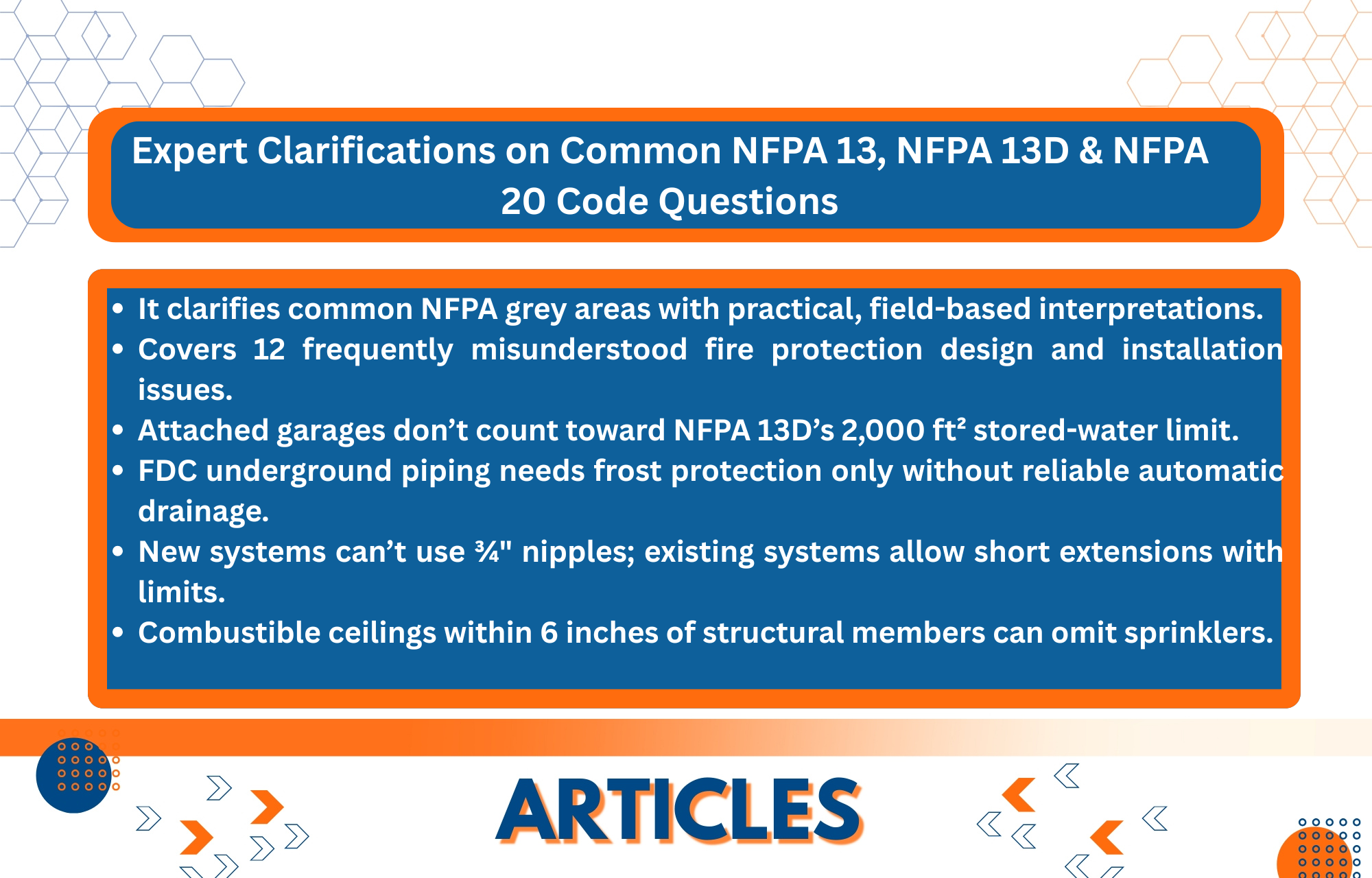
Fire protection experts, system designers, and Authorities Having Jurisdiction (AHJs) often run into grey areas in NFPA regulations. These are situations where the stated standard isn’t clear or where real-world conditions make it hard to follow the rules. Technote 571# gathers together a number of real-life fire protection situations that people often argue about and gives clear, technically sound answers based on NFPA 13, NFPA 13D, NFPA 20, and NFPA 24.
This blog lists twelve of the most commonly misunderstood technical problems in the field. These include whether an attached garage affects NFPA 13D stored-water standards, what FDC underground freeze protection goals are, and how to properly install sidewall sprinklers under ducts. It also talks about complicated design and installation problems such the limits on pipe size, the need for ventilation in diesel fuel tanks, the use of design-area reductions, and the pitch requirements for deluge system piping. Direct quotes, the committee’s intent, and practical logic that fire protection experts, contractors, and inspectors can trust have been used to explain each question.
This technote is meant to help practitioners avoid frequent mistakes when designing, installing, inspecting, and testing acceptance by bridging the gap between NFPA advice and field application. The answers below give you useful information that you can use to figure out if a 3,000 ft² design area can be changed, when a deluge system needs pitched pipework, or how to accept NFPA 13D pump-and-tank systems.
Engineers, designers, inspectors, and building authorities can use Technote 571# as a reference to find short, correct interpretations that are in line with NFPA intent and best industry practices.
Question #1 – 13D Garage – Part of Dwelling Unit
Description: NFPA 13D says that homes with less than 2,000 square feet must have at least 7 minutes of stored water, but it doesn’t say for sure if the area of an attached garage should be included in that 2,000 square feet restriction. This makes it hard for designers and AHJs to tell if something is compliant.
Question 1. According to NFPA 13D, residences with a floor area of less than 2,000 square feet must have a stored water supply with a minimum duration of seven minutes. It is unclear whether the floor area of a connected garage is included in the 2,000-square-foot maximum.
Ans. No, the garage does not contribute to the 2,000-square-foot limit.
Although NFPA 13D does not specifically address this issue, the garage should not be counted among the 2,000 square feet allotted for the 7-minute water supply. Section 6.1.3 states that the allowance only applies to dwelling units, and a garage is not considered part of the dwelling unit. applies to dwelling units, and a garage is not considered part of the dwelling unit.
Question #2 – Fire Department Connection Underground Piping
The topic concerns whether underground piping connecting to a Fire Department Connection (FDC) must be built below the local frost depth. It requests clarification on whether burying it deeper is necessary to keep the line from freezing.
Question 2. Does FDC Underground have to be below frost depth to prevent freezing?
Ans. The topic is whether subterranean fire department connection (FDC) piping, which is generally dry and not water-filled, must be insulated from freezing and installed below the frost line. This circumstance is not addressed expressly by the standard.
Although underground FDC piping is usually dry, it can get saturated with water during fire department operations or system testing, according to numerous expert perspectives and regulatory interpretations. If a dependable mechanism is given that ensures the subterranean pipe is automatically and completely emptied once it has been charged, freeze protection is unnecessary. In these circumstances, the plumbing does not need to be put below the frost level.
However, unless such a drainage system exists, freeze protection must be installed. Although this piping is not regularly filled with water, it may hold water during testing or in an emergency. If the water is not immediately and thoroughly emptied after usage, the pipe is susceptible to freezing, thus placement below the frost line is recommended.
NFPA 24 specifies that subterranean plumbing have a minimum depth of cover to prevent mechanical damage and freezing. For example, “the depth of cover shall not be less than 30 in. (0.8 m) below grade to prevent mechanical damage,” and greater depths are necessary beneath roadways or railway tracks. If freezing conditions present, the pipe should be put below the frost level unless a dependable, automatic drainage system is available for the FDC pipework.
Underground FDC piping that is typically dry should be protected from freezing and put below the frost level, unless it can be automatically and reliably drained after use. This precaution protects against freeze damage, which could limit system operation during an emergency.
Question #3 – 3/4`` Nipple Extension
The project is located in a seismic zone. A new sprinkler system is slated for installation, however the upright sprinklers are too deep below the deck to meet the requirements for obstructed construction outlined in Section 10.2.6.1.2(1) of NFPA 13. The upright sprinklers are connected to 3/4-inch threaded outlets.
Question 3. Is it acceptable to add a 3/4-inch 3-inch Schedule 40 nipple to boost sprinkler elevation to meet with Section 10.2.6.1.2 of NFPA 13, as long as the arrangement remains hydraulically acceptable?
Ans. The answer to this question is not as easy as “yes” or “no,” but rather a more nuanced explanation, as detailed below.
For new systems, the answer is no. The 2022 edition of NFPA 13 specifies that the minimum permitted diameter for steel pipe in sprinkler systems is 1 inch. This requirement is applicable to all system configurations, including tree, looping, and gridded layouts. Section 28.2.1.2 specifies that “the minimum pipe size for steel pipe in a sprinkler system shall be 1 in.”
However, there is an exception stated in Section 30.5 of Chapter 30, Existing System Modifications or Evaluation. Sections 30.5.1 and 30.5.2 establish the notion of redesigning, which allows for the removal of a sprinkler from an outlet and the extension of a smaller nipple, less than 1 inch in diameter, to a new sprinkler position. According to Section 30.5.2.1, this nipple cannot exceed 4 inches in length. The following section involves hydraulic calculations to ensure that the design flow rate is maintained.
This allowance is applicable in seismic areas, except if the nipple acts as an armover to a pendant sprinkler. Because this situation involves an upright sprinkler, a 3/4-inch nipple of no more than 4 inches in length is permissible under this provision for system adjustments.
Because this exception falls under Chapter 30, which addresses adjustments to existing systems, it is best to consult with both the design expert and the Authority Having Jurisdiction (AHJ) before proceeding.
An alternative method is to employ extension fittings. Section 16.8.6 allows extension fittings if the sprinkler has a K-factor of 8.0 or less and the occupancy is Light Hazard or Ordinary Hazard.
The extension fitting must have an internal diameter that matches the sprinkler’s nominal inlet diameter. The fitting length is limited to 2 inches, unless specified otherwise. Additionally, when the fitting length is 2 inches or less, it is not required to be included in the hydraulic calculation.
Question #4 – Combustible Construction
A flammable wood ceiling is erected two inches below the underside of 14-inch steel beams set four feet apart. The overall concealed space depth is 16 inches, which includes 14 inches for the beam depth and 2 inches between the beam and the ceiling.
Question 4. Is Section 9.2.1.5 of the 2019 version of NFPA 13 applicable, allowing sprinklers to be omitted in this flammable concealed space?
Ans. Yes. Based on the description, it appears that Section 9.2.1.5 of the 2019 edition of NFPA 13 would apply.
Section 9.2.1.5 allows sprinklers to be omitted in concealed compartments if the ceiling is immediately attached to, or within 6 inches of, wood joists or other comparable solid structural members.
In this situation, the steel beams can be treated as equivalent solid parts, and there is no requirement that the ceiling material be noncombustible. As a result, the specified conditions appear to fit the criteria of Section 9.2.1.5, which permits the lack of sprinklers in the concealed space.
Section 19.3.3.1.5 must be reviewed to see if a 3,000 ft² design area is necessary.
Question #5 Preaction System Trip Test
This issue enquires whether a physical fluid-delivery test is still required at the inspector’s test connection for a big double-interlock preaction system, even after fluid-delivery calculations have been completed. It requests clarification on whether calculations alone satisfy the criterion.
Question 5. When testing a double interlock preaction system with a capacity more than 750 gallons, is fluid delivery time required at the inspector’s test connection if fluid delivery calculations have already been performed?
Ans. According to NFPA 13, 2022 edition, Section 8.3.2.3.1, there are many compliance methods for ensuring acceptable water supply time. If the design employs the calculated water delivery option in Section 8.3.2.3.1.3, the system must be analysed in accordance with Section 8.2.3.6 (Dry Pipe System Water Delivery Calculations), and the calculated results must demonstrate that the system meets the maximum delivery times listed in Table 8.2.3.6.1 for the applicable hazard classification.
When using this calculating approach, NFPA 13 does not require an additional timed test at the inspection/test connection (ITC). The fluid delivery calculation replaces the physical trip test requirement. The test manifold option in Section 8.3.2.3.1.4 is a distinct design approach that is not designed to validate the results of a calculation conducted in Section 8.3.2.3.1.3.
In summary, if a water delivery calculation was completed under Section 8.3.2.3.1.3 and the results were within the limits specified in Table 8.2.3.6.1, no timed ITC test is necessary. The computation itself passes the NFPA 13 delivery time verification criterion.
Question #6 – Area Size Modifications When Adjacent to Combustible Concealed Space?
This question asks if the procedures for reducing the design area in NFPA 13 Section 19.2.3.2 may also be used for the fixed 3,000 ft² design area that Section 19.2.3.1.5 says is needed. It basically wants to know if the required 3,000 square feet area may be changed utilising those allowances.
Question 6. Are the design area size modifications allowed by NFPA 13, Section 19.2.3.2, applicable to the 3,000 ft² specified by Section 19.2.3.1.5?
Ans. This is not a simple “yes” or “no” response.
NFPA 13 prescribes a minimum design area of 3,000 ft² for building areas adjacent to unsprinklered combustible concealed spaces, unless specific exceptions apply.
The 3,000 ft² represents a minimum criterion. All appropriate design area changes, such as those required for ceiling slope or other conditions in Section 19.2.3.2, must first be implemented.
If the adjusted design area is less than 3,000 ft², it needs to be increased.
If the amended design area exceeds 3,000 ft², the higher figure should be applied.
To summarise, the design area modifications from Section 19.2.3.2 are applied first, and the resulting area is compared to the 3,000 ft² minimum needed by Section 19.2.3.1.5. The greater of the two rules.
Question #7 – Diesel Fuel Tank Vents
This question asks if each of the four vents listed in NFPA 20 (2025), Section 11.4.1.6.4 needs its own pipe to the outside, or if the atmospheric and emergency vents in the same compartment can share an exhaust path. It asks for more information on the rules for vent routing.
Question 7. Referring to Section 11.4.1.6.4 of the 2025 version of NFPA 20, are all four vents have to be piped independently to the exterior, or can the atmospheric and emergency vents servicing the same compartment be interconnected?
Ans. No, NFPA 20 does not say that all four vents need to be piped outside individually. There are times when the emergency and atmospheric vents in the same compartment can be connected.
Section 11.4.1.6 of NFPA 20, 2025, says that vent piping must be set up so that vapours are released vertically or horizontally away from nearby walls and are not blocked by eaves or other things. There should be at least 5 feet between outlets and building openings. At least 12 feet above the finished ground level, outlets must end. Vents from the interstitial areas of double-wall tanks must follow the rules in Sections 11.4.1.6.2 and 11.4.1.6.3. They cannot be connected to a vent from the tank’s main compartment.
The standard doesn’t say that the atmospheric and emergency vents from the same compartment have to be routed to the outside separately. In this scenario, since the standard doesn’t say anything specific, the vent piping should be arranged and sized according to the manufacturer’s installation instructions.
Question #8 – Placard for Pipe Schedule System
This question asks if the code only wants a simple indication that says “This system is a pipe schedule system” with no more information. It wants to know just how much information the sign is supposed to give.
Question 8. Is the goal of the code to place a sign that merely says “This system is a pipe schedule system” and nothing else?
Ans. Yes, a hydraulic design information sign on a pipe schedule system must simply read “pipe schedule system”. There is no need to submit any further information. This rule was included in the 2014 edition of NFPA 25.
Question #9 – Fixed Obstructions
This question asks if a duct needs sprinkler protection if its main body is less than 4 feet wide but its extra outriggers make the whole thing broader than 4 feet. It wants to know if the protection requirement is based on the overall width of the duct or only the width of the core.
Question 9. Is sprinkler protection required beneath a duct if the duct itself is less than 4 feet wide but the addition of outriggers increases the total width above 4 feet, notwithstanding the fact that no component of the actual duct exceeds 4 feet?
Ans. No, the standard does not require sprinkler protection below the portion of ducting with the additional ductwork attached perpendicularly.
According to NFPA 13, 2022 edition, Section 10.2.7.4.2, sprinklers must be installed under fixed impediments that are more than 4 feet wide. The annexe section illustrates that the width of an object is the smaller of the two horizontal dimensions, while the length is the longer horizontal dimension. Sprinkler protection is not required under items with lengths larger than 4 feet and widths of 4 feet or less.
In this example, both pieces of ductwork are 4 feet or less wide, hence Section 10.2.7.4.2 does not apply in requiring extra sprinkler protection under the blockage.
Question #10 – Sidewall Sprinklers Under Ducts
This subject concerns whether sidewall sprinklers can be utilised to give coverage under impediments such as ventilation ducts, even if they are not installed close to a wall. It requests clarification on whether their use is permitted in non-traditional settings.
Question 10. Is it acceptable to utilise sidewall sprinklers to give protection beneath impediments such as ventilation ducts, even if the sprinklers are not located near to the wall?
Ans. Yes, Section 10.3.2 of the 2019 version of NFPA 13 allows for the use of sidewall sprinklers in barriers. Previously, this section focused on their use beneath overhead doors. However, in the 2019 amendment, NFPA 13 amended the clause to include additional sorts of impediments. The NFPA 13 technical committee states, “Sidewall sprinklers are commonly used to protect under various obstructions, and this use should be spelt out in this section.”
This modification defines the authorised applications of sidewall sprinklers, allowing them to be installed beneath any impediment where sprinkler coverage is necessary.
Question #11 – Deluge System Piping Pitch
This discussion is about whether the pipes in a deluge system with open nozzles need to be put in with a slope, or “pitch.” It wants to know if this kind of system needs drainage or water movement.
Question 11. Is the pipe for a deluge system with open nozzles supposed to be pitched?
Ans. The 2016 edition of NFPA 13 contains no specific requirement that deluge system piping be pitched. Section 8.16.2.1 requires that all sprinkler pipes and fittings be designed to allow drainage; however, this can be accomplished without pitching the pipe.
NFPA 13 clearly specifies pitched pipes for dry and preaction systems, but does not include a requirement for deluge systems. Although the plumbing downstream of a deluge valve does not contain water under typical circumstances, this does not qualify the system as dry pipe. Deluge systems are classified separately in Section 3.4.4 as a distinct type of sprinkler system, thus the regulations applicable to dry pipe systems do not apply to deluge systems.
If the technical committee had intended to pitch deluge system pipe, the title of Section 8.16.2.3 would have been “Dry Pipe, Deluge, and Preaction Systems.” The section is captioned “Dry Pipe and Preaction Systems,” indicating that the rule does not apply to deluge systems.
Question #12 – Testing 13D Pump & Tanks
The safety official wants to know if an NFPA 13D system with a pump and storage tank needs to run the pump on a 10-minute timer. It wants to be clear since running the pump for 10 minutes would use more stored water than is needed, even with recirculation.
Question 12. The system in question is an NFPA 13D installation with a pump and a water storage tank, intended for a two-sprinkler calculation of 34 gpm and 342 gallons of stored water. The inspector has asked that the pump be turned on for exactly 10 minutes on a timer.
Clarification is asked regarding whether this 10-minute timed pump run is required. According to the system layout, the pump would release more than 342 gallons in 10 minutes, even if water was recirculating back into the storage tank.
Ans. NFPA 13D specifies that a pump test be performed as part of the system acceptance procedure. This test is carried out by opening the combined drain/test connection and allowing the pump to run for the required design time—typically 10 minutes, or 7 minutes under particular conditions—without fail. See Section 11.2.2 of the 2019 edition of 13D.
The pump must continuously discharge water for the duration specified in the 2019 edition of 13D, Sections 6.1.2 or 6.1.3 (10 minutes or 7 minutes, respectively), without interruption from flow stoppage, pump shutdown, or electrical circuit interruption.
It should be noted that, as mentioned in Annex Section A.11.2.2, using a timer is not suggested due to the risk of damaging the pump if there is no flow.
Closing Thoughts
Designing fire protection is never a simple task. Even though there are well-known standards like NFPA 13, NFPA 13D, NFPA 20, and NFPA 24, professionals often have to figure out what the code means based on their own experience, engineering judgement, and a clear grasp of what the system needs to do. Technote 571# points out these differences and makes things clearer in places where the standards are still up for debate or where real-world setups create unique design problems.
These twelve examples make it clear that fire protection is a field that is always changing. Code language is always changing because of problems in the field, new technologies, and feedback from the industry. But even the most thorough regulations can’t predict every unusual structure, obstacle, or operating limit in modern buildings. That’s why it’s still important to share information, like this technote. It enables designers, installers, and AHJs all understand the same thing, making sure that systems are not just up to code, but also reliable and ready to work in an emergency.
Another key point is that people need to work together. Engineers, inspectors, manufacturers, and contractors need to talk to each other about a lot of the concerns that are answered here, like FDC freeze protection, deluge piping pitch, 13D pump testing, and concealed-space exemptions. Writing down the design purpose, going over the manufacturer’s requirements, and talking to the AHJ early on can all help avoid expensive delays and redesigns later.
The ultimate purpose of fire protection is to keep people safe and make sure the system works. Technote 571# helps with that goal by making things clear. The industry is moving towards safer installations, better inspections, and a more consistent grasp of NFPA standards by helping everyone understand what the code says and what it can’t do. This technote is a step in that direction. It gives fire protection personnel the information they need to make smart, defensible judgements in the field.
Courtesy: Roland