
Summary: Examining the complicated nature of fire safety systems necessitates a thorough comprehension of pertinent building regulations and standards. Let’s cover many aspects of fire safety in this comprehensive guide, addressing important issues and offering perceptive solutions based on NFPA guidelines and building code requirements.
Here are the highlights of the importance of quarterly inspections, starting with the importance of automatic ball drips as described in NFPA 24. The complexities of trapeze hangers for several pipes are then discussed, emphasizing the significance of following NFPA 13 recommendations for appropriate stability and support.
Also the significance of listed air compressors in fire sprinkler systems, explaining impending modifications to NFPA 13 that will take effect in 2025. Then investigate how adding auxiliary dry systems affects hydraulic calculations and the identification of full design areas.
To determine if interior hoses should be taken into account when calculating sprinkler systems, further investigation must examine the relationship between fire pump systems and standpipes. Also evaluate a 24-inch-deep steel beam’s suitability as a draft curtain using NFPA 13 guidelines. Follow-through with the NFPA 25 criteria is crucial because of frozen fire sprinkler systems and the requirement for pipe labeling. It also discusses how to secure outside openings and where to put stage hose valves in accordance with construction requirements.
Let’s seek to provide clarity and insight into fire protection systems, concluding with an assessment of the fire-resistance capabilities of fire sprinkler water curtains and their compliance with fire rating criteria. Through answering all of the questions, readers have the ability to understand legal requirements and guarantee the highest level of safety in construction environments.
Automatic drain valves were allowed to be buried until the 2016 edition of NFPA 13.
Section 8.17.2.6.1 of NFPA 13 requires automatic drain valves to be fitted in a way that allows for inspection and testing in accordance with NFPA 25. Previous NFPA 13 editions lacked clear guidelines for routine inspection and testing of drain valves. NFPA 25 does not establish inspection techniques for buried drain valves. When a hidden drain valve is not accessible for quarterly inspection, the operation is delayed until the FDC pipework hydrostatic test is due. If the buried drain valve fails, excavation and repair are essential. To ensure good access to the drain valve, consider installing a road box or other alternate means.
NFPA 13 does not clearly prohibit suspending numerous pipes from a trapeze hanger. Alternate hanger options are permissible under NFPA 13 Section 9.1.1.2, but an engineer with certification must review and approve them. This comprises designing and certifying the hanger assembly to meet the performance standards outlined in Section 9.1.1.2.
However, it is worth mentioning that a modification is coming in the 2025 version of NFPA 13. Section 7.10 in the 2025 edition requires the listing of air compressors used for fire prevention in sprinkler systems. This shift emphasizes the importance of air compressors in system performance and attempts to assure longevity and reliability by adhering to accepted product standards.
Although the 2025 version of NFPA 13 has not yet been approved, it is important to be aware of the upcoming need for listed air compressors. Installing a listed air compressor is recommended to meet future standards and optimize system performance, however it is not essential at this time.
Instead, consider using the room design method. For this situation, the dry pipe system room must be rated as described in Section 11.2.3.3.3, with openings covered as per Section 11.2.3.3.5. According to Section 11.2.3.3.1, water supply needs for sprinklers should be based on the room with the highest demand if it meets the required rating and protection standards. Section 23.4.4.1.1 recommends focusing calculations on the most hydraulically demanding rooms and communication spaces when using the room design method.
While drawing water from the public water supply, which the fire department also uses, Table 19.3.3.3.2 mandates total hose stream demand on the fire pump suction side. If the fire pump is running on a tank or raw water source, hose stream demand is optional.
The National Fire Sprinkler Association (NFSA) does not have any manufacturing guidelines that mandate using additional tags or labels in addition to those that the fabrication shop has already installed. Additional tags or labels can be removed once the plumbing is installed.
Some suggest placing a pitot gauge in the drain outlet to convert velocity pressure values to flow rates. However, this approach does not provide correct flow calculations. The formula for translating velocity pressure to flow implies complete utilisation of the outlet diameter, which is not always accomplished with drain pipes.
As a result, it would produce inaccurate flow conversions. The 2-inch drain test confirms the water supply integrity and ensures system valves are open after the previous test.
The main drain test ensures that the valves connecting the water supply and sprinkler system are open. Opening the main drain connection consistently during each test compares residual water supply pressure to earlier tests, identifying potential faults such as closed valves or choked pipes.
However, the following actions are advised as best practices:
- Make sure the system is thoroughly thawed.
- Inspect sprinklers, pipelines, fittings, and components to ensure proper operation.
- Replace any broken parts or components.
- Air test the system; if no leaks are found, perform a hydrostatic test per NFPA 13.
- If leaks are discovered, patch them and repeat the air test until all are rectified before performing the hydrostatic test as per NFPA 13 standards.
Consult the local authority having jurisdiction (AHJ) for additional requirements and guidance.
These guidelines are not mandatory under NFPA 25 or NFSA. These are options for repairing frozen pipes; however, other ways may also be considered.
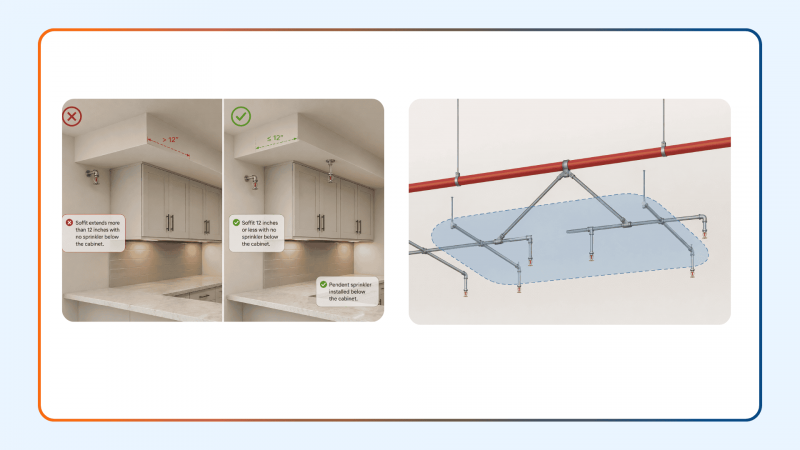
We do not have enough information to determine whether sprinkler protection is necessary in this location. You mentioned that the ceiling is flammable. However, no information is provided on whether the projection or overhang is built of combustible or non-combustible materials. The combustible vs. non-combustible issue determines the applicable section of NFPA 13. Section 8.15.7.3 may be applicable if the building materials are combustible and the exposed finish surface has minimal combustibility.
Insufficient information prevents us from determining if Section 8.15.1.2.18.2 applies. Based on the photograph, it appears that the space at the forefront is an outside projection. Other locations may qualify as overhangs and must adhere to Section 8.15.1.2.18 standards. NFPA 13’s exterior projection regulations, as well as sections on soffits, eaves, and overhangs, may apply to this case.
According to the CBC 2022 edition, stages larger than 1,000 square feet require a Class III standpipe on each side that meets NFPA 14 installation criteria.
Automatic fire sprinkler systems require only 1 1/2-inch hose connections. To install 1 1/2-inch hose connections on sprinkler systems, see NFPA 13 (2019 edition), Section 16.15.
The exemption in Section 905.3.4 specifies that hose connections must be accessible to reach all sections of the stage with 100 feet of hose and 30 feet of spray (total of 130 feet). The CBC allows for distances to exceed these limitations with approval from the AHJ.
Hose stations are designed to be used by trained occupants to control incipient flames on stage.
Some jurisdictions may omit this requirement for stages, as the International Fire Code and NFPA 1 Fire Code allow for the removal of fire hose and nozzles from 1 1/2-inch hose connections (Class II) with AHJ permission.
The building code requires fire-resistant assemblies to be tested using ASTM E119 standards. This standard specifies the materials needed for various fire ratings, including 1-hour, 2-hour, and 3-hour assemblies. ASTM E119 testing confirms that a single layer of 5/8 inch Type X gypsum board can withstand a 1-hour fire. Sprinklers may reduce the fire resistive rating, but they do not ensure a 1-hour or 2-hour fire rating for a barrier or wall.
Listed window sprinklers offer up to two hours of glazing protection. Section 703.4 of the International Building Code (IBC) allows for this exception, which differs from fire-resistant assemblies.
Courtesy: Roland Asp, CET, TechNotes