
The blog includes the most commonly asked question(s) pertaining to fire protection within our day-to-day operations with NFPA promulgated Standards.
This blog addresses a wide range of practical issues faced by Fire Protection Designers, Inspectors and Authority Having Jurisdiction (AHJ) as it pertains to the use of NFPA 13, 13D, and 13R in Projects built using modern technology. Topics include how to apply the use of Extended Coverage Sidewall Sprinklers at Overhead Garage Doors; Improvements to Performance of Dry Pipe Systems; Lithium-Ion Battery Storage; Considerations for Fire Protection of ESFR Sprinklers; and Spare Sprinkler Requirements; to name a few.
Also included in this blog are various clarifications of common misconceptions regarding Fire Protection Systems; for example: Must Older Fire Protection Systems be Brought up to the Current Standards? What is a Dwelling Unit as Identified in NFPA 13R? and Does a Riser Closet/Cubicles Require Sprinkler Protection? Additionally, the authors have provided clarification about Fire Pump Room Size, Omissions of Sprinklers on Exterior Projections, and Proper Placement of Deflectors When Constructing Concrete Tee’s.
The primary goal of this blog is to provide a clear understanding of intent, definition, and Annex Practical Guidance as it relates to NFPA Standards. Most of the interpretations are reinforcing that New Code Editions do not create New Requirements, but rather clarify past code editions
The blog can serve as an excellent resource for Fire Protection Professionals looking for Agreement and Consistency on how to Apply the Codes when Working with Complex or Non-Traditional Fire Protection Applications.
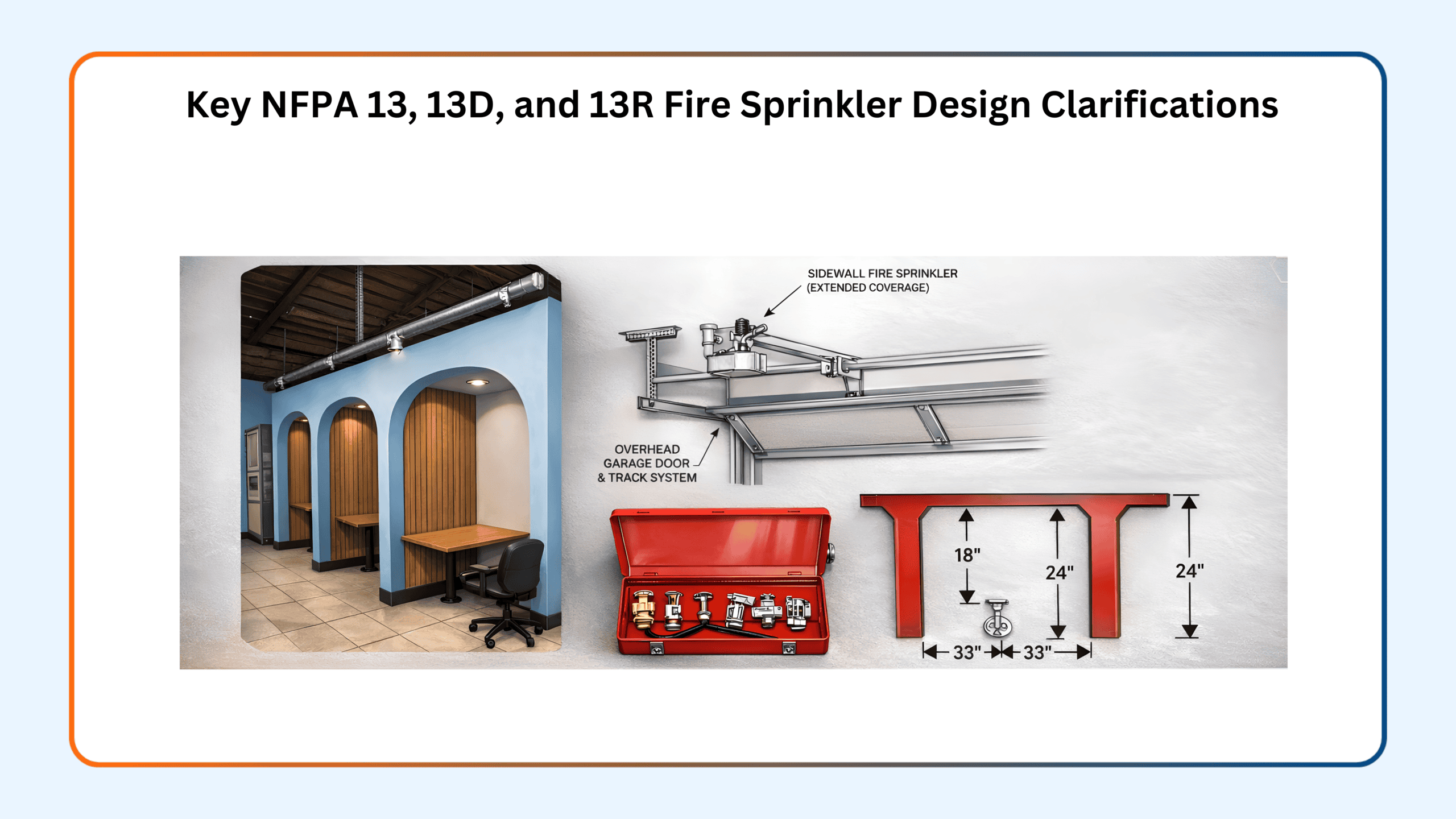
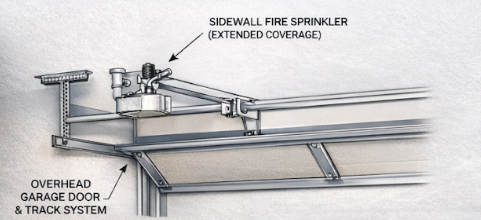
Question #1. A. Can you install extended-coverage sidewall sprinklers beneath above doors in an Ordinary Hazard occupancy?
- If so, can they be spaced according to the light-hazard spacing guidelines for extended-coverage sidewall sprinklers?
Answer: A. Yes. Although the 2013 edition of NFPA 13 does not expressly declare this permission, Section 8.9.5.3.2 (the EC sidewall section) states that sprinklers must be installed behind overhead doors. This notion was later addressed in the 2019 version of NFPA 13, where Section 11.3.2(8) indicates that extended-coverage sidewall sprinklers can be used to protect regions beneath a single above door.
- B. Yes. Like the first question, this limit is not expressly specified in the 2013 edition of NFPA 13. In the 2022 edition of NFPA 13, Section 11.3.4.1.4 states that listed light-hazard sidewall extended-coverage sprinklers can be installed to protect areas below overhead doors in Ordinary Hazard occupancy spaces or rooms. The protection area and maximum sprinkler spacing for light hazard are specified in Table 11.3.3.2.1.
While these principles are not specifically stated in the 2013 edition, the language in subsequent editions can be interpreted as clarification rather than a new requirement.
Question #2 – Is a sprinkler required for 13D systems in a riser closet that does not normally require fire sprinkler protection?
Answer: Sprinkler protection is not necessary in a closet placed within a garage simply because it has a sprinkler riser.
According to Section 8.3.8 of the 2019 version of NFPA 13D, sprinklers are not required in garage closets as long as there are no unprotected openings into the dwelling unit. Section 8.3.9 confirms this point by stating that sprinklers are not necessary in garage closets that hold heating equipment, washers, dryers, or water heaters.
A sprinkler riser does not represent any significant fuel load or ignition source. If sprinklers are not necessary in a garage closet containing equipment with a much higher fire potential, then they are also not required in the presence of a sprinkler riser.
Question #3 – Is it permissible to put an exhaust valve on the cross main, separate from the dry pipe valve, to accelerate water delivery? This presupposes an accelerator has already been fitted in the dry pipe valve trim.
Answer: Section 7.1.1.2 of NFPA 13, 2019 edition, demands the listing of equipment essential to a fire sprinkler system. Exhaustors for fire sprinkler systems have not been put on new systems in decades, and our study does not indicate whether there are listed exhausters available for new sprinkler systems.
The inquiry claims that an accelerator is put at the valve assembly. Section 8.2.3.6 establishes a maximum water delivery time for dry-pipe systems based on system size and the presence of a quick-opening device (QOD):
- There is no maximum water delivery time for containers of 500 gallons or less.
- Size: 500-750 gallons; maximum water supply time: 60 seconds.
- Over 750-gallon size (without QOD) – 60 seconds maximum water delivery time.
- Over 750-gallon size (with QOD), no maximum water delivery time.
The reason for wanting to install an exhauster in addition to an accelerator is unknown. With an accelerator, the system would most likely meet the water supply criteria of NFPA 13. Exhausters, once fitted, were difficult to modify and maintain.
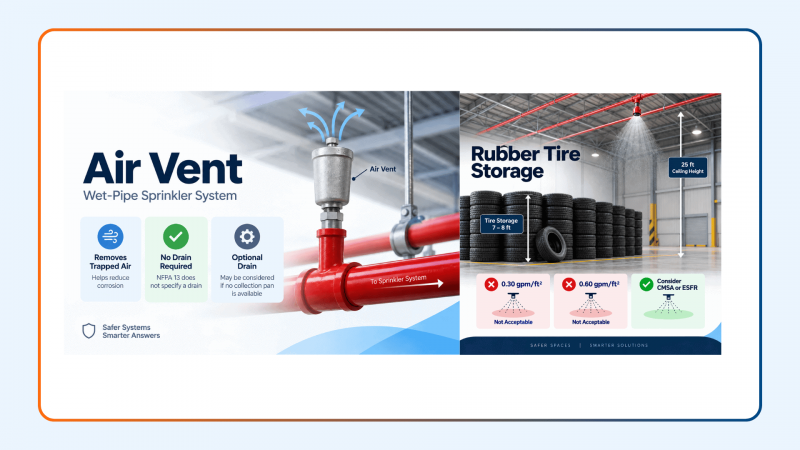
Question #4 –Are there the same worries for open top “buckets” as there are for ESFR systems’ storage “open top container”?
Answer: It depends; according to the definition of Open-Top Containers in Section 3.3.156 of the NFPA 13 2025 edition, open-top buckets may be termed Open-Top containers.
This section defines an open-top container as having the following characteristics:
- Of any shape
- Fully or partially open at the top.
- can gather sprinkler discharge water that runs down through the storage array.
This definition appears to apply to the open top bucket; however, the annexe to this definition suggests that “consideration should be given to the potential degree of water collection possible within the container when applying the definition of an open-top container.” This implies that the designer must consider the number of buckets and the potential amount of water collection that may occur.
Question #5 –A client plans to store e-bikes and e-scooters with lithium-ion batteries in their original packaging, with no charging taking place on-site. Does NFPA 13 specify sprinkler design standards for this type of storage arrangement?
Answer: Unfortunately, NFPA 13 and prescriptive codes in general do not currently include detailed sprinkler design criteria for lithium-ion battery storage. The 2024 version of the International Fire Code, Section 903.3.1.1.3, specifies sprinkler design standards for battery-containing areas to be based on fire testing. NFPA 855 provides some guidelines for lithium-ion battery storage; nevertheless, its scope is confined to energy storage systems, and the accompanying criteria are designed for battery cells used in those systems, rather than consumer devices such as e-bikes or e-scooters.
FM Global Data Sheet 7-112 includes prescriptive design guidelines for lithium-ion battery storage. If the storage comprises batteries installed in e-bikes, FM Global refers to Data Sheet 8-9 for the necessary protection criteria, which are based on the overall commodity classification and assume the e-bike batteries have a charge level of 60% or less. Although FM Global data sheets are rarely adopted by countries, they are frequently employed when no alternative criteria exist, and because FM recommendations are based on fire testing, they meet the intent of IFC 2024 Section 903.3.1.1.3.
However, NFPA 13, 2019 version, Section 9.2.10, may permit sprinklers to be deleted. Although the cubicles meet several of the criteria in that section, they do not appear to be “isolated” from one another, implying that sprinkler discharge can reach the floor throughout the whole circumference of the enclosure.
Question #6 –Do these cubicles need sprinkler protection?
Answer: Sprinkler protection appears necessary based on the provided description (4 feet x 5 feet cubicles with ceilings, no doors, not isolated from each other).
NFPA 13 does not provide an explicit provision allowing sprinklers to be removed from these types of locations. Section 9.2.10, Small Temporarily Occupied Enclosures, is the most likely applicable section; nevertheless, as previously said, this (which was attended for lactation stations, hearing booths, and so on) requires these enclosures to be isolated. As explained, these cubicles do not meet this requirement because they are directly adjacent to one another.
The committee intended to split each enclosure so that ceiling-level sprinkler discharge could reach the floor from all sides. The configuration displayed does not satisfy that goal.

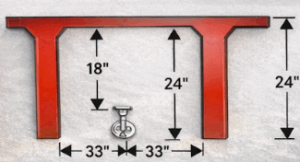
The inspector wants the sprinkler deflectors to be installed 1 inch below the tee—about 25 inches below the deck—but we can’t find any code wording that says this.
Question #7 –Please ensure that our proposed installation is compliant with Section 10.2.6.1.2.
Answer: Yes, according to the diagram, your installation looks to conform with NFPA 13, 2019 edition, Section 10.2.6.1.2(2).
Section 10.2.6.1.2 specifies the appropriate sprinkler deflector placements for standard spray upright and pendant sprinklers in blocked construction.
Option (2) allows the deflector to be set at or above the bottom of the structural element, up to a maximum of 22 inches below the deck, as long as the installation also meets Section 10.2.7.1.2.
Section 10.2.7.1.2 (the “beam rule”) states that if the deflector is put up to 6 inches above the bottom of the obstacle, it must be at least 2.5 feet away from the leading edge of that obstruction.
Based on the information provided, these conditions are met, hence the installation is in accordance with Section 10.2.6.1.2(2).
However, Section 10.2.6.1.2(5) offers an additional compliance option.
This section allows sprinklers under concrete tee construction with stems spaced less than 7.5 feet on centre to have deflectors situated at or above a horizontal plane 1 inch below the bottom of the tee stems, regardless of tee depth, if Table 10.2.7.1.2 is used.
In your example, option (5) would place the deflector roughly 25 inches below the deck, which is what the AHJ requires.
It is vital to note that Section 10.2.6.1.2 allows compliance with any of the mentioned choices. In this scenario, you may comply with items (2) or (5) at the discretion of the designer.
To raise awareness, the 2025 edition changes item (5) to apply only when tee stems are 30 inches deep or less, and requires compliance with updated Tables 10.2.8.2(a) or (b).
Question #8 –Given these circumstances, is it allowed to exclude sprinklers below outside projections in line with NFPA 13, 2016 edition, Section 8.15.7.3?
Answer: Yes. According to Section 8.15.7.3 of NFPA 13, the omission of sprinklers beneath the outside projection is permissible based on the given parameters. Sprinklers may be deleted under outside projections of combustible construction if certain criteria are met. The exposed finish material must be noncombustible, limited-combustible, or fire-retardant-treated wood, and the projection may only include sprinklered concealed spaces or one of the permissible unsprinklered concealed space conditions.
This includes:
- Combustible concealed spaces must be completely filled with noncombustible insulation.
- Light or ordinary hazard occupancies with a noncombustible or limited-combustible ceiling attached to the bottom of wood joists, resulting in joist spaces of 160 ft³ or less,
- or concealed spaces over isolated exterior projections less than 55 ft² in area.
In this scenario, the wood-truss concealed compartment will be sprinklered, while the metal liner provides a noncombustible exposed finish. As a result, the requirements of Section 8.15.7.3 are met, and sprinklers can be deleted below the external projection.
Question #9 –NFPA 13R, 2019 edition, Section 6.2.1.3 allows for the use of up to four quick-response sprinklers within a dwelling unit that fits the criteria of a compartment. Clarification is sought as to whether the entire apartment, including the living room, bedroom, kitchen and bathroom, comprises a single dwelling unit, or if each individual enclosed room within the apartment should be treated as a distinct dwelling unit for the purposes of this section.
Answer: The standard’s purpose is for the entire flat to serve as the housing unit. Individual rooms or compartments inside an apartment are not considered separate dwelling units under NFPA 13, 2019 edition, Section 6.2.1.3.
Section 6.2.1.3 allows the use of listed quick-response sprinklers in dwelling units that fit the definition of a compartment, as long as the dwelling unit does not contain more than four sprinklers.
Section 3.3.5 defines a housing unit as one or more rooms designed for the purpose of one or more people living together as a single housekeeping unit, complete with cooking, living, sanitary, and sleeping amenities.
According to Section 3.3.3, a compartment is a space completely enclosed by walls and a ceiling. Openings to adjacent spaces are authorised as long as they meet particular lintel-depth and total-width requirements.
Because the entire apartment must be classified as a dwelling unit, only four sprinklers can be installed for the quick-response substitute allowed by Section 6.2.1.3. If more than four sprinklers are needed throughout the dwelling unit, residential sprinklers can be employed
Question #10 –When examining a fire sprinkler system more than 20 years old, is it merely failed because it does not meet current criteria, or is the building owner obligated to replace the NFPA 13D system to conform with the most recent version of the installation standard?
The system in question is 13-dimensional.
Answer: Before addressing this subject explicitly for NFPA 13D systems, it is vital to establish a basic principle: NFPA 25 does not have the authority to require an existing system to meet current installation criteria.
NFPA 25 is a maintenance standard that focusses on the operational status of an existing system. No NFPA installation standard, including NFPA 13, 14, 20, and others, requires an existing system to be upgraded to the latest edition. Any such requirement would be derived from a building code or a state/local ordinance, which are normally activated only when a building is renovated.
Remember that codes specify required actions, such as system installation or upgrading.
Standards determine how things must be done.
NFPA 13 regulates system installation, while NFPA 25 supervises system maintenance.
Additional points:
- NFPA 25 does not generally apply to NFPA 13D systems unless the facility comes under Chapter 16, Special Requirements from Other Standards (often modest board-and-care facilities). This is explained in NFPA 25 Section 1.1.5.
- The inspection and testing standards in NFPA 13D are fairly limited, as described in Chapter 12.
- Most NFPA installation standards, including NFPA 13D, include retroactivity (“grandfather”) clauses. This means that existing systems do not need to be upgraded just due to age. Repairs are carried out in line with the edition under which the system was originally installed, unless the AHJ considers that an intolerable level of risk requires upgrades.
- NFPA 25 does not contain a retroactivity clause. Regardless of when a system was installed, it must be kept in compliance with the most recent version of NFPA 25 (or the edition officially adopted by the jurisdiction).
Question #11 –Is there a minimum size for a fire pump room?
Answer: There is no minimum size for a fire pump room specified as a fixed dimension in the standards. However, certain parameters must be completed to establish the minimum size of a fire pump room.
- The room must have sufficient space for installing, operating, and maintaining the fire pump and accompanying equipment, as per the instructions. This includes plumbing, valve, and gauge clearances, as well as NFPA 70-compliant electrical equipment spaces. The layout must ensure that all valves are accessible and the gauges are legible.
- The fire pump room doors should be large enough to enable for the removal of the largest piece of equipment (such as the fire pump or controller) without the need to dismantle or disassemble fire-resistant walls. This is to ensure that the fire-rated enclosure remains intact.
- There should also be an unobstructed passage for moving equipment into and out of the room, which may influence the room’s placement and access points.
- To reduce turbulence, there should be enough area to bring in the suction pipes without making large curves or fittings. Refer to Section 4.16.6.3 of the 2025 edition of NFPA 20.
Question #12 –A project was rejected under Section 6.2.9.5 of the 2016 edition of NFPA 13. The inspector interprets this clause as stating that the number of sprinklers of each type placed in the facility determines the number of spare sprinklers necessary.
Because two sprinkler types have fewer than 300 installed, he uses Section 6.2.9.5(1) to require six spare sprinklers for each kind. One sprinkler type has more than 300 installed, thus he applies Section 6.2.9.5(2) and requires twelve spare sprinklers for that kind.
Under this view, a facility with fewer than 1,000 total sprinklers is obliged to keep 24 spare sprinklers.
Answer: No. Before delving into the interpretation of Section 6.2.9.5 of NFPA 13, 2016 edition, it is necessary to first study Section 6.2.9.1. Section 6.2.9.1 requires a minimum of six spare sprinklers on the premises, and Annex A.6.2.9.1 specifies that at least two sprinklers of each type and temperature rating shall be present.
Returning to Section 6.2.9.5, the language relates to the total number of sprinklers in the facility, not the total number of sprinklers by kind. As a result, if the facility has more than 300 but fewer than 1,000 sprinklers, Section 6.2.9.5(2) requires the spare cabinet to have a minimum of 12 spare sprinklers rather than 24.
At least two of each type shall be given among the 12 spare sprinklers, in accordance with the Annex guidelines.

Understanding NFPA codes entails more than simply reading the standards; it necessitates practical interpretation based on specific applications. The FAQs in this blog address common but often misunderstood parts of fire protection system design, installation, and inspection. Whether you’re working on a two-story office building, a multi-residential construction, or a specialised warehouse, being up to date on NFPA guidelines assures safety and code compliance. Bookmark this blog and share it with your fire protection network to receive regular updates, case-based explanations, and expert insights.
Courtesy: Roland ASP, CET NFSA Technotes.