
Introduction: Changing business needs and public comments are guiding NFPA 25, the standard for inspecting, testing, and maintaining water-based fire prevention systems, towards Some of the significant proposed enhancements and changes under discussion will be covered in this blog article.
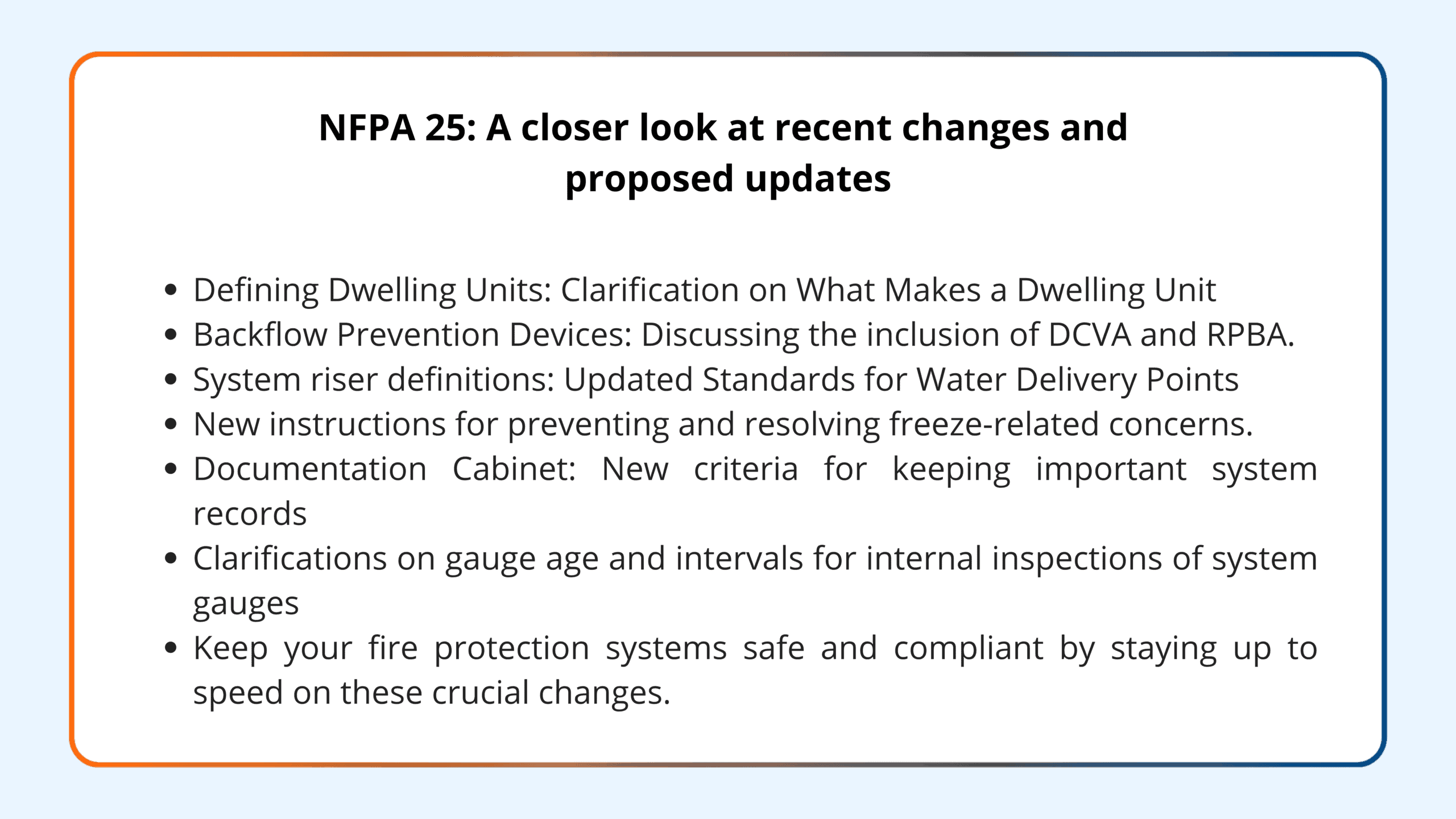
Among the most hotly contested subjects is the definition of a “dwelling unit.” A clear definition would help to promote uniformity and clarity, according several public remarks. This topic was discussed back and forth, and because of insufficient data the committee opted to reject the first proposals. Still, the issue is still under discussion as the public comment period runs.
The definition of backflow preventing devices also comes under more focus. Public comments have pushed for the elimination of less often inspected references to Double Check Valve Assemblies (DCVA) and Reduced Pressure Backflow Assembly (RPBA). Although the standard does not particularly address these devices, their placement in an annexe has caused concern.
Suggested changes cover the definition of a system riser, guidelines for frozen systems, maintenance plans, the need of a documentation cabinet, system gauges, and internal inspections of several kinds of sprinkler systems. These changes are meant to make water-based fire protection systems more safe, clear, and effective.
It’s important to be aware of the revisions as they work through and how they can affect your company. Though for the most current information, do consult the official NFPA 25 standard; this page offers a quick overview of some of the significant advancements.
Repair Timelines: PI No. 16 suggests repair times for critical, non-critical, and degraded systems. The NFPA 1 Fire Codes for 2021 and 2024 have similar compliance standards. The technical committee’s remarks led to the rejection of the original PI language, which will be addressed in the second edition. The committee will consider the amended language during its September 2nd draft meeting.
Internal Inspections: Public feedback was received about internal inspections of dry, precipitation, and deluge systems. Currently, dry pipe valves must be opened annually, regardless of how they are reset. Preaction and deluge valves can be inspected inside every 5 years if reset externally. Although the first two updates remove the 5-year internal restrictions, the standard still requires annual valve openings. After acceptance, a PI becomes a First Revision (FR) and is approved by the committee through a ballot process.
Conclusion: As NFPA 25 evolves, it is important to stay up to date on the most recent modifications and how they may affect your organisation. The improvements mentioned in this blog article cover critical topics such as dwelling unit definitions, backflow protection devices, system riser definitions, and inspection requirements.
Understanding these updates allows you to guarantee that your water-based fire protection systems are inspected, tested, and maintained in accordance with the most recent requirements. This not only protects your property, but also the lives of those who dwell in your building.
It is suggested that you evaluate the NFPA 25 standard on a regular basis and consult with trained professionals to stay current on new developments and ensure that your systems satisfy all applicable standards.
Courtesy: Vincent, NFSA’s Inspection, Testing, and Maintenance Specialist