
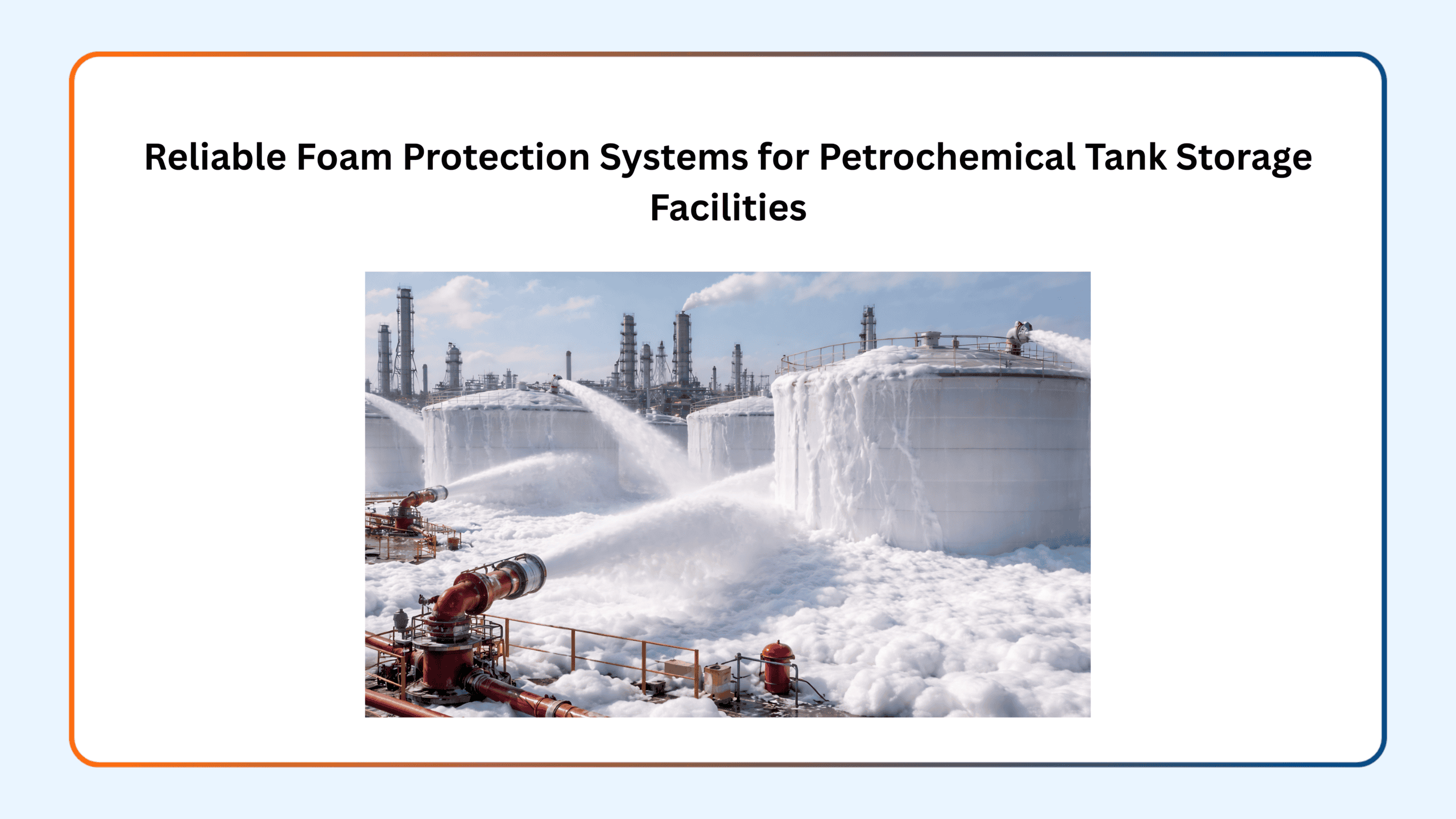
Tank farms are oil and petrochemical product storage facilities that contain large amounts of fuel and vapour that can cause serious fire safety hazards. Firefighting foam is still the most effective way to extinguish fires in these facilities because it cools burning fuel, suppresses vapors, and prevents the flames from coming back once the burning material has cooled down. This article highlights the importance of having access to foam systems in tank farms, how foam systems work, and what you need to keep in mind regarding their design/installation maintenance for foam systems at tank farms to perform reliably.
Introduction
While storage tank fires in the oil and petrochemical industries are rare occurrences, they are among the most destructive fires that can happen. Once a storage tank fire has started, the fire can spread quite rapidly across the tank surface and overflow from the bund into the surrounding area that may contain still other storage tanks and fire. Large petroleum facilities and large refineries have proven that when these types of fires occur, the incidents often escalate and result in consumption of much larger firefighting resources than anticipated.
Unlike water only, foam is the proper product when it comes to fighting flammable liquid fires. Foam creates a cohesive and uniform blanket over the burning liquid and is capable of cooling and separating the burning liquid from the oxygen (which absorbs heat and can become flammable) thereby interrupting combustion and preventing re-ignition if re-ignition were to occur.
Foam systems are the primary means of fire protection for Class B hydrocarbons and other flammable fuels found at tank farms. Therefore, foam systems are the most common fire protection systems used throughout the world in all types of tank farms, refineries, terminals, and petrochemical facilities.
The Role of Foam in Tank Farm Fire Protection
Why Foam Is Essential for Hydrocarbon Fires
Water is often ineffective or dangerous when applied directly to burning fuel because it can boil, spread the fire, or cause fuel overflow. Foam, however, creates a protective barrier that prevents vapour release and oxygen contact.
For this reason, foam is widely considered the preferred extinguishing agent for liquid fuel fires in tank farms and similar high-hazard facilities.
Low-expansion foams are especially effective for tank fires because they form dense, stable blankets capable of covering large liquid surfaces and suppressing vapours for extended periods.
How Firefighting Foam Works
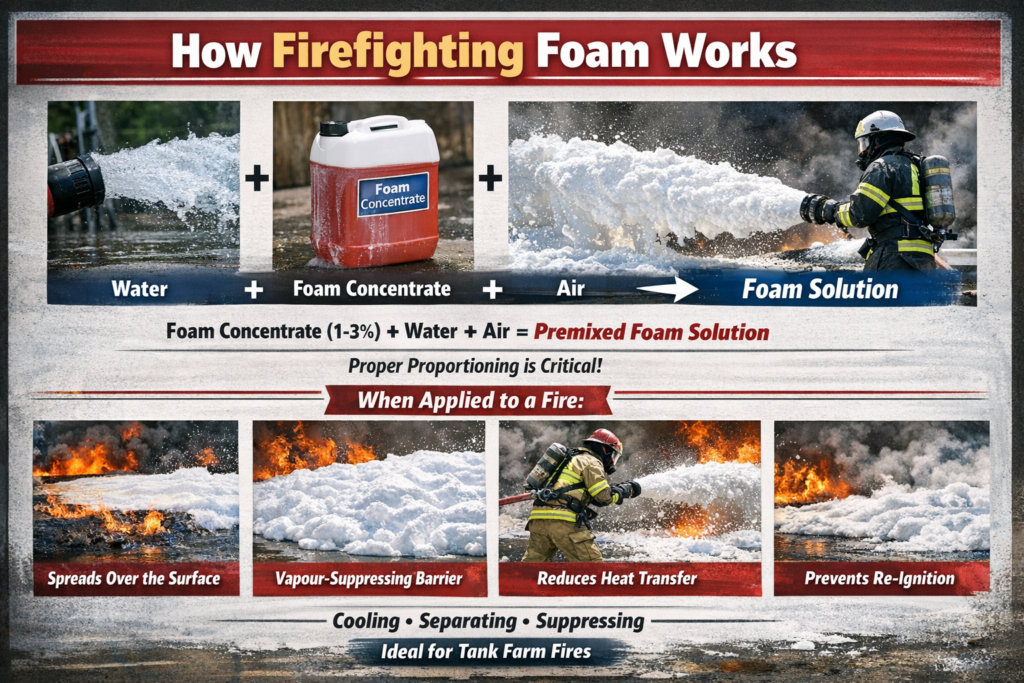
Firefighting foam is produced by mixing three key components:
- Water
- Foam concentrate
- Air
The concentrate is dosed into the water stream at a set rate (generally between 1% and 3%) and mixed into a premixed solution using air (which expands the liquid into a foam). Getting the proportioning right is critical because not enough concentrate can produce an unstable foam, and too much will waste resources.
When applied to a burning liquid, foam:
- Spreads over the liquid surface
- Forms a vapour-suppressing layer
- Reduces heat transfer
- Prevents re-ignition.
The three functions of foam (cooling, separating and suppressing) make it particularly suitable for use in tank farm fire situations.
 Foam System Technologies in Tank Farms
Each industrial facility has a variety of foam proportioning systems, and each of these different systems has unique advantages and disadvantages.
Bladder Tank Proportional Systems are one of the most common types of foam proportioning systems. A bladder tank is a pressurized vessel in which the foam concentrate is located within an internal bladder. When the tank is filled with water, the pressure in the tank pushes the foam concentrate through the proportioner and mixes it with the water that is coming out of the tank.
Bladder tank proportioning systems are very popular for a number of reasons:
- Simple Mechanical Design
- Do Not Require External Power
- Dependable & Repeatable Proportioning
The downside to bladder tank proportioning is that foam concentrate can become contaminated when the bladder is damaged, and it is necessary to drain the entire system in order to refill the bladder, reducing operational readiness.
Pump-Based Proportioning Systems
In many cases, more modern systems use pumps that have foam concentrate controlled by electric controls and operate independently of any external foam-concentrate reservoir. These proportioning systems measure the water flow, then adjust the injection of the foam concentrate according to the measurement. Because the systems adjust proportionately based on the flow rate of the water, the foam concentrate is delivered to the surface of the tank at the same proportion regardless of any changing fire fighting demand during either day or night.
Foam Application Methods
Foam can be applied to storage tank fires in several ways:
- Fixed foam chambers delivering foam directly onto tank surfaces
- Foam monitors capable of projecting foam from a safe distance
- Mobile firefighting systems for bund or spill fires
Foam Monitors can also be used to cool tanks or the walls of tanks that are adjacent to a fire to prevent the tanks from causing a secondary fire due to the boiling over of the product within the tanks.
A properly designed tank farm will have both fixed and mobile foam delivery systems to provide redundancy and flexibility for emergency situations.
Foam Types Used in Petrochemical Facilities
Different fuels require different foam types.
- AFFF (Aqueous Film Forming Foam) is able to produce a thin layer over hydrocarbon fuels and extinguish vapours quickly.
- Alcohol resistant foams work with fuel that has polar solvents mixed in, which could compromise a standard foam blanket.
- More and more people are using fluorine free foams because of the environmental issues surrounding PFAS chemicals.
It is necessary to choose the appropriate type of foam in order to achieve effective suppression during an emergency as well as to comply with relevant laws and regulations.
Design Considerations for Tank Farm Foam Systems
When designing foam protection for storage facilities, engineers must evaluate:
- Tank size and configuration
- Fuel type and volatility
- Required foam application rates
- Water supply capacity
- Bund area drainage and containment
The scale of tank fires means that large foam volumes may be needed for sustained suppression. Historical incidents have shown that massive quantities of foam may be required for extended firefighting operations.
Proper system design ensures sufficient foam concentrate storage, reliable delivery infrastructure, and integration with site firewater systems.
Maintenance and Testing Importance
Even the most sophisticated foam system is ineffective if poorly maintained. Regular inspection and testing ensure:
- Correct proportioning rates
- Functional pumps and valves
- Adequate foam concentrate quality
- Reliable system activation
Routine maintenance and testing are essential to ensure foam systems operate as intended during emergencies.
Closing Thoughts
Tank Farms Fires are one of the most difficult and dangerous environments to fire in the industrial world. The potential for these fires to grow out of control and cause environmental damage or shut down manufacturing operations makes having good fire protection critical.
Foam is the most effective method of extinguishing fires at hydrocarbon storage facilities since it deals with the basic nature of liquid fuel fires. Foam creates a vapor-suppressing/cooling blanket over the fire that enables it to be controlled and to protect people, property and the infrastructure around them.
In today’s environment in petrochemical facilities, a trend towards more reliable foam proportioning systems, eco-friendly foam types and fire protection strategies is emerging. With proper design, testing and maintenance, foam systems will continue to be the linchpin to safe industrial fire protection and support tank farm fires around the world.
Courtesy : Jake Dowling
Fire System Project Manager, Rotaflow