
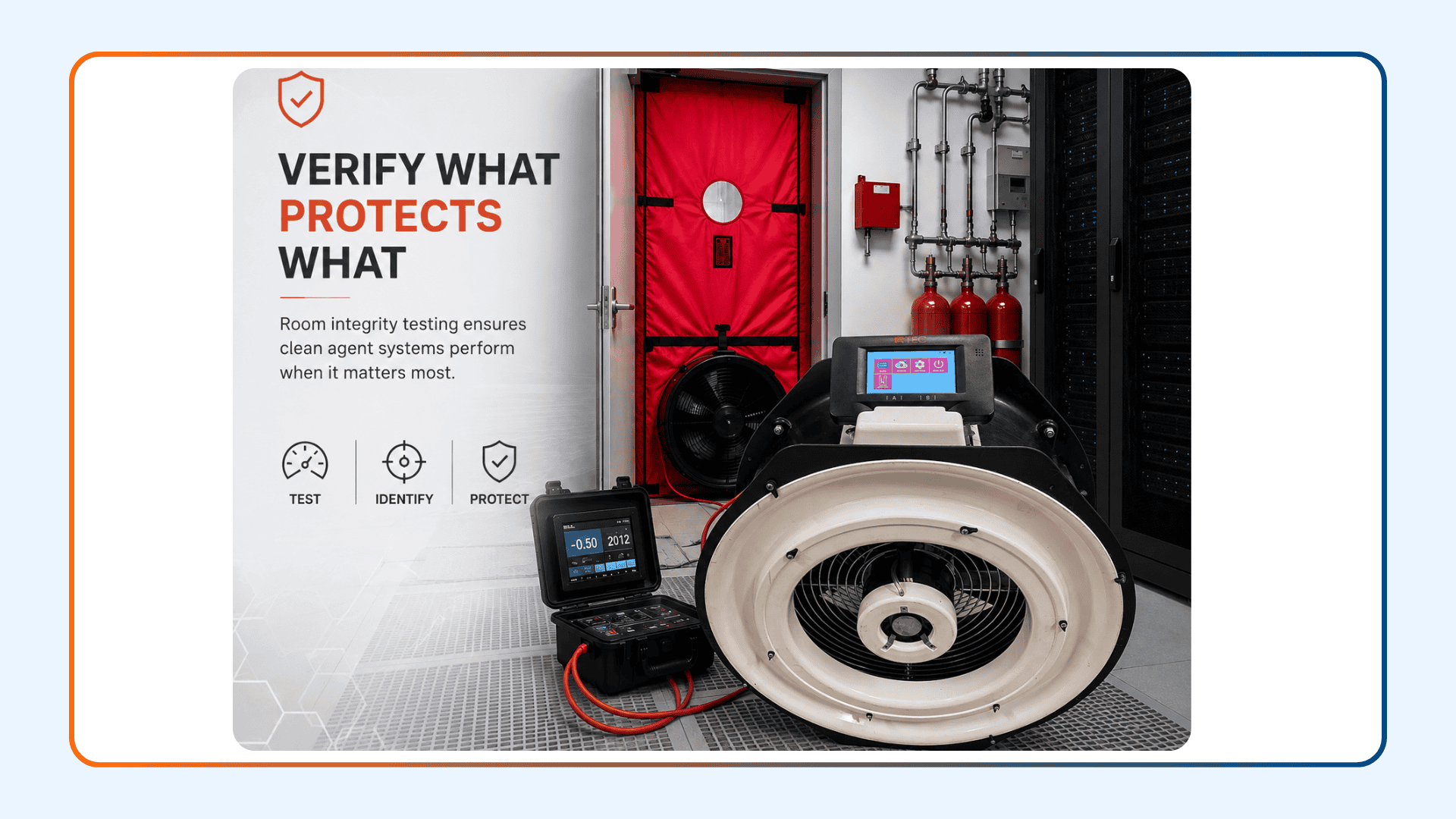
Most facility managers assume that once a clean agent fire suppression system is installed, the job is done. The cylinders are charged, the piping is run, the nozzles are in place surely that’s enough to protect the server room or electrical vault. In reality, none of that matters if the room itself can’t hold the agent long enough to do its job. That’s what room integrity testing is for, and it’s one of the most overlooked services in fire protection maintenance.
What Room Integrity Testing Actually Checks
Clean agent systems the gaseous suppression systems used in server rooms, data centres, control rooms, and electrical enclosures work by flooding a space with an extinguishing agent and holding it there long enough to fully suppress a fire and prevent it from reigniting. NFPA 2001, the governing standard for clean agent extinguishing systems, requires that at least 85% of the design concentration be maintained at the highest level of combustibles for a minimum of 10 minutes (20 minutes for CO2 systems).
The catch is that almost every protected room has penetrations that weren’t part of the original design: cable trays, conduit runs, HVAC ductwork, cut-outs for new equipment, gaps around raised floors. Every one of those is a potential leak path. If the room leaks too fast, the agent concentration drops below the effective threshold before the fire is out and the system that was supposed to protect the space quietly fails at the moment it matters most.
Room integrity testing, often called a door fan test or blower door test, is the only way to verify this before there’s ever a real fire. A calibrated fan is temporarily sealed into the room’s doorway and used to pressurize and then depressurize the enclosure, while instruments record the airflow needed to maintain each pressure differential. That data feeds into modeling software that calculates the room’s leakage area and predicts how long the space would actually hold the clean agent if the system discharged. No agent is released and no equipment is put at risk the entire test is non-destructive.
Why This Test Gets Skipped and Why That’s a Problem
Room integrity testing tends to fall through the cracks for a simple reason: it’s invisible until something goes wrong. Unlike a fire alarm test or a sprinkler flow test, there’s no obvious visual confirmation that a room is compromised. A server room can look perfectly sealed and still fail to hold agent for the required time, especially after IT teams have run new cabling, contractors have cut new penetrations for equipment upgrades, or a renovation has altered the ceiling plenum.
This is exactly why the test isn’t a one-time commissioning checkbox. It should be performed when a clean agent system is first commissioned, again after any renovation or significant change to the room, and on a recurring schedule after that because a room that passed five years ago isn’t guaranteed to pass today. A facility that skips retesting is often relying on a suppression system that was only ever proven to work in the room’s original condition, not its current one.
What Happens If a Room Fails
A failed room integrity test doesn’t mean the fire suppression system itself is faulty it means the room around it can’t do its part. The good news is that this is almost always fixable. Once leakage points are identified through the test, technicians can seal penetrations, replace worn door seals, add pressure relief venting where needed, and retest until the room reliably holds the required concentration for the full retention period. The alternative leaving it unaddressed means a facility believes it’s protected when, in the event of an actual fire, the agent could dissipate before the fire is fully suppressed.
Why This Matters for Data Centres and Mission-Critical Facilities
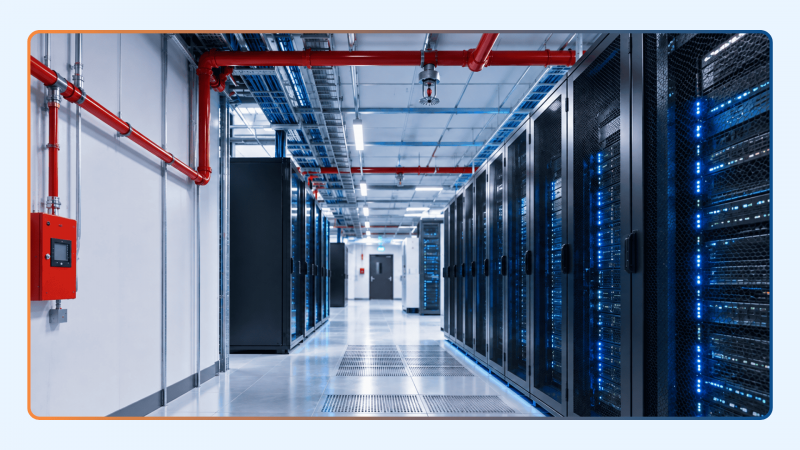
Nowhere is this more important than in server rooms and data centres, where clean agent systems are chosen specifically because they extinguish fires without damaging sensitive electronics the way water-based suppression would. But that advantage only holds if the room integrity is verified. A data hall with unnoticed leak paths around cable penetrations or raised floor tiles can look fully protected on paper while actually falling well short of the retention time it needs.
For any facility running clean agent protection server rooms, control rooms, telecom vaults, electrical rooms room integrity testing is the piece of verification that turns “we have a fire suppression system” into “we know our fire suppression system will work.”
Rotaflow’s Room Integrity Testing Services
Rotaflow provides room integrity testing as part of our broader inspection, testing, and maintenance services across Alberta. Using calibrated door fan testing equipment and industry-standard modeling software, our technicians verify that protected enclosures meet NFPA 2001 retention requirements whether that’s a newly commissioned data hall, a control room after a renovation, or a routine retest on an existing system. If a room doesn’t pass, we identify the leak paths and provide practical sealing recommendations, then retest to confirm compliance.
If your facility has a clean agent suppression system and it’s been more than a year since its last room integrity test or if you’ve had any recent construction, cabling work, or renovations near a protected room it’s worth having that verified before it becomes a problem. Contact Rotaflow to schedule a room integrity test or to learn more about our clean agent inspection, testing, and maintenance services.
Article written by Hamid Shami, Lead Engineering Rotaflow.