
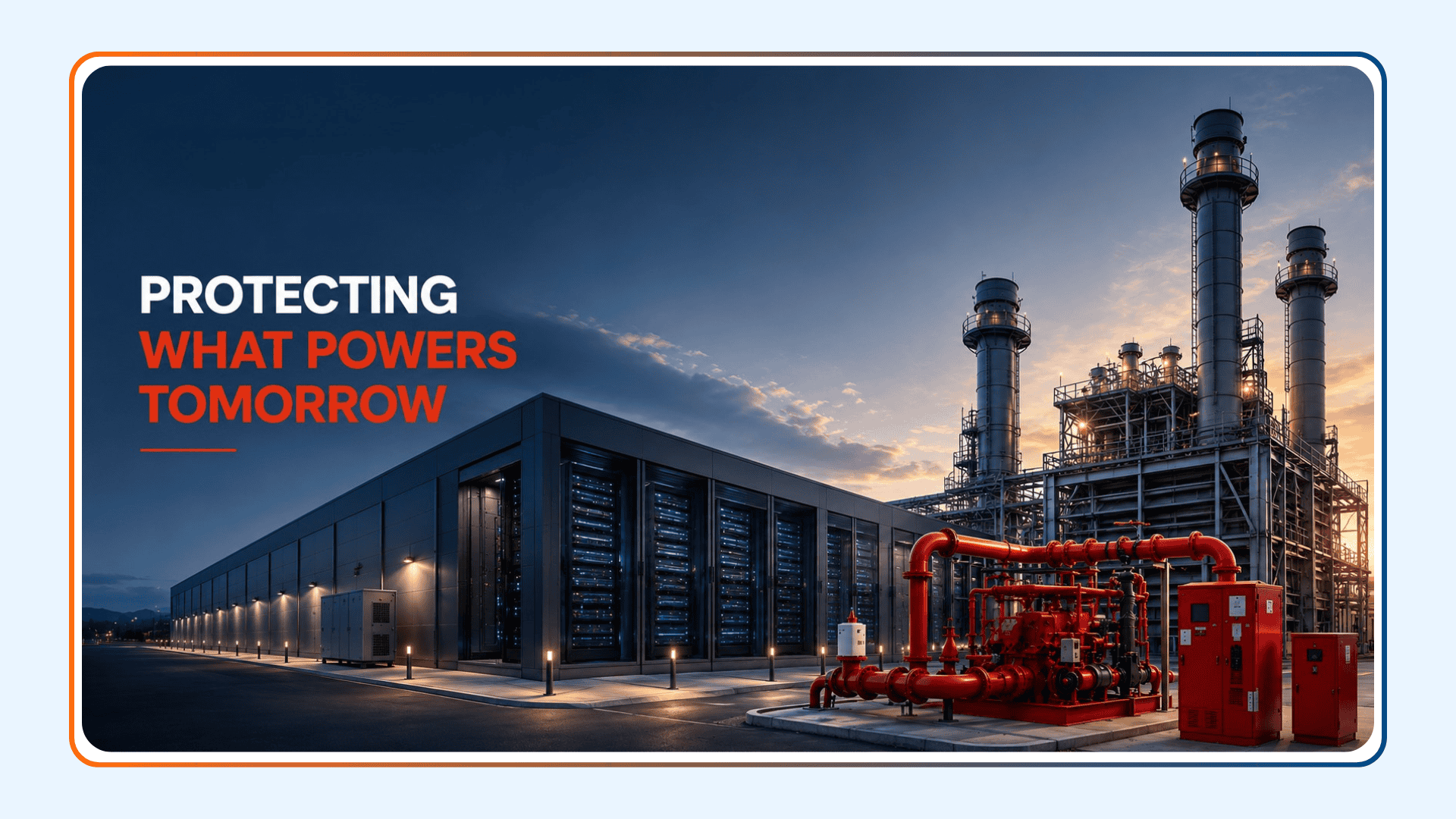
Alberta is in the middle of an infrastructure buildout that hasn’t been seen in the province before. Hyperscale data centres, AI-optimized computing campuses, and the natural-gas power plants built to feed them are moving from announcement to construction all along the Industrial Heartland corridor near Edmonton. For a fire protection contractor, this isn’t a one-off opportunity — it’s the start of a new category of project in our own backyard.
These facilities don’t behave like a typical commercial building. A data hall runs at full load, every hour of every day, and a single unplanned shutdown can mean millions in losses and a very public service disruption. The power plants built to support them carry their own risks — turbines, transformers, switchgear, and fuel systems that each demand a different protection strategy. Owners, EPC contractors, and consulting engineers building these projects aren’t just looking for a fire protection installer. They’re looking for a partner who can carry a project from early design through commissioning and stay on for the life of the facility.
Rotaflow has spent more than 30 years doing exactly that for industrial clients across Western Canada, and this new wave of mission-critical construction plays directly to that experience.
Why Data Centres Need a Different Approach to Fire Protection
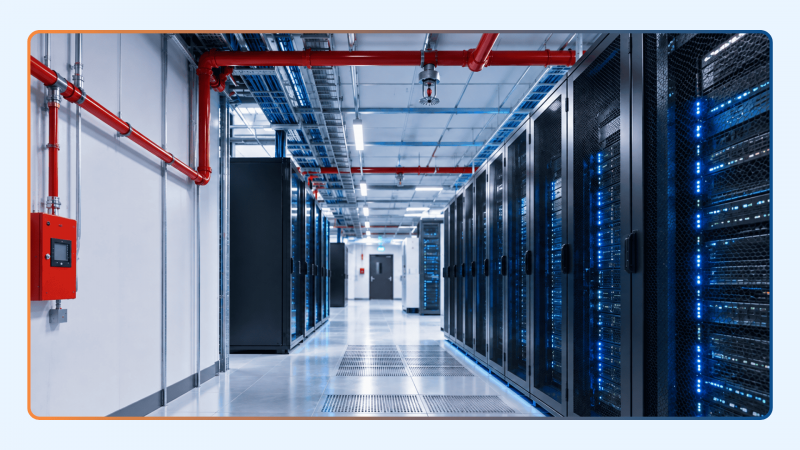
Data halls are dense with equipment that conventional commercial fire codes were never really written around: high-density server racks, layered electrical distribution, battery energy storage, and telecom infrastructure that all have to keep running without interruption. Meeting code is the floor, not the goal. The real objective is to catch a problem early, contain it without destroying the equipment it’s meant to protect, and keep the facility operating through the event.
That starts with detection. Overheating cabling, failing batteries, or stressed electrical components tend to smoke well before they produce visible flame, so early-warning detection technology gives operators a window to intervene before a minor issue becomes a shutdown.
Suppression is where the real engineering judgment comes in. Pre-action sprinkler systems have become the standard approach for data halls because they add a layer of protection against accidental discharge — water only flows once both a detection event and a sprinkler activation confirm an actual fire, which matters enormously in a room full of servers. NFPA 75, the standard governing protection of information technology equipment areas, shapes a lot of these decisions, and clean agent suppression is often layered in for the most sensitive electrical and control rooms. None of it works in isolation — firewater supply, fire pumps, underground mains, and the fire alarm system all have to be engineered, installed, and tested as one coordinated system, not a collection of separate products.
The Power Side Carries a Different but Equally Serious Risk Profile
Every data centre of this scale needs power to match, and increasingly that means new natural-gas generation being built alongside it. A power plant’s fire risks look nothing like data hall’s: turbines, transformers, generators, substations, fuel handling, cable tunnels, and lubrication systems each bring a distinct hazard that usually needs its own protection strategy layered into a single integrated system.
Deluge systems remain the backbone for protecting transformers and turbine areas, backed by firewater storage, underground mains, hydrants, and fire pumps sized to the specific hazard. Depending on the equipment involved, foam suppression or gas detection may be layered in where standard sprinklers aren’t the right tool. As with data halls, none of this can be bolted on late — it has to be engineered alongside the mechanical, electrical, and controls design from early in the project, or it ends up costing far more to retrofit later.
Why One Partner for Both Sides Is Rare — and Valuable
Most fire protection contractors are comfortable on one side of this equation: either mission-critical building systems or heavy industrial and power infrastructure. Very few firms can credibly speak both languages on the same project.
That’s the gap Rotaflow is built to fill. Our background is in complex industrial environments — oil sands, midstream, and heavy processing facilities where firewater systems, deluge protection, and special hazard suppression are everyday work. Layered on top of that is the fire alarm, detection, and life-safety expertise that mission-critical facilities like data centres require. Rather than bringing in one specialist for the building and a different one for the power plant, an owner or EPC contractor can work with a single team across both scopes: engineering, in-house fabrication, ULC-listed fire alarm capability, suppression system installation, integrated commissioning under standards like ULC-S1001, and long-term inspection, testing, and maintenance once the facility is operating.
That combination cuts down on the coordination headaches that come with managing separate vendors for the data centre and the power plant, and it means one relationship carries through from concept to years of ongoing service.
Why It Matters That This Partner Is Based in Alberta
Advanced fire protection technology only gets a project so far. Knowing how Alberta’s building and fire codes actually get interpreted, what a given Authority Having Jurisdiction expects to see, and how local trades coordinate on site is what keeps a project moving instead of stalling in redesigns and approval delays.
That local knowledge pays off long after construction wraps, too. Mission-critical facilities need a fire protection partner who can respond quickly for inspections, preventive maintenance, testing, and emergency service — not one working the file remotely from another province. Rotaflow’s technicians and engineers are based here, which means the relationship that starts in design is the same one an owner can call five or ten years into operation.
Start Fire Protection Planning Early
The projects that go smoother are the ones where fire protection is at the table from the earliest design conversations, not brought in once the drawings are mostly locked. Early involvement means fire pump sizing, suppression system selection, detection technology, and equipment layout all get resolved before they become expensive change orders. It also means smoother BIM coordination, fewer clashes with other building systems, and a commissioning process that goes as planned instead of uncovering surprises once the facility is close to going live.
For a project of this scale, commissioning isn’t a formality — it’s the point where every fire alarm, suppression system, pump, and control interface has to prove it works together exactly as designed. That only goes smoothly when the team running commissioning has been involved in the engineering from the start.
Rotaflow Is Ready for What’s Coming
Alberta’s data centre and power infrastructure buildout is just getting started, and it’s going to keep demanding fire protection engineering that goes beyond a checklist of code minimums. Rotaflow brings 30-plus years of industrial fire protection experience, in-house engineering and fabrication, ULC-listed fire alarm capability, and a track record with the kind of heavy industrial clients — oil sands, midstream, and processing facilities — that prove out firewater and special hazard systems under real conditions.
If you’re planning a data centre, a power generation facility, or any mission-critical build in Alberta, we’d welcome the conversation early. Reach out to Rotaflow to talk through how our engineering, installation, commissioning, and maintenance teams can support your next project from concept through years of operation.
Article written by Hamid Shami, Lead Engineering Rotaflow.