
Question 2: According to NFPA 14, 2024 edition A.9.5.1, “For Class III systems, the connections for 2½ in. Class II connections should be placed in the corridor or area next to the stairway enclosure, while the (65 mm) hose should be placed in a stairway enclosure. Does this requirement imply that the 40 mm (Class II) and 65 mm (Class I) connections for Class III systems need to be placed in different places? Class III systems are usually a hybrid of Class I and Class II systems, aren’t they?
The useful but optional annex material found in NFPA codes and standards is the answer. The annexes of a standard offer technical explanations, practical tools, and assistance to assist users in putting the enforced “shall” requirements in the main body of the standard into practice. For clarification, the submitted questions are restated below:
Question 1: Does Table A.10.2.6, 2024 edition’s “Outlet Pressure” refer to the lowest pressure needed at the hose connection for the relevant configuration?
Answer 1: In order to satisfy NFPA requirements for flow in standpipe-equipped structures, the annex note does, in fact, offer very general hose stream friction loss information for a number of common fire department hose/nozzle combinations. It also argues in favor of large-diameter attack hose packages with smooth bore nozzles.
Although it has been modified over time, the appendix table was first added in 1990 and only offers broad samples of fire department hose packages and friction loss to help with understanding particular hose and nozzle options. It does not supply the necessary pressures as required by the standard.
In response to the subsequent query, “Is 11.1 bar too high of a pressure for a combined fog nozzle?It would be necessary to know the production requirements for the hose/nozzle package under consideration. However, as the table indicates, the high pressure requirements and lack of recommended flow make the employment of combination fog nozzles in standpipe operations less than ideal.
Question 2: Does A.9.5.1 mandate that the 40 mm and 65 mm hose connections for Class III standpipes be in different places?
Second Response: No. Once more, the standard does not require the placements of hose connections to follow this annex material, which offers recommendations on the subject. Class III systems are exempt from the necessity to isolate connections, which is contained in Section 9.5.
The governing code, which is frequently Section 905 of the International Building Code (IBC), mandates standpipes. Generally speaking, a Class III standpipe is needed when the IBC mandates one. It is now uncommon to see the Class II piece placed in contemporary construction, as the IBC contains several exclusions that permit just the Class I portion to be erected.
Because Class II standpipes can not supply the necessary flow for fire service interior or exterior structural firefighting, they have essentially become a legacy system designed for skilled occupants to use to control incipient fires. This is also true for installations in hallways, where Class II hoses are usually shorter and do not require a protected space because they are not meant for use by fire departments.
Note: According to Section 10.2.6, Class I standpipe hose connections must deliver 100 psi (6.9 bar). In order to choose a package that can deliver the necessary flows within the design standard of 100 psi (6.9 bar) hose connection pressure, the fire department must take into account the friction loss of various hose/nozzle combinations.
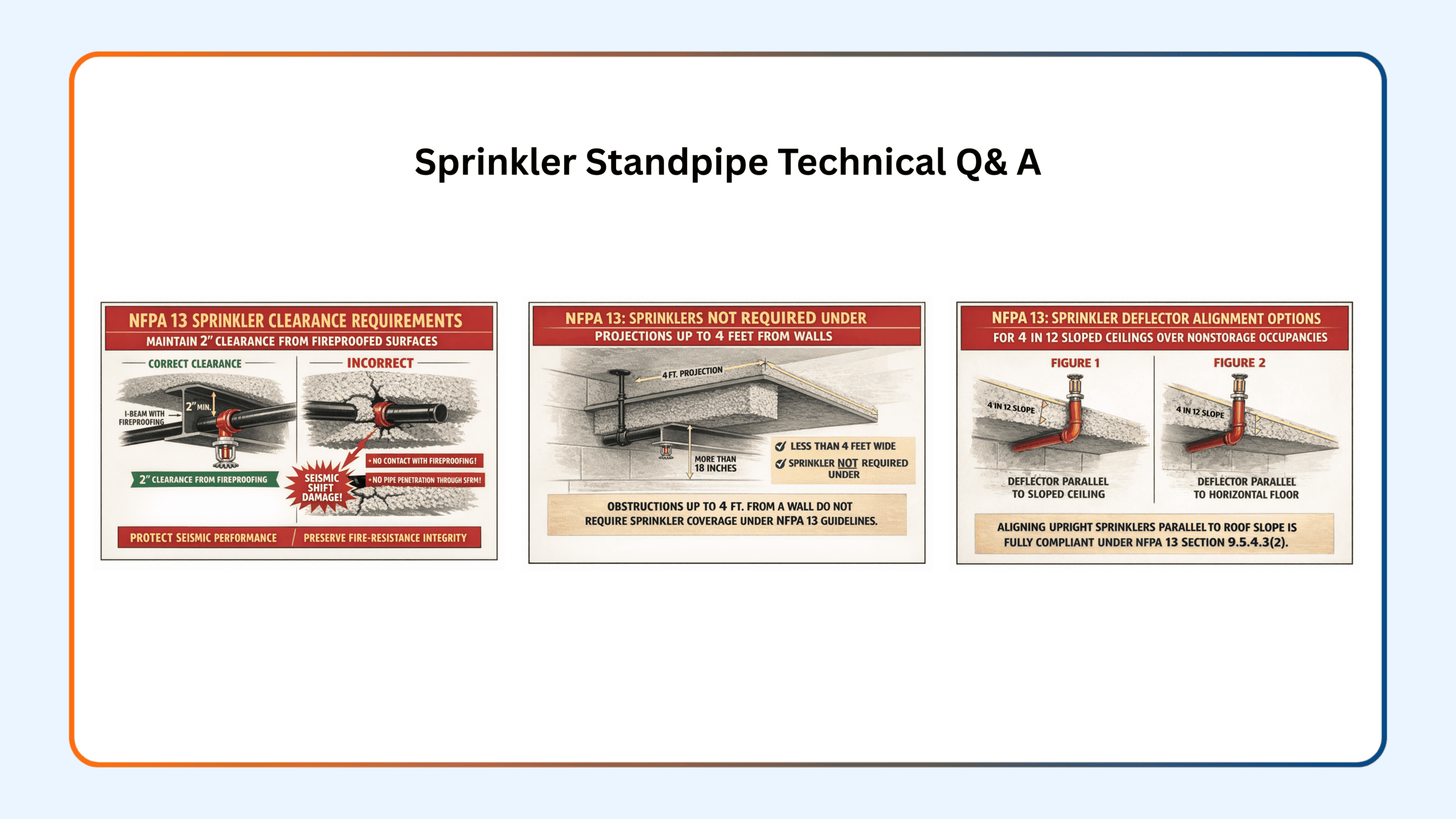
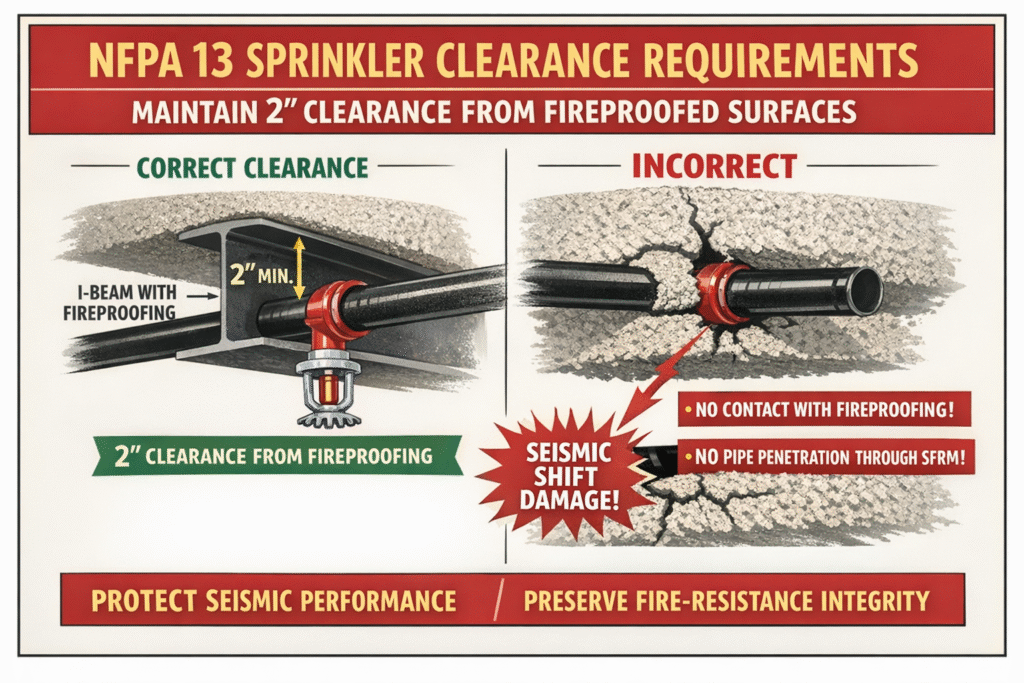
Answer : In accordance with Section 18.4.9 of the 2022 version of NFPA 13, the required 2-inch clearance is measured from the fireproofing rather than the steel. In order to prevent damage from differential movement during seismic occurrences, that portion needs a minimum 2-inch space between horizontal sprinkler piping and structural sections that are not pierced or used to support the piping. The exposed surface of the structural member for clearance purposes is the spray-applied fire-resistive material (SFRM), which is used to protect the steel.
SFRM is not given the same treatment as piping, even though Section 18.4.4 permits it to pass through frangible construction, such gypsum board, without clearance. Despite its potential for flammability, it fulfills the steel’s necessary fire-resistance role and is not a suitable substitute seismic buffer.
Therefore, in order to maintain both seismic performance and fire-resistance integrity, NFPA 13 forbids compromising the fireproofing during seismic movement. The full 2-inch clearance must be maintained from the fireproofed surface.
Answer: If the sprinklers are unaffected, there is no need to replace them according to NFPA 25 and 13. Section A.4.1.2.6.2 of the 2026 edition of NFPA 25 contains some appendix information designed especially for circumstances like this. It suggests doing hydrostatic testing of the system using air first, followed by water, and visual inspections of the sprinklers to ensure there is no stress on the seat and functioning elements.
Unless the AHJ deems them hazardous, existing materials that were in use in the building at the time of its erection or installation and that complied with the applicable standards or permissions are allowed to stay in use, according to the International Existing Building Code (IEBC).
Talking about any suggestions outside of NFPA 25 with the building owner, AHJ, and any insurance companies would also be a smart idea.
In accordance with NFPA 13R, 2019 edition, Section 6.2.2, common areas—that is, areas outside of the housing units—may be equipped with residential sprinklers or conventional spray sprinklers.
Except as allowed by 6.2.2.2, sprinklers outside of dwelling units must respond quickly, according to Section 6.2.2.1.
According to Section 6.2.2.2, the following kinds of areas are allowed to have home sprinklers installed in compliance with Section 7.1:
- Hotel and motel lobby areas
- Foyers
- Corridors
- Halls
- Lounges
- Areas with normal hazards in compliance with 7.2.4.1
- Garages that adhere to 7.3.4.1 and 7.3.4 (1)
- Lanais, balconies, and porches, among other places
- Other locations where fire loads are comparable to those in homes
- Residential sprinklers may be installed in conventional danger areas that satisfy the following requirements, according to Section 7.2.4.1 for such places:
- 30-minute fire-rated construction divides the space into 500 square feet or less.
- There are 130 square feet between each sprinkler.
- The lintel of an opening is at least 8 inches deep.
- Each compartment has a total opening area of no more than 50 square feet, excluding any overhead garage doors that open to the outside.
- The discharge densities comply with NFPA 13 for normal hazards.
In response, there is no maximum hanger rod length specified by NFPA 13. When hangers are placed in seismically active places, it does, however, control the installation requirements and the slenderness ratio of the hanger rod.
With the 2010 version, NFPA 13 was updated to allow for a maximum slenderness ratio of 400. If a hanger rod is long in relation to its diameter, it may experience compressive forces during a seismic event. This restriction is meant to lessen the chance of buckling. The technical committee pointed out that if hangers are positioned at a 45-degree angle to both sides of the piping, longer rod lengths might be permissible. Hanger rods are weak in compression but strong in tension. Buckling under compressive force is more likely when rod length grows in relation to thickness. NFPA 13 restricts the slenderness ratio for hangers that are mounted on a single side of the sprinkler piping because of this.
L/r, or the unsupported length of the rod (L) divided by its radius of gyration (r), is the definition of the slenderness ratio. This value cannot be greater than 400 for installations of single-sided 45-degree hangers. Since at least one rod will always be in tension rather than compression, the slenderness ratio does not limit the length of the rods in dual-sided 45-degree setups
The standards for the 30 percent area increase for dry pipe or double interlock preaction systems do not apply to a wet pipe fire sprinkler system that has dry sprinklers attached because it is a wet pipe system.
The maker of the dry upright sprinklers should provide the hydraulic calculations for wet pipe protection in addition to the relevant hydraulic factors (mostly friction loss).
To make up for the delay in getting water to the fire, the design area for dry systems has been increased by 30%. For the water to reach the fire, the air in the dry system piping must first escape. A bigger fire that would require more sprinklers to contain could result from this delay. In order to make up for this, NFPA 13 expands the dry pipe fire sprinkler system design area.
Even with dry sprinklers installed, a wet pipe system would not encounter this delay in water supply, thus expanding the design space is not necessary.
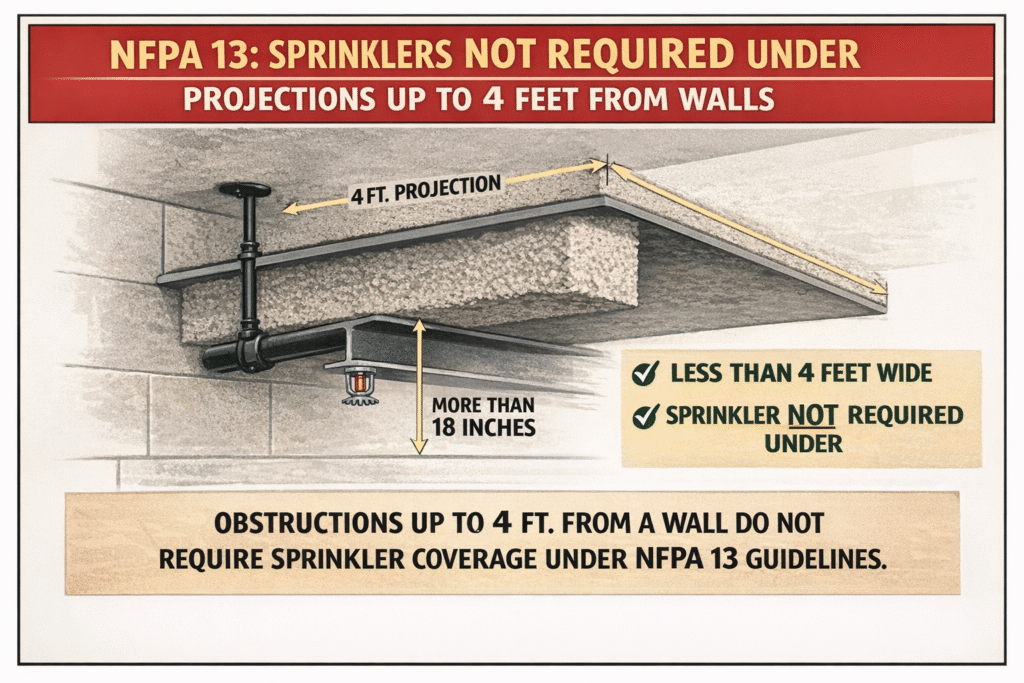
Do sprinklers need to be installed beneath this obstruction?
Answer: No, this feature does not require sprinklers. Annex Figure A contains guidance. 11.2.5.1.2 that does not require further protection underneath and permits impediments to extend up to 4 feet from a wall.
This feature is essentially an impediment that keeps the sprinkler discharge from reaching the hazard because it is more than 18 inches below the sprinkler deflector. Additionally, because it is less than 4 feet wide, sprinklers would not be needed beneath it.
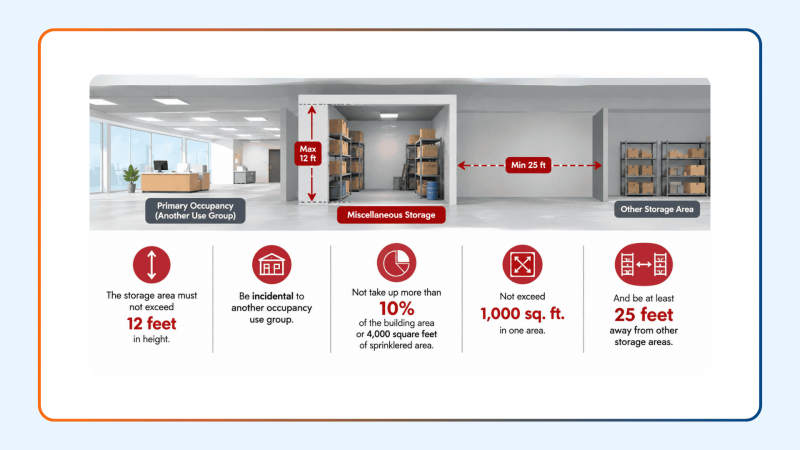
The answer is no. It is not possible to classify the suggested shelf and bin box storage as miscellaneous storage.
Section 3.3.123 of the NFPA 13, 2019 edition defines miscellaneous storage as storage that is ancillary to another occupancy use group. This is a significant drawback. For small volumes of storage in non-storage occupancies like manufacturing, mercantile, or business occupancies, miscellaneous storage is designed.
In this instance, palletized rack storage is still the major use of the building (or fire area), which is already a storage occupancy covered by ESFR sprinklers. A change in storage layout inside the same storage occupancy is represented by the addition of bin boxes and shelves at the bottom level; this does not render the storage incidental. Reclassifying parts of a storage occupancy as miscellaneous storage in order to loosen storage protection requirements is prohibited by NFPA 13.
Storage configuration has a significant impact on ESFR systems. Even at heights under five feet, adding bin boxes or solid shelving (plywood) can have an impact on airflow, sprinkler discharge efficiency, and fire propagation. According to Sections 23.1.4.1 and 25.6, ESFR sprinklers are not allowed to protect storage on solid shelf racks without in-rack sprinklers, and the suggested plywood shelving is considered solid shelving.
Furthermore, ESFR sprinklers cannot be used to protect bin box and shelf storage arrangements because the solidity of the shelves and bin boxes may prevent sprinkler discharge from getting to the location of a fire that starts inside such units. Spray sprinklers that are constructed utilizing density/area criteria in line with Section 21.2 or 21.2.4, rather than ESFR requirements, are necessary for protecting bin boxes and shelf storage.
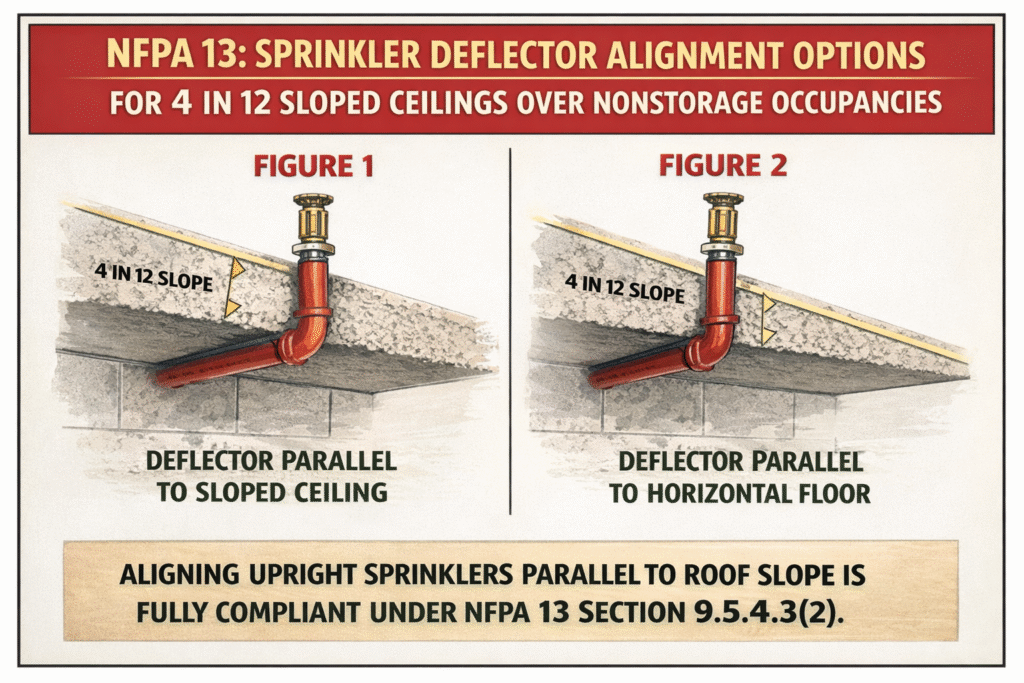
The requirements in NFPA 13, 2025 edition, Sections 9.5.4.2 and 9.5.4.3, do not, in fact, conflict when read in tandem for a building with a 4 in 12 roof slope. Except in situations where Section 9.5.4.3 is applicable, sprinkler deflectors must be positioned parallel to the ceiling, roof, or stair inclination, according to Section 9.5.4.2. This is then further refined according to slope and danger category in Section 9.5.4.3. In your situation, Section 9.5.4.3(2) is applicable as the ceiling slope is greater than 2 in 12 and the sprinklers are guarding against a nonstorage hazard that was created in compliance with Chapter 19. Intentionally, Chapter 19 is mentioned in order to cover common spray control sprinklers used in non-storage spaces. The deflector for these sprinklers may be positioned parallel to the floor or parallel to the sloping ceiling.
The reason for this provision is because the Fire Protection Research Foundation’s testing, which led to the necessity for a horizontal deflector, was restricted to storage occupancies, where the deflector’s horizontal design best matches the water flux to the commodity. Nonstorage dangers protected by typical spray sprinklers, which have distinct discharge characteristics, were not assessed in that testing. The technical committee consequently restricted the required horizontal orientation to storage occupancies exclusively. Therefore, even if a horizontal orientation is also allowed, it is totally compliant to line the upright sprinkler deflector parallel to the roof slope for a 4 in 12 pitched roof over a nonstorage occupancy protected by standard spray sprinklers.
Yes, according to Section 8.3.3.11 of the 2023 edition of NFPA 25, “the testing requirements (churn, flow, and 150%) tests shall be repeated at each flow condition with all pumps operating simultaneously where simultaneous operation of multiple pumps is required to meet the water-based system demand for flow and pressure.”
Although this was included in the 2023 edition, NFPA 20 acceptance testing has required it for a number of cycles. Prior to the 2023 edition, it appears to have been disregarded in NFPA 25.
In essence, each fire pump will be checked separately before the entire pump set is evaluated.
In this case, the standard does not include a prescriptive tolerance.
When using ESFR sprinklers to protect exposed expanded Group A plastics, NFPA 13, 2019 edition, Section 23.7.8.3, does not provide a tolerance for the distance between the vertical barrier and beams or columns, including rack structural parts.
Section 25.7.2 for horizontal barriers, which stipulates that barriers must be installed within 2 inches horizontally around rack uprights, is the sole tolerance mentioned in the standard.
The barrier’s purpose is to retain heat and encourage sprinkler activation on the fire side. It would appear reasonable to apply Section 25.7.2’s recommendations in this situation. Reviewing the test results related to the Section 23.7.8.3 fire testing for ESFR sprinklers as recorded by the listing or approval laboratory would be an additional choice.
The answer is no. The NFPA 13, 2022 version offers a number of distinct approaches to fire sprinkler system design:
Method of room design, Section 28.2.4.1.1
Method of density/area, Section 28.2.4.2
Sprinkler technique, CMSA, Section 28.2.4.3
Sprinkler technique, ESFR, Section 28.2.4.4
Only the density/area technique is subject to the phantom flow requirements; the room design method is not.
The compartmentalization of the space is the foundation of the room design process. It is anticipated that compartmented fires will more efficiently activate the sprinkler or sprinklers nearest the fire and confine the heat generated by the fire to the room where it started.
The density/area approach, on the other hand, frequently addresses wide open spaces where more sprinklers may be in operation and sprinkler activation may be delayed. The room design method requires less safety factor because it operates faster and has fewer sprinklers that need to be activated.