
Summary: The National Fire Protection Association (NFPA) sets standards for fire safety systems. Essential publications outlining sprinkler system installation and fire pump testing criteria are NFPA 13 and NFPA 24. Navigating these rules might be difficult; this blog seeks to streamline matters for you! We have prepared responses to some of the most frequently asked issues about sprinkler spacing close to barriers, fire pump testing protocols, and particular storage type unique considerations. This blog will provide you with insightful analysis from the most recent versions of NFPA 13 (2022) and NFPA 24 (2022), regardless of your position—contractor, building inspector, or just someone interested in fire safety.
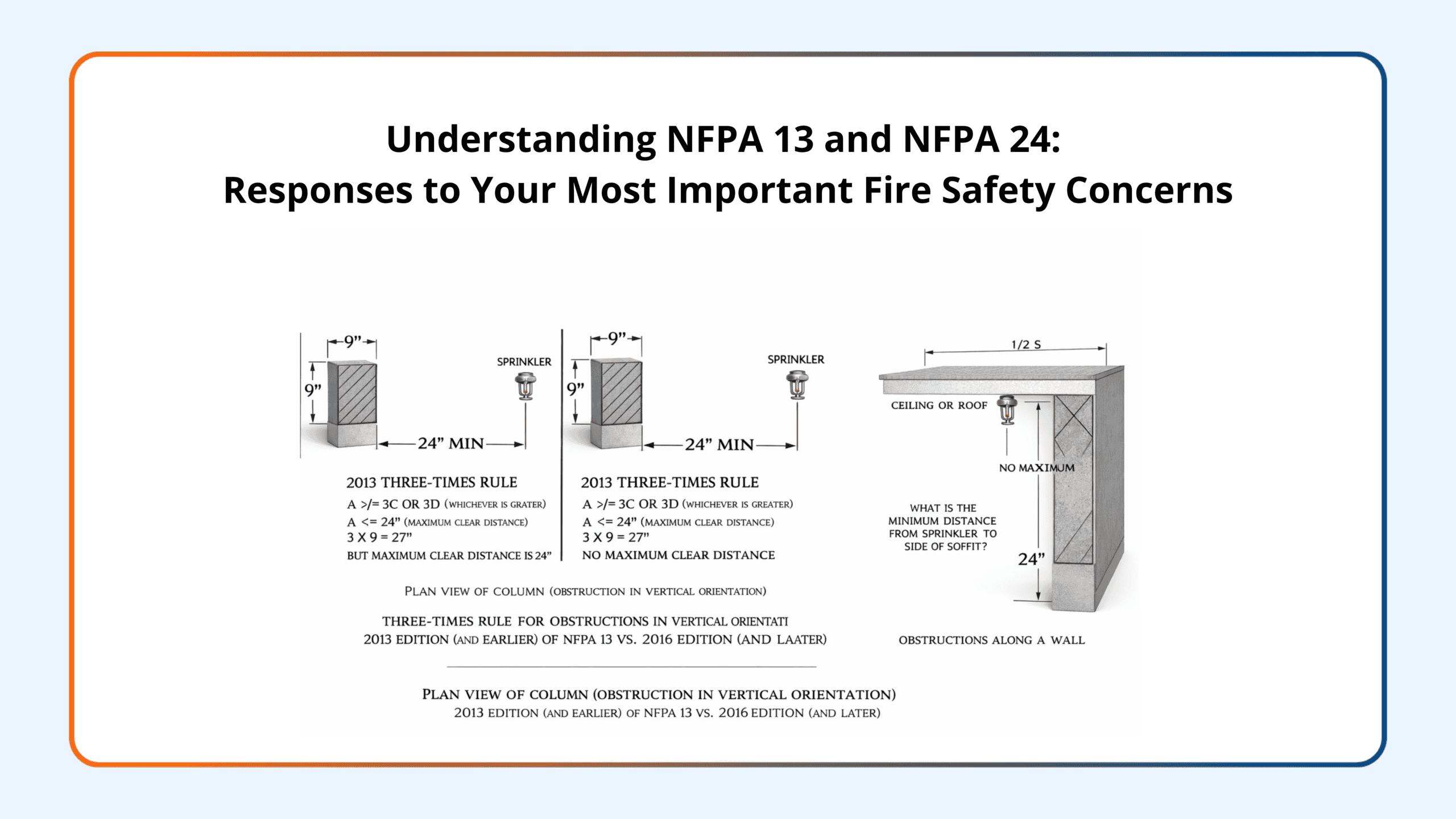
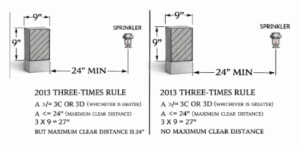
It should be mentioned that the 2016 edition (and all following editions) of NFPA 13 modified this criteria. Beginning with the 2016 edition, the 24-inch limit clear distance was eliminated for vertically oriented impediments, including columns. This means that for obstacles like columns, the three times rule determines the minimum space between the sprinkler and the column. If a column measured 10 inches by 10 inches, for instance, the sprinkler would have to be positioned 30 inches from the column to satisfy 8.6.5.2.1.3.
This article from the October 2, 2015 issue #328 of NFSA’s TechNotes helps to clarify this change: Changes in the 2016 Edition of NFPA 13 Installation Criteria. Minimum distance from an obstruction in vertical orientation (8.6.5.2.1.3). Applying the guidelines of 8.6.5.2.1.3, sometimes referred to as the “three times rule,” the maximum clear space of 24 inches has been reduced for vertical orientation obstructions, including columns. Work by the NFSA E&S committee work group on shadow regions and fire testing has revealed that the “three times rule” allows a maximum clear distance of 24 inches, which is not ideal. This experiment revealed that the fire may not be under control when sprinklers are located near significant obstacles using this maximum clear distance allowance.
Since this experiment just focused on vertical columns, the removal of the maximum clear distance is confined to vertical orientational obstacles.
For other sprinkler kinds as well, this rule—which is “three times rule”—and “four times rule” were changed similarly.
This adjustment simply removes the maximum clear distance to obstructions in the vertical orientation, such as columns, and does not alter the base three times rule or four times rule. Only when applying this rule to significant vertical impediments in excess of 8 inches (or 9 inches for the four-times rule) would this suggested alteration become relevant. These big columns can still be treated using the three- or four-times method without considering a maximum clear-distance allowance of 24 or 36 inches.
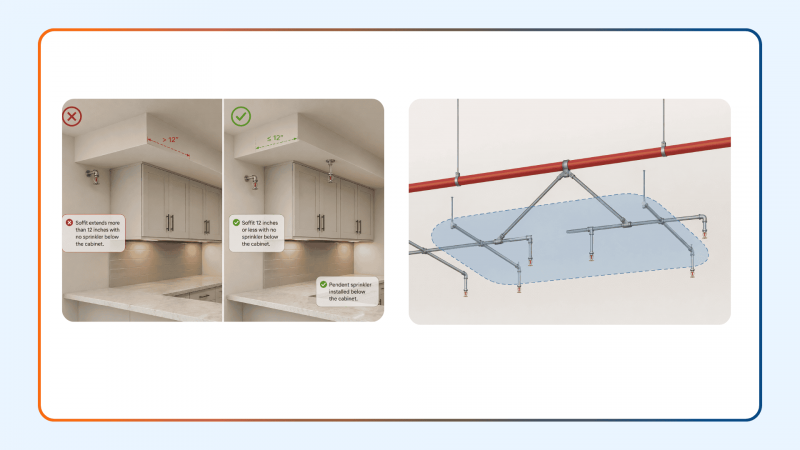
NFPA 13 excludes closets less than 24 square feet in hotel and motel living quarters as well as in hospital patient rooms less than 6 square feet. Outside of these particular examples, sprinklers are usually needed in closets of any size. Under 400 cubic feet, there is an installation exception for closets, allowing a sprinkler to be positioned in the ceiling without regard for impediments.
There are further exclusions for confined areas; these only relate to sprinklers in concealed areas.
Section 14.2.6.2 indicates that where the maximum flow available from the water supply cannot provide a flow of 150 percent of the rated flow of the fire pump, it shall be operated at the greater of 100 percent of the rated flow or the maximum flow demand of the fire protection system(s) maximum allowable discharge to determine their acceptance.
Section 14.2.6.2.4 considers this an acceptable test even if 150% of the rated flow of the pump cannot be reached due to the available water supply, if acceptance testing the fire pump at 130% of the rated flow also satisfies the maximum flow demand of the fire protection system(s).
Section 14.2.6.2.4.1 therefore indicates that, provided the pump discharge exceeds the fire protection system design and flow rate, this reduced capacity will represent an acceptable test.
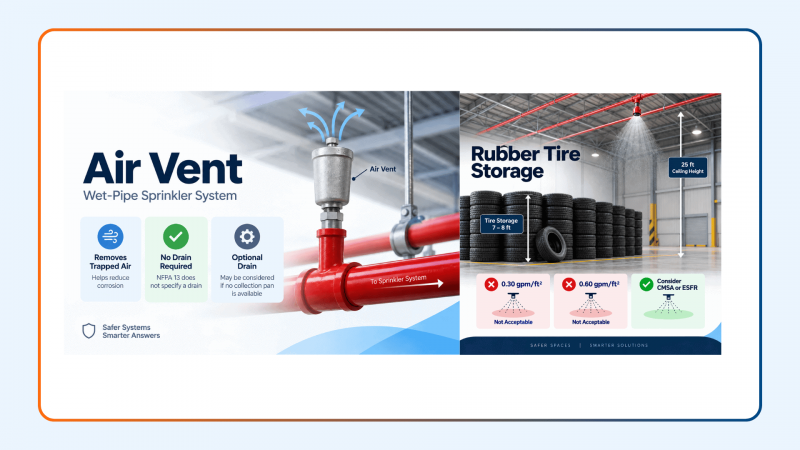
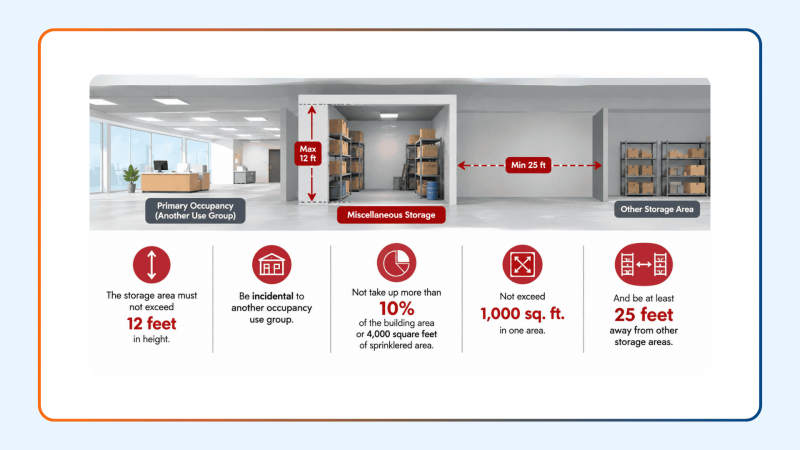
Storage covered by ceiling sprinklers only should be chosen from Table 4.3.1.7.1 and Figure 19.3.3.1.1 in line with the density/area approach of 19.3.3.2. Table 4.3.1.7.1 Discharge Criteria for Miscellaneous Storage has a header noting “Table 4.3.1.7.1 Discharge Criteria for Miscellaneous Storage.”
Up to 12 feet (3.7 m) in height, as stated in the body of the standard in Section 4.3.1.7, this table also applies to low-piled storage.
One cannot substitute on-side for pyramid piles. Should this be the case, it would be stated as “Pyramid piles or on-side.” For instance, see Table 18.4(a), (3). This part is detailing palletized movable rack storage with tires kept either on-side or on-thread. As can be seen, “on-side or on-thread” descriptions abound for these different storage configurations.
Pyramid piles could incorporate tires kept either on-side or on-threat to address the second question. As it happens,. Exhibit 3.45 of the 2013 Automatic Sprinkler Systems Handbook
shows a pyramid stack of tires kept on thread.
Nitrogen must be utilized in line with Section/Table 28.2.4.8.1 if one wants to apply the C factor of 120. Some changes were made to Section 28.2.4.8.1 in the 2022 edition. Condition #13 says that the C value of 120 is only allowed when nitrogen is added to the system according to Section 8.2.6.9 and all the other conditions in this section are met. It should be noted that, should a vapor corrosion system be adopted, the 2025 edition of NFPA 13 will probably allow a C-factor of 120. The 2025 edition will not especially target the regenerative air dryer, though.
Although NFPA 703 offers standards and specifications for field-applied coatings, these coatings do not fit as FRTW since they do not satisfy the pressure impregnation need. Consequently, untreated plywood in the hidden area is regarded as combustible, and field-applied coatings are insufficient to prevent the sprinkler installation. Still, covering the plywood with a limited-combustible material—like drywall—would be a reasonable substitute for skipping sprinklers in this area. Without depending on field-applied coatings, this method guarantees adherence to NFPA 13 and other requirements.
Section 6.2.1 notes that “each pipeline from each water supply” has to be furnished with a control valve. Although the word “pipeline” is not defined in NFPA 24, it is described in other NFPA publications as: “A length of pipe including pumps, valves, flanges, control devices, strainers, and/or similar equipment for conveying fluids,” thereby including the lead-ins to a fire protection system.
Section 6.2.9 of the 2025 edition of NFPA 24 also stipulates that “all connections to private fire service mains for fire protection systems” must have a control valve and offers 8 alternatives to support the above.
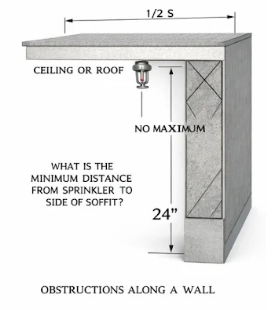
Courtesy: Roland Asp, CET, TechNotes