
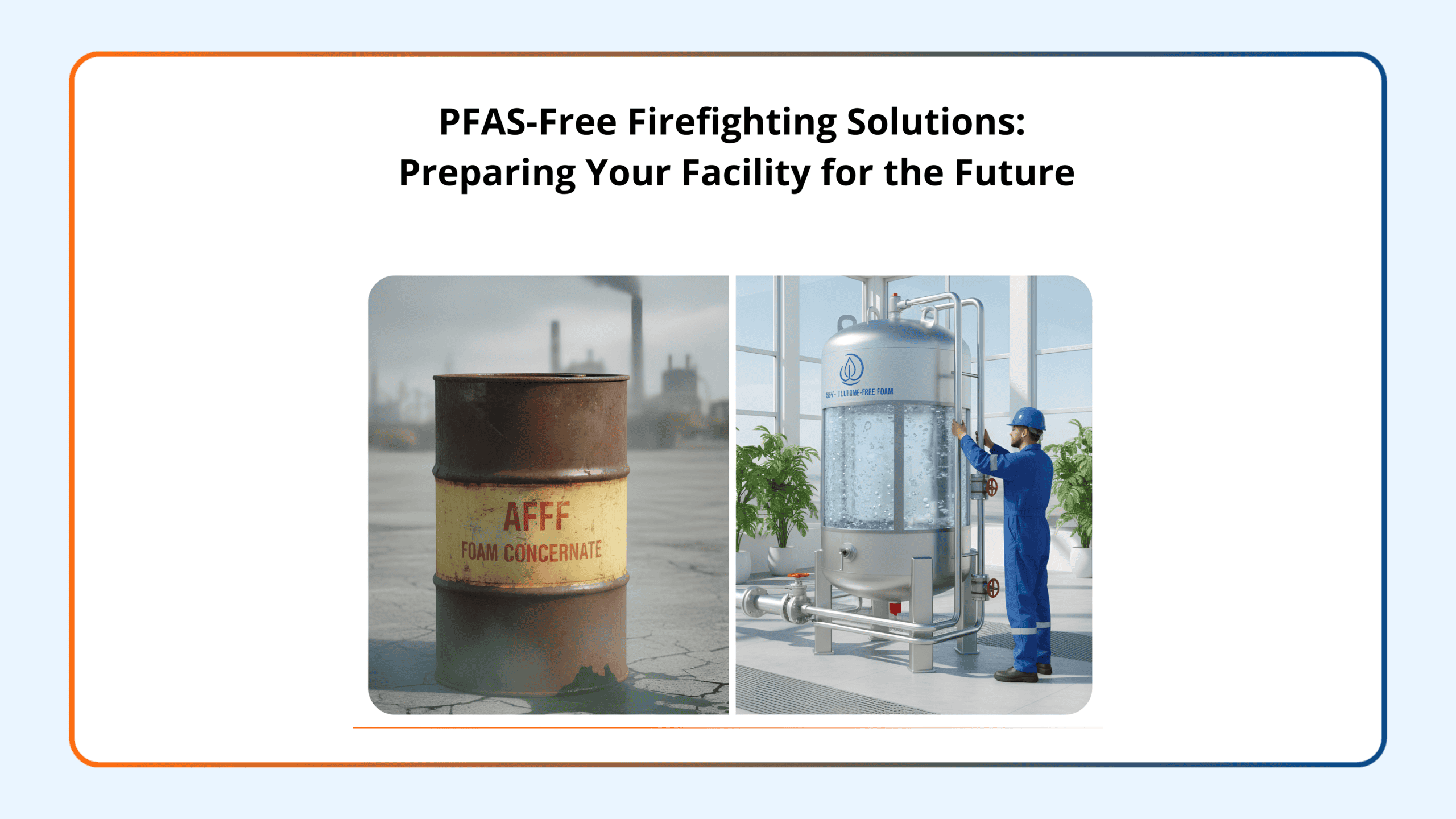
PFAS (per- and polyfluoroalkyl substances) used in previous AFFF (Aqueous Film-Forming Foam) concentrates are now known to last a long time, build up in living things, and be toxic. Regulators and customers are moving quickly. Many industrial uses are now allowed to utilise fluorine-free foams (SFFF/FFF) instead of PFAS. This blog talks about what PFAS are, how they affect the environment and regulations, how to safely get rid of them, and the technical problems that come up while converting permanent foam systems. It also lists the actions that facility owners should take, such as assessing risks and testing samples, upgrading systems, and verifying commissioning. It also shows how Rotaflow may help with PFAS-free foam upgrades, safe decommissioning, and long-term compliance.
Why PFAS in firefighting foam is now a core facility risk
PFAS are a big group of man-made chemicals that were utilised a lot in AFFF products because they can make a film and shine fuel. PFAS, on the other hand, don’t break down in the environment (thus the name “forever chemicals”), build up in soils and groundwater, and have been related to health problems. Regulators and insurers throughout the world see legacy AFFF as a risk to people and the environment. Many governments are already considering or putting into action plans to phase out firefighting foams that contain PFAS. Canada is working hard to get rid of PFAS in firefighting foams and telling people to treat AFFF as hazardous waste. Other countries in the EU and throughout the world are doing the same thing.
For facility operators, this means they have to do a lot of things in the short term: safely get rid of the existing concentrate, check the system piping and tanks for contamination, see if the site needs to be cleaned up (if there were any releases), and come up with a replacement plan that is technically sound and still meets environmental rules while keeping the firefighting performance.
What regulators and industry guidance currently say
Two things are coming together in regulatory bodies and expert guidance documents:
(1) a phase-out or strict limit on foams that include PFAS, and
(2) thorough, proven strategies for moving to fluorine-free foams when allowed.
Recent federal plans and provincial guidelines in Canada demand the disposal of AFFF at authorised hazardous-waste sites and provide options to make the switch. The U.S. EPA and other groups have also put out temporary advice on how to destroy and get rid of PFAS-containing items. In the meanwhile, manufacturers, FM/UL, and other industry and standards organisations are clearing certain fluorine-free foam concentrates for hydrocarbon and polar solvent concerns. However, the technical message is clear: SFFF is not a guaranteed drop-in replacement, and system compatibility must be checked.
Important real-world effects:
- Don’t mix foams unless you know they work together and the maker says it’s okay.
- After any change, test and record the performance of proportioning and discharge.
- According to local standards, you should treat removed AFFF concentration, contaminated tanks, and wipes as hazardous waste.
A practical guide to evaluating your facility
Step 1: Look over your documents and inventory
Make a list of all the foam stocks (AFFF and replacements), storage tanks, bladder tanks, proportioning equipment, foam pumps, and training stocks. Look at service and incident records to see whether there were any foam discharges or training activities that could have let PFAS out.
Step 2: Take a sample and test it
If you’re worried about legacy contamination (such spills that are still there, training that happened on-site in the past, or damage to storage), you should send foam concentration, tank bottoms, and storm drains nearby to a certified lab for PFAS testing. The ITRC and EPA PFAS guidance talk about how to take samples and analyse them.
Step 3: Making a map of the risks
Make a list of possible receptors (such onsite sumps, storm sewers, and groundwater) and rank the best ways to fix or control the problem. If discharges happen, check local laws to see if you have to report them.
Step 4: Get advice from a professional
PFAS problems cross the fields of hazardous waste management, environmental science, and fire protection engineering. Hire environmental specialists to help you come up with a plan for cleaning up and a fire-protection expert (like Rotaflow) to check that your equipment will work with the new system and make a plan for the switch.
Safe removal, disposal, and interim handling
In many places, AFFF concentrate, contaminated absorbents, and sludge from tanks must be handled as hazardous waste. Canada says that AFFF should be taken to authorised hazardous waste facilities. The U.S. EPA gives temporary advice on how to destroy and get rid of it. Some practical procedures are to safely store the remaining concentrate in containers, hire a registered hazardous waste transporter, and work with an approved disposal facility. Do not let AFFF flow into storm or sewer systems.
High-temperature incineration (for concentrated wastes), secure landfill under regulated conditions, and improved treatment for aqueous wastes (see next section) are some of the most common ways to get rid of or destroy waste that are already in use or being developed. There are big differences in regulatory permissions and available amenities from one place to the next. Always check with the provincial or state authorities.
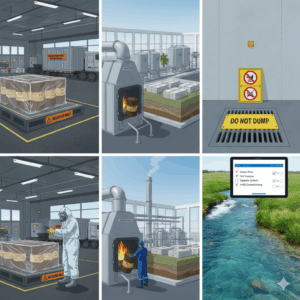
Water and soil treatment options for PFAS contamination
- If foam or a spill has polluted stormwater, groundwater, or soil, cleanup methods can include designed treatment trains like:
- Granular activated carbon (GAC) adsorption is a common way to get rid of long-chain PFAS in water.
- Ion-exchange resins have a better capacity and selectivity for particular PFAS species. They are typically employed in series with GAC.
- Reverse osmosis, also known as high-pressure membrane filtration, concentrates PFAS into brine that must be disposed of or destroyed safely.
- Advanced oxidation / thermal destruction — under investigation and used for concentrated wastes; technology readiness and pricing vary.
Most site responses use a combination of methods (pretreatment → adsorption/ion exchange → polishing), and then they either destroy the leftovers away or keep them safe. The ITRC and scientific literature offer comprehensive evaluations of treatment technologies and decision-making frameworks.
Changing from AFFF to PFAS-free foams: what engineers need to know
It is becoming more and more possible to switch to PFAS-free foam concentrates, also known as Synthetic Fluorine-Free Foam (SFFF) or Fluorine-Free Foam (FFF), but this is not always an easy process. What we can learn from manufacturers and field guidance is:
- Different manufacturers and products have different levels of SFFF performance. Approvals (FM, UL) for hydrocarbon and polar solvent applications are starting to come out, however they are only for certain products. Check that the product you choose is safe for your sort of hazard.
- System compatibility is important. You may need to recalibrate or replace proportioners, balanced-pressure bladder tanks, inductor systems, and foam pumps. Viking and other companies have put out information on how to switch to balanced pressure bladder tanks and proportioners.
- Interaction between the nozzle and the drain. The film-forming chemistry of AFFF created specific flow and spread behaviours that SFFF would not be able to exactly copy. It is important to do system hydraulic studies and discharge performance experiments.
- Changes to training and standard operating procedures (SOPs). When new foams are used, firefighting methods, training, and maintenance procedures typically need to be changed.
A solid conversion strategy comprises choosing a foam that the manufacturer approves, checking the proportioner and pump, running an acceptance test program (proportioning ratio, discharge pattern, extinction test if safe/allowed), and documenting the commissioning to satisfy AHJs and insurers.
A useful step-by-step plan for facility owners
- Immediate containment: protect current AFFF stocks and stop any more from being released. Set up temporary controls for spills.
- Inventory and sampling: find out what kinds of foam there are, how old they are, and if anything happened. Take samples when you need to.
- Plan for disposal: Get approved hazardous waste removal for concentration and contaminated items according to local rules.
- System audit: have a fire-protection expert check the proportioners, bladder tanks, pumps, pipelines and nozzles to see whether they need to be updated.
- Choose a PFAS-free product: pick an FM/UL-approved fluorine-free concentration that fits your needs and has been tested.
- Upgrade and test: retrofit or replace proportioning equipment as needed, do hydraulic and discharge tests, and do thorough acceptance testing.
- Keep detailed records of disposal, lab results, retrofit works, and commissioning for regulators, insurers, and prospective buyers, and be sure to disseminate these records.
How Rotaflow helps: real-world assistance for making the switch and following the rules
Rotaflow is the only partner you need to help facilities make the switch to PFAS. They have experience in fire safety engineering, skid and pump systems, and project delivery.
- System audit and risk assessment: take stock of AFFF supplies, check bladder tanks, proportioners and foam pipelines for contamination, and make a plan for the conversion.
- Foam system upgrades and skid solutions: design and deliver upgrade packages (balanced pressure proportioner retrofits, foam concentrate feed systems, deluge/monitor modifications), including modular skid alternatives that make field work easier and cut down on downtime. (Rotaflow makes and sells foam and deluge skid systems.)
- Testing and acceptance: check the proportions, test the nozzle discharge and performance, and make verification reports for AHJs and insurers.
- Disposal coordination and environmental liaison: work with contractors who remove hazardous material and environmental experts; give them documents that show they are following the rules (chains of custody, disposal certificates).
- Remediation advice: When needed, link clients with trusted environmental remediation partners who can help with water and soil treatment alternatives like GAC, ion exchange, and RO.
- Training and SOP updates: update the operator manuals and train operations staff and emergency responders on how to use and deploy PFAS-free agents.
Rotaflow’s integrated strategy lowers risk, gives regulators and insurers technical documentation, and makes sure that the converted system works in the real world.
Cost & timing considerations
Costs vary according to the scope of the work. Simple concentrate removal and foam replacement are cheaper, whereas full system retrofits (new proportioners, pumps, testing, disposal, and any environmental cleanup) are more expensive. Importantly, putting off the shift can raise costs for legal, cleanup, and reputation, especially if releases are found. A lot of clients want staged approaches. First, they want to secure the concentrate and remove the training foam. Then, they want to schedule system retrofits during planned maintenance windows to keep operations running smoothly.
Final Thoughts
The time of using PFAS-based foams to put out fires is coming to an end. The message for facility owners and managers is clear: recognise old AFFF as a risk to the environment and compliance, move immediately to secure and properly dispose of concentrate, and plan system updates with technical care. Switching to PFAS-free foams can help the environment without hurting fire safety, but only if the changes are planned, tested, and recorded. Rotaflow has the fire protection knowledge, system engineering skills, and project management experience to help facilities with inventory, disposal, upgrades, and commissioning. This turns regulatory risk into a managed, compliant solution.