
The 11th edition of Merriam-Webster’s Collegiate Dictionary is cited in Sections 3.1.2 and 3.1.3 of NFPA 13, 2025 edition, for the commonly recognised definition of terms that are not defined in the standard.
“Store” is defined by Merriam-Webster as 1. to accumulate or store. 2). to provide or supply. 3). to store or leave for later use, disposal, or preservation in a place (like a warehouse, library, or computer memory).
The relevant context appears to be item 3.
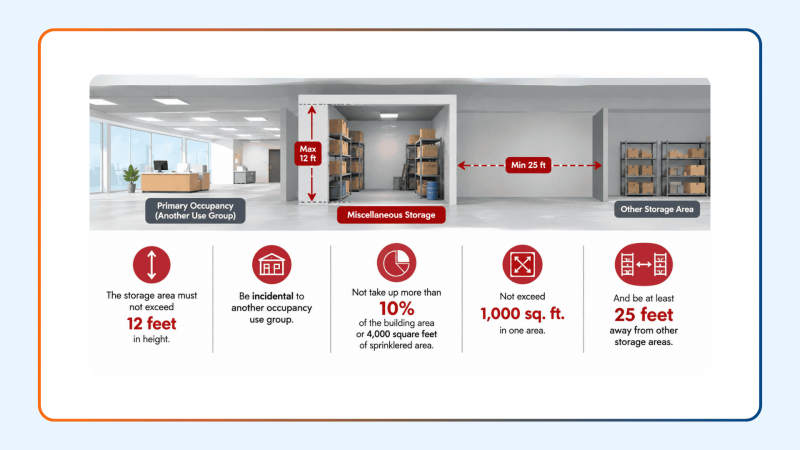
The length of time the product is left in a specific location is essentially irrelevant. Storage is the act of placing or leaving goods in a location. A specific package or product may only be present for a little time in a staging area, like a shipping operation, yet the facility is continuously utilised for that purpose. This would be classified as storage under NFPA 13.
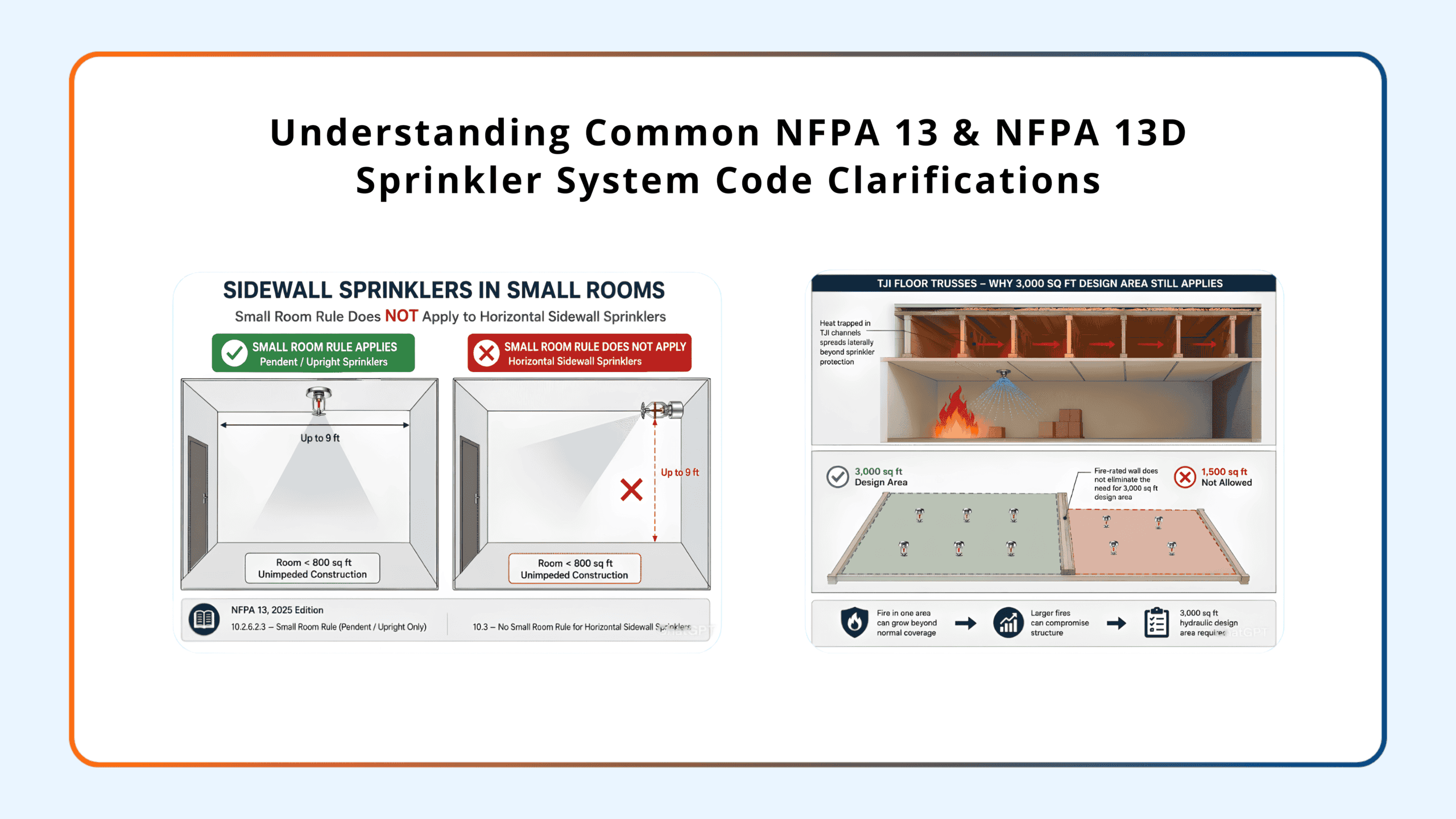
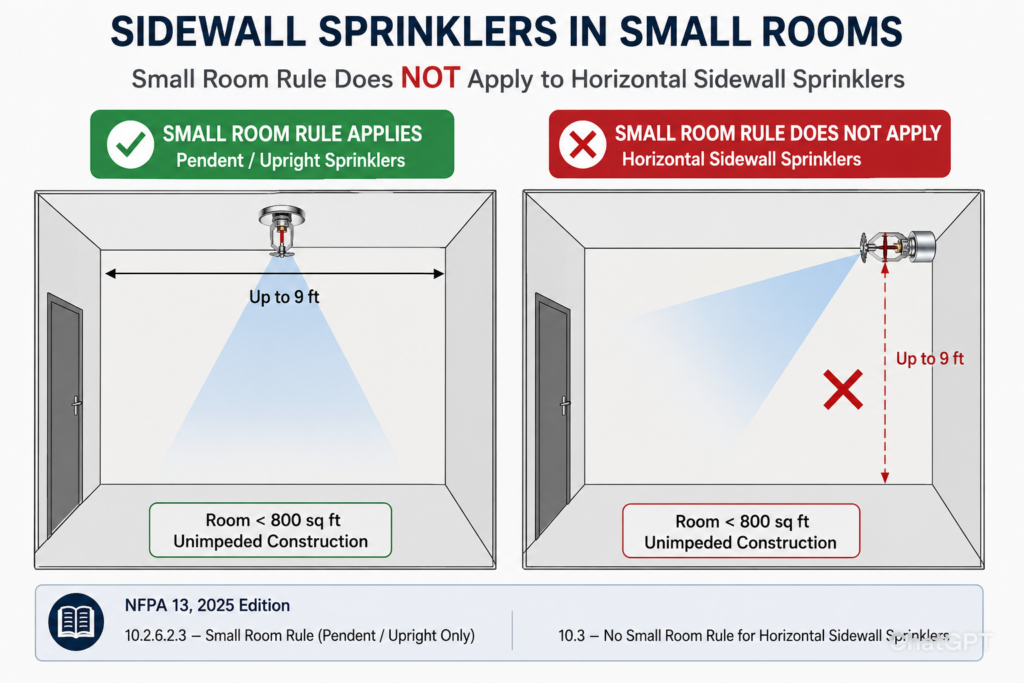
The small room rule is not allowed by NFPA 13 for horizontal sidewall sprinklers. Only standard spray pendent and upright sprinklers are covered by NFPA 13, 2025 edition, Section 10.2.6.2.3 for the small room regulation. Section 10.3 does not have a comparable clause for conventional spray horizontal sprinklers.
To be clear, does Section 9.4.2.2 specify circumstances in which ordinary-temperature sprinklers must be replaced with intermediate- or high-temperature sprinklers because of exposure to heat sources or high ambient temperatures, while Section 9.4.2.1 allows the use of intermediate-temperature sprinklers throughout a building without restriction?
Yes, in response. Ordinary or intermediate-temperature sprinklers may be used throughout a structure, according to NFPA 13, 2022 edition, Section 9.4.2.1. The Annex note to Section 9.4.2.1 provides clarification on this allowance, stating:
“A.9.4.2.1 Installing ordinary-temperature sprinklers, intermediate-temperature sprinklers, or a combination of ordinary- and intermediate-temperature sprinklers throughout a building is acceptable.”
The difference in activation times between sprinklers with ordinary and intermediate temperatures is not statistically significant, according to extensive testing and research. The sprinkler’s relationship to the ceiling and whether it is quick-response, which activates more quickly, or standard-response, which activates more slowly, are more significant factors influencing sprinkler activation.
By permitting a single sprinkler temperature classification to be utilised throughout a building or space, allowing intermediate-temperature sprinklers in place of ordinary-temperature sprinklers can simplify installation and maintenance. As a result, switching from ordinary-temperature sprinklers to intermediate-temperature sprinklers solely at specific heat sources is no longer necessary.
Higher-temperature-rated sprinklers must be used in circumstances where excessive ambient ceiling temperatures above 100°F are anticipated, according to Section 9.4.2.2. Furthermore, Section 9.4.2.3 allows the use of higher-temperature sprinklers in storage and comparable occupancies to lessen the possibility that quickly spreading fires will activate an excessive number of sprinklers, including sprinklers that are far from the fire area.
Can plastic bin boxes be protected using NFPA 13’s bin box criteria?
In response, no. The container, or bin box, must be made of cardboard, metal, or wood in order to qualify as Bin Box storage. Bin box storage is defined as follows in Section 3.3.21 of the 2025 edition of NFPA 13:
“Storage in five-sided cardboard, metal, or wood boxes with an open face on the aisles that are either self-supporting or supported by a structure so that there is little to no horizontal or vertical space surrounding boxes.”
There isn’t enough information provided to pinpoint the exact kind of storage setup in this case. The fact that the containers are made of plastic must be taken into account when figuring out the storage’s commodity class. The product, the packing material, and the container are all taken into consideration while determining commodities.
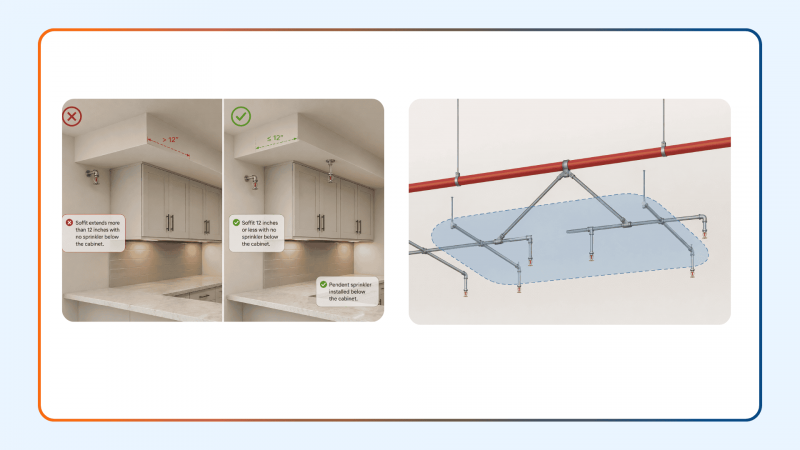
In light of this, are sprinklers needed beneath this ceiling feature?
Dropout ceilings are covered by NFPA 13. It is found in Section 9.3.11 of the 2025 version and Section 8.15.15 of the 2016 edition. The allowance has been in place for several NFPA 13 cycles.
According to this rule, sprinklers cannot be put beneath specified drop-out ceilings or ceiling materials.
According to the annexe, these ceiling materials have been examined in compliance with FM Class Number 4651, Plastic Suspended Ceiling Panels, or UL Subject 723S, Outline of Investigation for Drop-Out Ceilings Installed Beneath Automatic Sprinklers. These ceiling materials are “designed such that the activation of the sprinkler and the ability of the sprinkler discharge to reach the hazard being protected are not adversely impacted.”
The “melt-away” ceiling tiles used in this project may or may not satisfy NFPA 13 requirements.
Would the existence of this electrical heater require the addition of sprinkler protection?
In response, no. The addition of this heater would not necessitate sprinkler protection, according to the guidelines in the 2016 edition of NFPA 13. Sprinkler protection is not necessary for hidden areas that are inaccessible, have restricted or non-combustible construction, and have little combustible loading, according to Section 8.15.1.2.1. We believe that a little electric heater shouldn’t raise the space’s combustible loading above “minimal.”
It is crucial to remember that the definition of “minimal combustible loading” is arbitrary and not specified in NFPA 13.
What is the procedure for documenting deficiencies?
The installation and design of a sprinkler system are not covered by NFPA 25, according to Section 1.1.3.1. Furthermore, it is expected that the system was installed correctly, according to Section 1.1.3.
Using an observation report is the industry standard procedure for handling situations that are not covered by NFPA 25. This report, which is distinct from the regular inspection and testing report, usually contains wording that makes it clear that the observations made are not covered by NFPA 25 or the inspection contract.
The owner can utilise this observation report to learn about possible problems or worries with the fire safety system that might go beyond the purview of regular testing, inspection, and maintenance procedures.
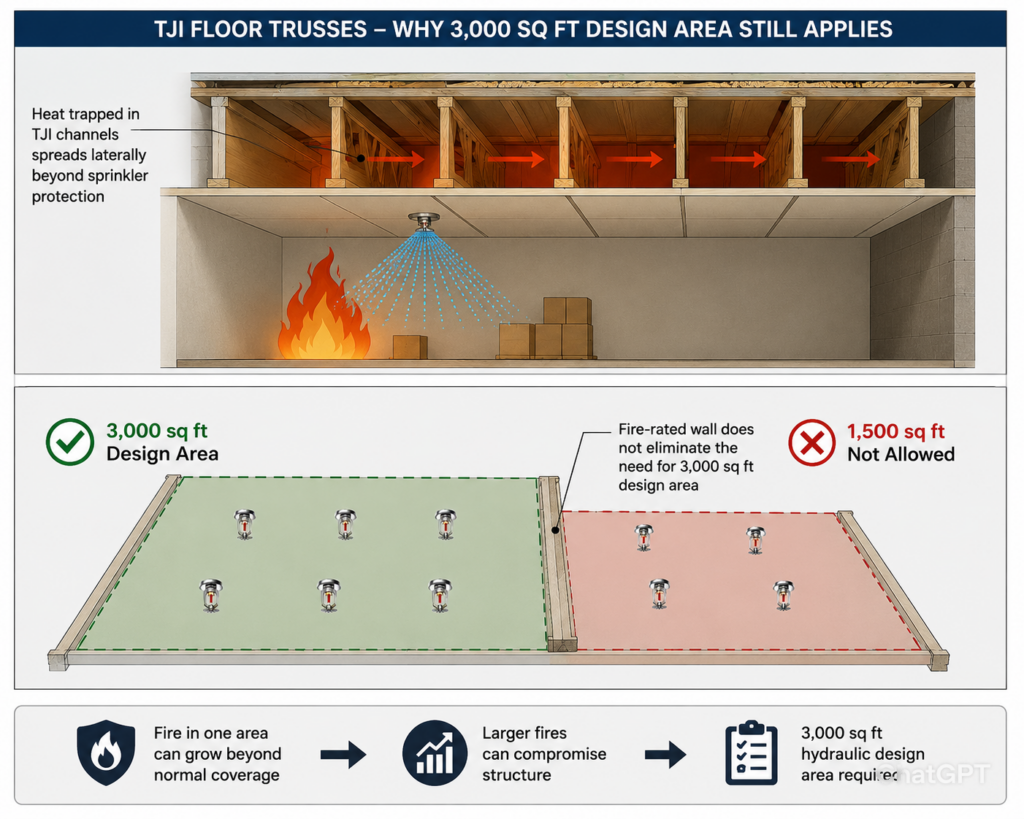
The necessity for the larger design area is not eliminated by the existence of fire-rated construction dividing a flammable hidden region. Section 11.2.3.1.5.2 contains exceptions for the 3,000 square foot design area. The technical committee believed that these ten factors lessened the necessity for the wider design area. The project in question doesn’t seem to fit any of these ten requirements that would permit the standard design space as opposed to the 3,000 square foot expanded design area.
The primary problem with truss joist I-joists (TJI) and comparable wood joists is that heat from a fire is trapped in the “channel” of the joists and can spread laterally, enabling the fire to grow beyond the sprinklers’ operational area and typical design area of 1,500 square feet. This could lead to a larger-than-expected fire that could rapidly jeopardise the floor assembly’s structural integrity.
Is it possible to space sprinklers from 12-inch-wide columns using the three-times rule?
In response, no. The “three times” criterion in Section 13.2.8.2.1.3 would not apply because the column in question is wider than eight inches.
The simplest way to deal with this “obstruction” would be to place sprinklers on both sides of the column in question because none of the prescriptive obstruction regulations listed in Chapter 13 apply to this particular circumstance.
This idea may be found in Section 13.2.8.1.1, which states that “additional sprinklers shall be provided to ensure adequate coverage of the hazard” or that the prescriptive obstruction regulations must be followed.
Is that correct in terms of NFPA 13, 99, and 101?
It is true that each story must be divided into smoking sections. Group I-2 occupancies are required by Section 407.5 of the 2024 International Building Code and the 2024 edition of NFPA 101 to be separated into a minimum of two smoke compartments per level, each of which is limited to 22,500 square feet. It is consistent with these rules to have two smoke compartments per level given the 20,000 square foot floor area.
The construction rules do not, however, mandate that sprinkler zones and smoke compartments coincide. Alignment has historically been accepted and is frequently regarded as a good practice, but it is not necessarily necessary.
The 2024 version of NFPA 99 is the main motivator. Sprinkler system zones must either align with smoke compartment borders or be covered in the facility fire plan, according to Section 16.9.1.3. This permits flexibility as long as the fire plan supports the defend-in-place approach and explicitly provides for any variations.
Sprinkler zones are not directly required to match smoke compartments, even though designers may refer to IBC Section 907.5.3 governing alarm zoning and annunciation to encourage alignment for operational clarity.
Lastly, there is no evidence to support the claim that each floor needs two different sprinkler systems. Multiple systems per floor are not necessarily necessary, even though zoning may coincide with smoke compartments for operational or announcement purposes. Multiple zones within a same floor system are permitted by NFPA 13 when floor control assemblies and suitable valving are used.
No, channels created by structural elements like beams are exempt from the ceiling pocket requirements. The 2025 edition of NFPA 13D included new information that clarified this.
A ceiling pocket is described as an architectural ceiling feature in NFPA 13D, 2025 edition, Section 3.3.2, as a confined portion of ceiling situated at a higher elevation than the associated lower ceiling. According to Section A.3.3.2, channels created by structural elements like beams are exempt from ceiling pocket regulations.
Does this case fall under Section 8.6.5.2.1.4?
According to the information provided, these light fixtures would not be subject to the requirements of Section 8.6.5.2.1.3, also known as the three-times rule. The mentioned Section 8.6.5.2.1.4 expressly limits the three-times rule to structural elements solely in light and conventional hazard settings; light fixtures are not considered structural elements.
To properly comprehend this section, it is necessary to read Annex section A.8.6.5.1.4. The performance objectives listed in Section 8.6.5.1 should be taken into consideration when applying this requirement, according to the annexe. According to Section 8.6.5.1.1, the goal is to “minimise” rather than completely remove obstacles. The annexe also suggests that the goals to reduce the impact of blockage have been achieved if water can spray on both sides of the obstacle based on the distance between the sprinkler and the top of the obstruction, in this case 12 inches.