
This question is a bit challenging to answer definitively because two processes are at play here. One is a technical process that leads to the development of an installation standard. The other is a legislative process that leads to the formal adoption of the code and the relevant standards.
As far as the technical process is concerned, NFPA, the publisher of NFPA 13, states in the foreword of the document:
“An official NFPA standard at any point in time consists of the current edition of the document, including any issued TIAs and Errata then in effect.”
According to this stipulation, TIAs are included in the NFPA standard. However, NFPA does not ‘adopt’ the code or the related standards, and a subsequent requirement or change does not become automatic and enforced simply because it has been issued by NFPA.
Where a jurisdiction has adopted a specific edition of NFPA 13, subsequent TIAs are not, by default, enforceable, unless the adoption process includes them, or the jurisdiction recognizes them separately. Whether a ‘TIA’ is considered to be automatically enforceable is a matter of the AHJ and the legal framework of the jurisdiction.
Discussing this issue with the relevant AHJ is advisable. This will determine whether the jurisdiction adopts the edition as published, adopts the edition including subsequent TIAs and Errata, or takes separate measures to recognize subsequent amendments.
Answer: According to the 2016 edition of NFPA 14, in the case of a standpipe system, Section 5.6.3 states that a paddle-type waterflow alarm flow device would be required, and Section 5.6.1 states that a standpipe system would have to be equipped with a waterflow alarm device. However, specifics do not describe a particular place of installation.
The NFPA standard would describe a standpipe system in Section 3.3.17 as the “arrangement of piping, valves, hose connections, and allied equipment installed in a building or structure, with the hose connections located in such a manner that water can be discharged in streams or spray patterns through attached hose and nozzles, for the purpose of extinguishing a fire, thereby protecting a building or structure and its contents in addition to protecting the occupants.”
Some jurisdictions would require the placement of waterflow devices downstream of each riser control valve in order for the system to show which standpipe was flowing water, and to show, during the inspection, testing, and maintenance, that the standpipe was operational and available while other standpipes were placed out of operation.
The 2024 edition of the standard would address some clarifications of the intent of earlier editions. Section 9.7.1.1 states that all of the automatic and semi-automatic systems will have a waterflow device, and that for each system, the flow from the hose connection shall be in the case of waterflow.
It’s stated that if there are multiple vertical zones in a building, each zone would need to comply with the same restrictions.
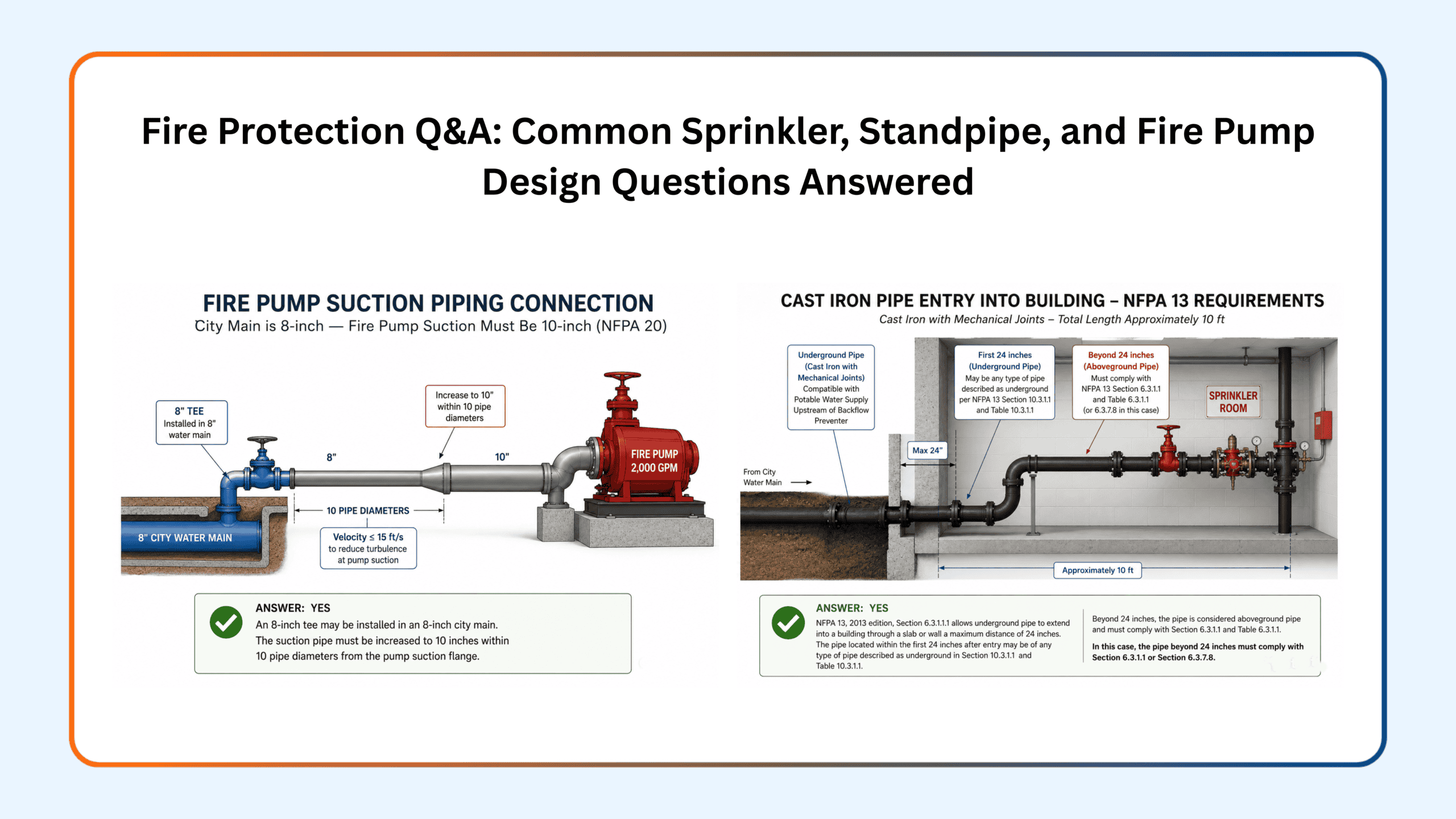
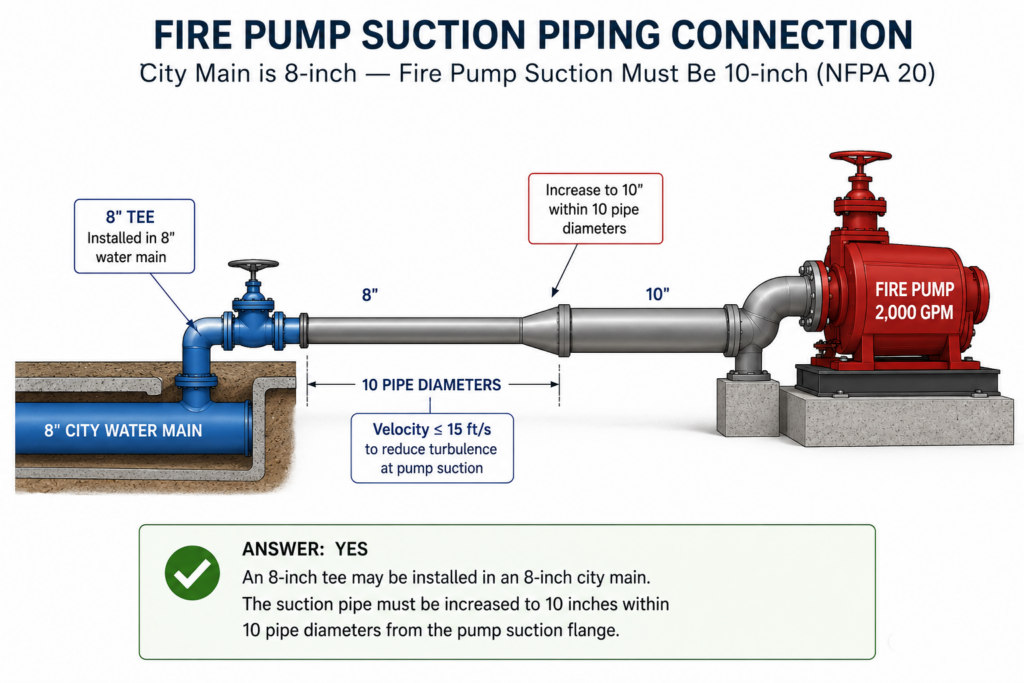
If the city’s water main is only 8 inches, can an 8-inch fitting be installed, then immediately increased to 10 inches for the fire pump?
This is to control the velocity of the water entering the pump to 15 feet per second to reduce the turbulence in the flow to the pump. The distance of 10 pipe diameters also satisfies this requirement.
Based on the information provided, the answer to your question is yes. An 8-inch tee may be inserted into the 8-inch water main. The suction pipe is required to be increased to 10 inches within a distance of 10 pipe diameters from the suction flange of the fire pump.
Answer: No, it is not intended that the NFPA 13, 2022 edition, Section 10.2.9, apply the ceiling pocket rule in this case to allow the removal of sprinklers from recessed areas behind deep perimeter I-beams.
In order to apply the ceiling pocket rule, the entire floor beneath the unprotected ceiling pocket must be sprinkler protected at the lower ceiling level, outside the ceiling pocket. In your case, the beam obstructs the sprinkler and protection is not provided to the entire floor beneath the unprotected ceiling pocket.
To deal with this specific scenario, the NFSA Engineering and Standards Committee has a draft revision with an additional section to the 2028 standard. Adding Section 9.2.19, Narrow Spaces Along Walls, would allow the beam to obstruct the sprinkler if the distance from the beam to the exterior wall is within the maximum spacing distance. This revision is referred to as first draft revision 1069. Proposed Section 9.2.19 (4) is still lacking and NFSA will provide public input for the second draft revisions.
The committee explains that the space enclosed by a beam that is located within 24” of a wall is too small to allow the sprinkler to operate effectively. This space also is a “narrow space” and will have similar requirements for the management of narrow spaces. The sprinklers located on the outside of the narrow space will provide the necessary floor coverage, and the heat will build in the narrow space will not impede the response time of the sprinkler to the extent that it would require the placement of additional sprinklers into the narrow space.
Answer: NFPA 13, 2022 edition, will be the standard referenced here. Sections 10.2.7.3.1.10, 11.2.5.2.1.9 (sprinklers extended coverage) and 12.1.10.2.1.9 (sprinklers residential) state that fan blades are not obstructions if they are in a light hazard occupancy, have fan blades 60 inches or less in diameter, and the blades are 50 percent or more open.
Section 10.2.7.3.1.10: Sprinklers may be installed without concern for ceiling fans that have blades less than 60 inches (1.5m) in diameter, if the plan view of the fan is at least 50 percent open.
The fan motor housing is an obstruction, and the “Three Times Rule” is applicable.
The National Fire Sprinkler Association (NFSA) has conducted water spray distribution studies with ceiling fans. The research has made its way into NFPA 13, NFPA 13D, and NFPA 13R. The blades of the fan are not obstructions as long as they are 50 percent open. The fan motor housing is an obstruction.
This applies only to light hazard occupancy and not to ordinary hazard, extra hazard, or storage occupancies. It does not apply to high volume low speed (HVLS) fans that are in industrial, storage, and other occupancies.
Answer: The spacing of the sprinklers can be in line with the Ordinary Hazard sprinkler spacing. The new NFPA 13, 2025 edition, high ceiling spacing requirements outlined in Section 19.2.3.2.5.2, do not affect the maximum spacing of sprinklers or the maximum area per ordinary hazard sprinkler with high ceilings.
Further, what would be an acceptable way to document to the AHJ that the diffuser discharge temperature will be below 100°F?
Answer: There are two parts to the question so each will be answered individually.
Question 1: If a duct diffuser, irrespective of horizontally discharging, discharges a maximum air of less than 100°F, does it follow there is no NFPA restriction on the proximity of an ordinary-temperature pendent head to that diffuser?
Answer 1: Yes, that is true. In accordance with NFPA 13, 2016 edition, in Section 8.3.2.5(9), there is no stipulated distance for an ordinary-temperature sprinkler from a “heat source that discharges air that is less than 100°F”. Here, the ordinary temperature rating for the sprinkler would simply be determined per Section 8.3.2.1, which would permit the ordinary and/or intermediate temperature sprinklers to be installed throughout, unless Section 8.3.2.2 is applicable. Section 8.3.2.2 would explain that if the maximum ceiling temperature is greater than 100°F – the selected sprinklers shall be in accordance with Table 6.2.5.1.
Question 2: What evidence could you present to the AHJ to substantiate a diffuser will not go over 100oF?
Answer 2: NFPA 13 is silent on how to demonstrate that the diffuser will not go over 100°F. We would recommend that you reach out to your HVAC Contractor and see if they could provide a letter or a specification to that effect. This will likely appease the AHJ. It may also be recommended to provide intermediate rated sprinklers in accordance with Section 8.3.2.1, as this would also provide an additional “buffer” between the temperature discharged by the diffuser and the operating temperature of the sprinkler.
Answer: No, it is not acceptable to pump continuous pressure at 150 psi for 2 hours to account for minor leakage when performing a hydrostatic test on a buried FDC pipe.
The NFPA 13, 2025 edition, includes the acceptance of underground piping in Section 6.11. Hydrostatic testing is described in Section 6.11.2.
In your case, Section 6.11.2.2.6 deals with the allowance of hydrostatic testing. If additional water must be added to the system to maintain the test pressures as described in Section 6.11.2.2.1, the quantity of added water must be recorded and shall not exceed the limits provided in Table 6.11.2.2.6, which are determined from the following math.
Section A.6.11.2.2.6 states that one acceptable method to perform this test is to use a pressure pump that draws its water supply from a full container. After the 2-hour test, the amount of water added to the container can be measured to determine the amount of makeup water. In order to avoid losing pressure, the pipe system may be cleared of any trapped air. The system may also be pressurized before the hydrostatic test to help account for the expansion, absorption, and any media that may be trapped within the system.
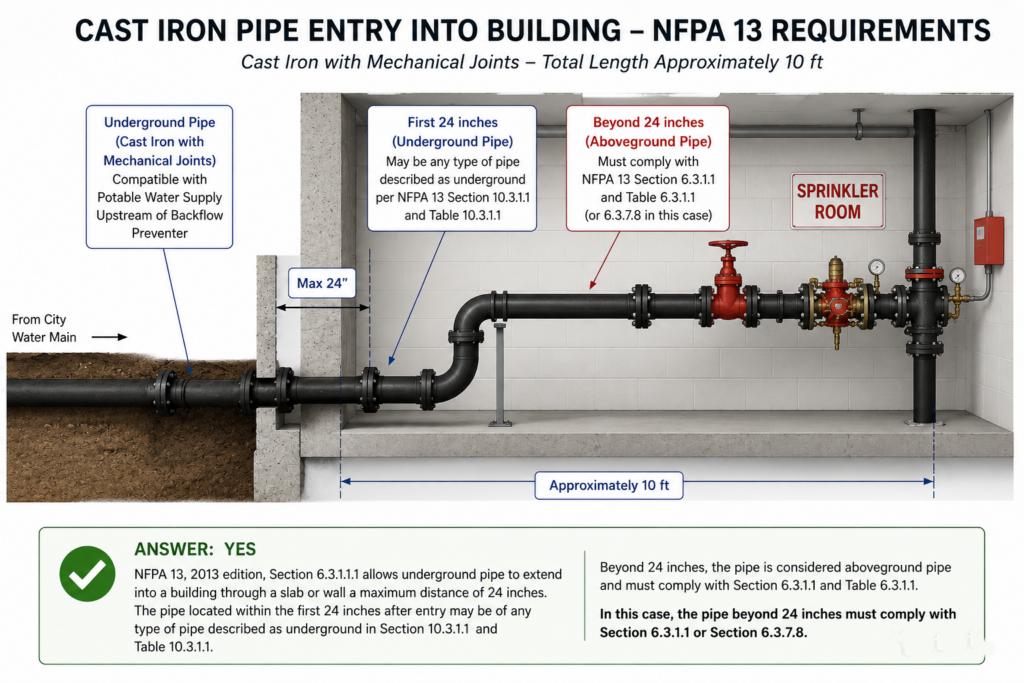
Answer: NFPA 13, 2013 edition, states in Section 6.3.1.1.1 that underground pipe may extend into a building through a slab or wall a maximum distance of 24 inches. The pipe located within the first 24 inches after entry into the building may be of any type of pipe described as underground in Section 10.3.1.1 and Table 10.3.1.1.
In the case of your installation, once the pipe extends beyond 24 inches into the building, it is considered aboveground pipe and must comply with Section 6.3.1.1 and Table 6.3.1.1.
In your case, the more than 24 inches pipe is required to comply with Section 6.3.1.1 or Section 6.3.7.8.
An individual asked whether a certain column would obstruct a face sprinkler that is located 18 inches from the aisle.
Based on the information provided, we can clarify that face sprinklers are in-rack sprinklers. Therefore, the column located behind the face sprinkler, toward the rack, does not fall in the ceiling sprinkler obstruction category.
Also, the design would be in compliance with Chapter 25. In particular, Section 25.5.1.7 deals with the positioning of face sprinklers next to the rack. In this case, the face sprinkler would be located at least 18 inches from the rack’s aisle and at least 3 inches from the rack’s vertical frame. In turn, this would allow adequate protection of the face of the storage commodities.
If the column, located behind the face sprinkler, does not interfere with the face of the rack, and does not block the face sprinkler, this would not constitute an obstruction. However, given the particular face sprinkler geometry and the column position, a more thorough obstruction analysis would be required if the column, located adjacent to the face sprinkler, prevents the face sprinkler from adequately discharging into the rack.
This section provides for a method to conduct a forward flow test of a backflow device without requiring modification of the system by the owner.
Answer: Yes, the described arrangement is acceptable to Section 16.14.5 of NFPA 13. This provision was added to avoid the owner or the contractor having to drain the system, remove the test check valve to conduct the test, and then reinstate the system. Since 1996, NFPA 13 has included in the annex a drawing of a normally closed control valve around the FDC Check valve. This would allow the test to be conducted in a more timely, efficient, and cost-effective manner. The 2019 edition of NFPA 13 has codified the requirement to conduct a forward flow test without draining the system.
As a side note, while it is a common practice, NFPA 13 and NFPA 25 do not require the flow rate for the forward flow test to be recorded.
The following is the justification that was provided during the 2019 revision to support not requiring the system to be altered to conduct the forward flow test.
New Proposed Section.
The proposed new section is to identify the section’s objective. The NFPA 13 Handbook Commentary verifies that, ‘It would be unacceptable to reverse the check valve orientation for new systems. Such a test is an important safeguard. However, it is unlikely that property owners would reverse the orientation and incur the time and expense to conduct this test.’ If the objective is to facilitate serviceability, then the standard needs to address this.
If NFPA 13 is applicable to dry pipe systems, does this also mean that NFPA 13R would allow the omission of sprinklers in certain locations like attics and the hose stream provision?
Answer: The use of a dry system in an NFPA 13R building would not then require the entire set of NFPA 13 requirements for that building. There would be no intention to require all other NFPA 13 provisions, such as sprinklers in concealed spaces, or to require the hose stream demand.
The fundamental provisions of NFPA 13R would still apply to the dry pipe system in an NFPA 13R occupancy.
What applies from NFPA 13 are the requirements from section 8.2 (2025 edition): including the following.
8.2.2.1 Sprinklers: which specifies what type of sprinklers are allowed. Dry Pipe System residential sprinklers are only allowed when they are listed as being Dry Pipe Systems (8.2.2.1.2)
8.2.4 Water Delivery: These water delivery times are applicable. Keep in mind that if the dry pipe system serves dwelling units, the water delivery time is a maximum of 15 seconds (8.2.4.1)
What does NOT apply to Dry Systems in NFPA 13R are the NFPA 13 requirements for:
Permitted Locations for the Omission of Sprinklers
Inclusion of a Hose Stream requirement
Courtesy: Roland ASP, CET NFSA Technotes.