
The second most important design consideration to consider after the selection of an automatic Deluge valve is the mThe design and development of any industrial fire protection system will involve a number of key decisions. Among the most important of these decisions will be the type of Deluge valve operating philosophy to employ. In many cases, manual activation of a Deluge valve is used as an option, however, in many high-risk and industrial settings, an automatic Deluge valve is often the only choice due to the speed of response and the dependability of the automatic Deluge valve.
ethod of operation for the fusible pilot line:
(1) hydraulic (wet) or
(2) pneumatic (dry).
Both methods offer their own set of distinct advantages and limitations, and the correct selection will depend on site-specific conditions, available utility sources, and the performance requirements of the Deluge system.
Automatic Deluge Valve Operation and Fusible Pilot Lines
Automatic Deluge Systems utilize automatic activation in fire conditions due to heat and flames with no need for there being a human to manually activate the system. This has been of great help in hazardous locations, unmanned areas or remote industrial sites, since rapid response to fires will help to lessen the chance of catastrophic structural and equipment losses due to fire.
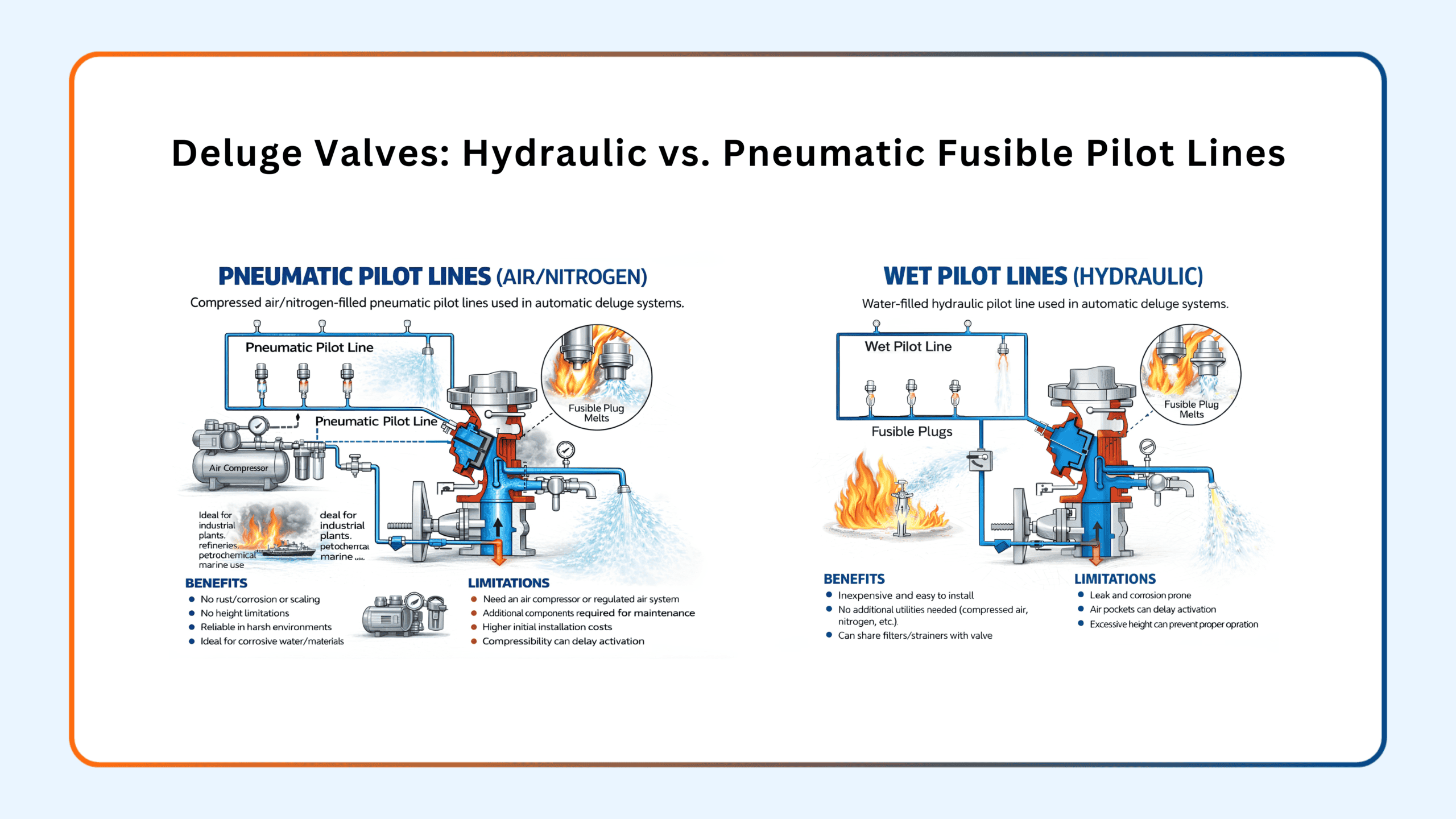
All automatic deluge systems utilize fusible plugs for fire detection. Mounted on the pilot line, the fusible plug is designed to melt or burst due to exposure to elevated temperatures above 60 degrees Celsius. When the fusible plug melts or bursts, the pressure is released from the pilot line which opens the deluge valve allowing water to flow out through the opened spray nozzle.
Fusible plugs are only one of the components of automatic deluge systems. The pilot line can be configured in one of two ways:
- Hydraulic (water-filled)
- Pneumatic (air or nitrogen-filled)
Although both types utilize the same piping and fusible devices for operation, the actual media used for operation, i.e. water for hydraulic and air or nitrogen for pneumatic, differentiates between performance characteristics and overall applicability.
Hydraulic (Wet) Pilot Lines
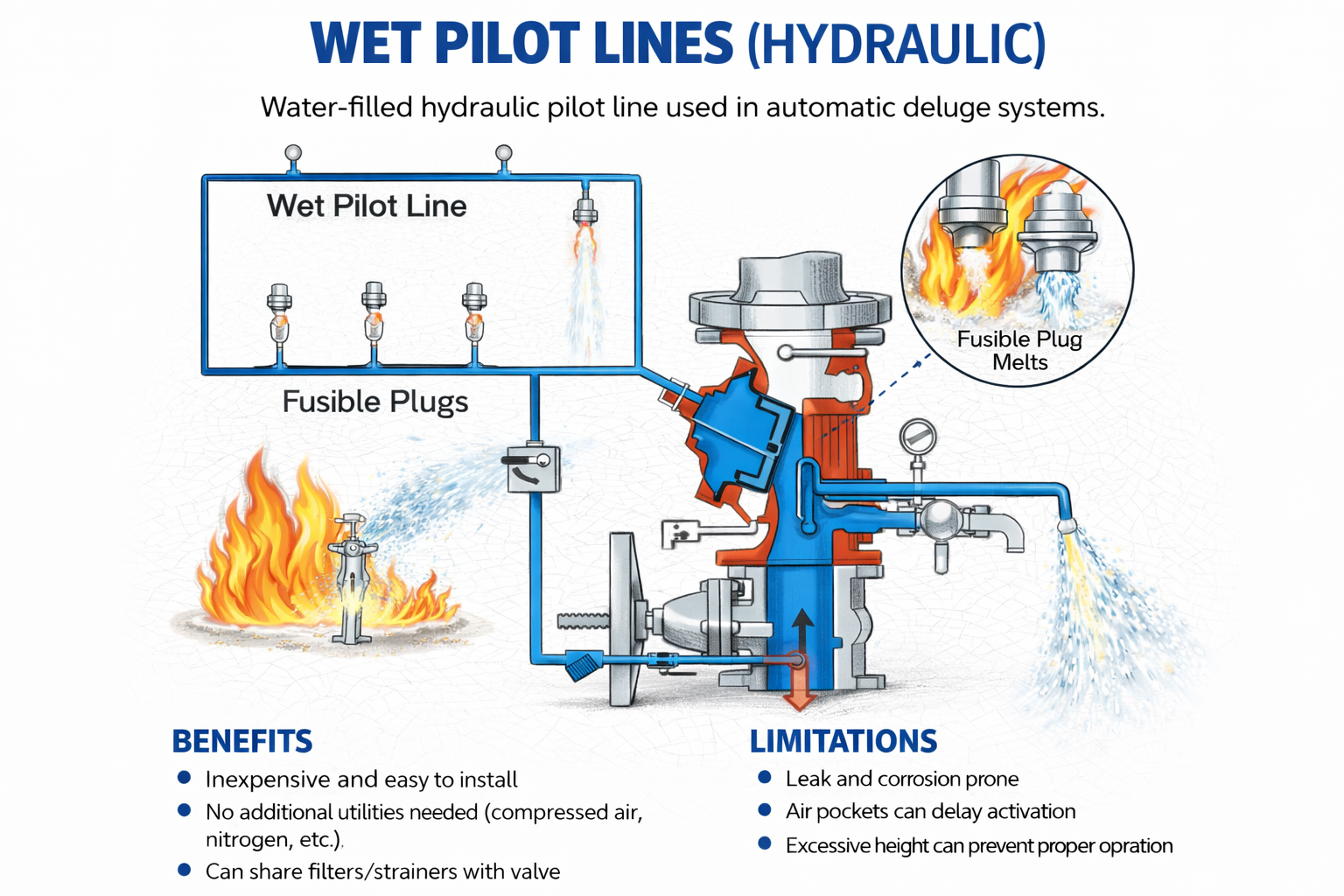 Hydraulic pilot lines were the original design of automation deluge systems, and the same source that supplies the valve fills them with water.
Benefits of Hydraulic Pilot Lines
- Hydraulic pilot lines are inexpensive and straightforward to install
- No other utilities are needed for installation (e.g. compressed air).
- Hydraulic pilot lines can share filters and strainers with the deluge valve.
- Hydraulic pilot lines are ideal in remote locations with little infrastructure.
Hydraulic pilot lines are more commonly used in situations where simplicity and low maintenance are the principal objectives.
Limitations of Hydraulic Pilot Line
Although they are straightforward, wet pilot lines have a number of operational limitations:
- They are subject to leakage and corrosion because they are always filled with water.
- The presence of air may form air pockets, which can delay activation of the valve and cause false trips.
- Malfunction caused by excessive height (water column pressure) can cause the valve not to open properly.
If not designed and maintained correctly, these variables could affect the overall reliability of the system.
Pneumatic (Dry) Pilot Lines
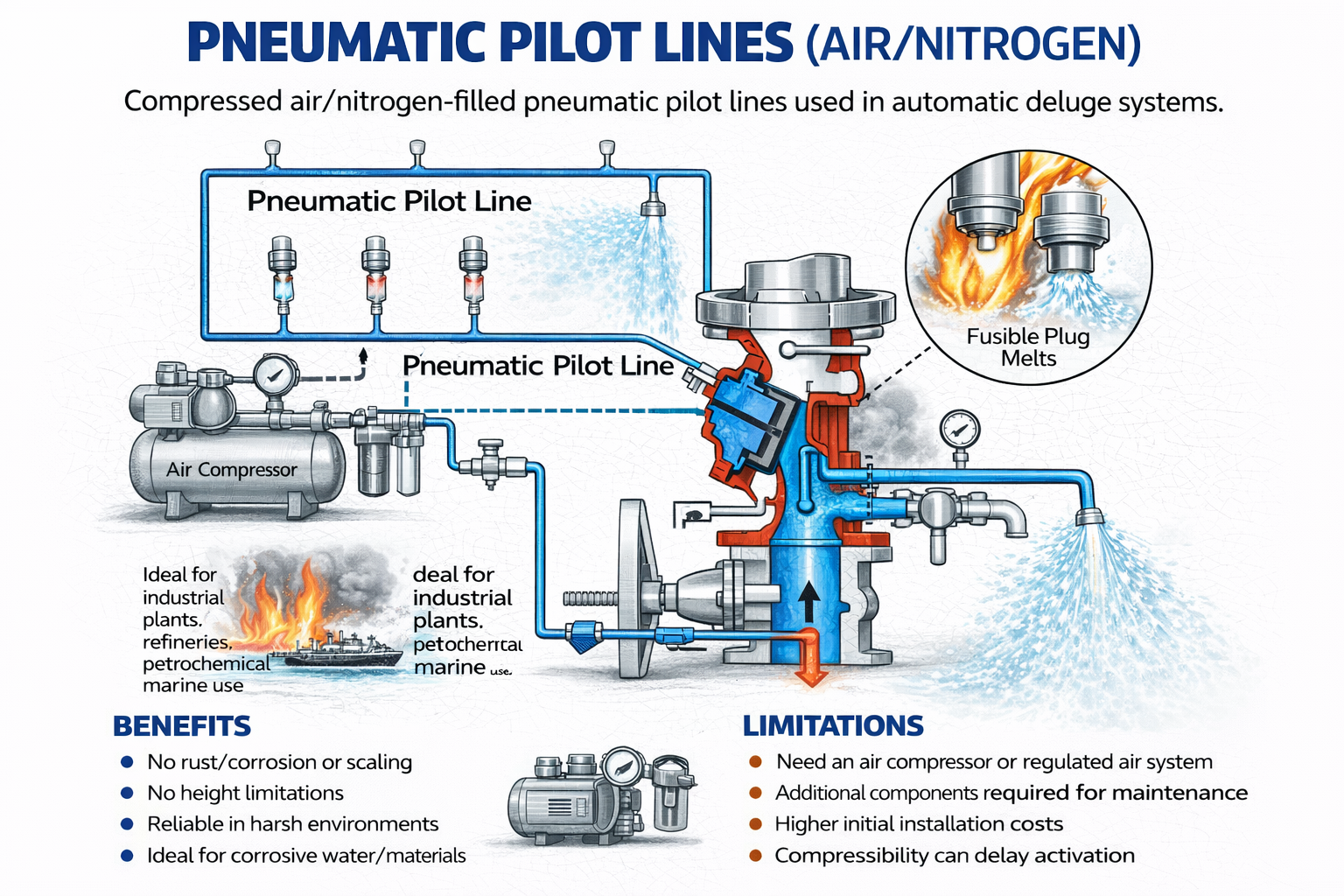 Pneumatic pilot lines were created to correct the many deficiencies of wet systems. These pneumatically operated lines carry compressed air or nitrogen rather than water, thus eliminating many of the factors that make wet systems less desirable due to their tendency to allow for the development of rust and corrosion.
Benefits of Pneumatic Pilot Lines
- No corrosion/scaling on the inside of the lines
- No height limitations for greater design flexibility
- More reliable in harsh environmental conditions
- Preferred in applications using sea water or other corrosive materials.
Pneumatic systems are very advantageous for applications such as industrial plants, refineries, petrochemical plants and marine use, as these facilities typically have existing compressed air utilities.
Limitations of Pneumatic Pilot Lines
In addition to operational advantages, dry pilot lines introduce additional requirements:
- Air compressors or regulated instrument air systems
- Additional components, including air maintenance devices
- More expensive initial installation costs
- Air compressibility can result in a slightly slower time to activate unless designed correctly.
Proper engineering is imperative in order for the pneumatic pilot lines to provide the necessary response time when activated by a fire.
Choosing Between Hydraulic and Pneumatic Pilot Lines
Choosing the correct pilot line when evaluating a deluge valve system is influenced by several factors. These include the following:
- The quality of the water source and the location from which it comes
- The availability of compressed air
- Environmental conditions (e.g., temperature or humidity)
- The height of the system, as well as its layout
- Your budget and the long-term maintenance costs you will incur
Pneumatic Pilot Lines Are Most Commonly Used in These Applications:
- Systems that use sea water (due to the possibility of salt clogging the solenoids)
- Refineries and other petrochemical companies that already use instrument air
- Facilities where corrosion protection is vital
- Systems that have multiple levels of elevation or complex arrangements
Hydraulic Pilot Lines Are Most Commonly Used in These Applications:
- Remote locations where no compressed air is available
- Facilities that focus on simplicity and cost effectiveness at the time of installation
- Applications that have limited access for maintenance disposal
Supporting Reliable Deluge System Design
Hydraulic fusible pilot lines and pneumatic fusible pilot lines have a major effect on the operation and dependability of deluge valves systems. Both types of pilot lines will supply speedy and dependable fire protection when the correct design, installation and maintenance is used.
Deluge systems designed by Rotaflow Fire & Utility always take into consideration the specific site conditions, hazard classification, and operational requirements to ensure compliance, dependability and longevity. The selection of the appropriate pilot line configuration is key to providing a system that will reliably operate in time of need.